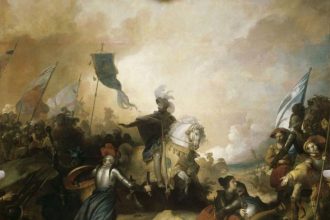
Stretching across five generations of kings from 1337 to 1453—a total of 116 years interrupted by fragile truces and the Black Death—the Hundred Years’ War between the Kingdom of England and the Kingdom of France was the longest military conflict in European history. What began as a feudal dispute over the duchy of Gascony and the English king’s dynastic claim to the French throne ultimately destroyed the medieval world of chivalric feudalism, gave birth to professional standing armies and gunpowder artillery, and forged the distinct national identities of modern France and England across five decisive turning points.
- 1. August 26, 1346: The Battle of Crécy and the Triumph of the Longbow
- 2. May 8, 1360: The Treaty of Brétigny (The Peak of the First Phase)
- 3. October 25, 1415: The Battle of Agincourt
- 4. May 8, 1429: Joan of Arc Lifts the Siege of Orléans
- 5. July 17, 1453: The Battle of Castillon and the Triumph of Gunpowder
1. August 26, 1346: The Battle of Crécy and the Triumph of the Longbow
Nine years after King Edward III of England—whose mother Isabella was the daughter of the French king Philip IV—formally claimed the throne of France in 1337, he landed an invading army in Normandy and marched north toward Flanders. Cornered near the forest of Crécy in northern France on the late afternoon of August twenty-sixth, 1346, Edward’s outnumbered twelve thousand English and Welsh troops—including his sixteen-year-old son, Edward the Black Prince—stood atop a gentle ridge facing upwards of thirty thousand troops led by King Philip VI of France.
In one afternoon, Crécy shattered the centuries-old military dominance of the armored feudal knight:
- While Philip VI’s proud French noblemen grew impatient, rode down their own Genoese mercenary crossbowmen whose bowstrings had been slackened by a summer rainstorm, and launched fifteen disorganized uphill cavalry charges into the twilight, seven thousand English and Welsh longbowmen fired ten to twelve armor-piercing bodkin arrows per minute—turning the sky black with half a million arrows.
- When night fell, over fifteen hundred French knights, counts, and dukes—including the blind King John of Bohemia, who had tied his horse’s reins to his companions’ mounts so he could strike one blow in battle—lay dead in the mud at a cost of fewer than two hundred English soldiers, allowing Edward III to capture the vital Channel port of Calais the following year.
2. May 8, 1360: The Treaty of Brétigny (The Peak of the First Phase)
Ten years after Crécy, at the Battle of Poitiers (1356), the Black Prince inflicted an even greater catastrophe on France: not only routing the French army, but physically capturing the King of France himself, John II the Good, on the battlefield and shipping him to captivity in the Tower of London and the Savoy Palace.

With France plunged into peasant rebellions (the Jacquerie) and fiscal collapse, the two nations signed the landmark Treaty of Brétigny on May eighth, 1360. In exchange for Edward III temporarily dropping his claim to the French crown, France ceded fully one-third of western and southwestern French territory (expanded Aquitaine, Poitou, and Calais) in absolute sovereignty to England, plus a staggering royal ransom of three million gold crowns for King John II—though in the decades that followed, the brilliant French King Charles V (“the Wise”) and his rugged Breton guerrilla commander Bertrand du Guesclin slowly reconquered almost all of those territories by refusing to fight the English in open pitched battles.
3. October 25, 1415: The Battle of Agincourt
By 1415, France was paralyzed by the recurrent mental illness of King Charles VI (“the Mad”) and a bloody civil war between the rival aristocratic factions of the Armagnacs and the Burgundians. Seizing the moment, the ambitious twenty-eight-year-old King Henry V of England invaded Normandy, captured Harfleur, and began marching his exhausted, dysentery-ridden army of roughly six thousand to eight thousand men (five-sixths of them longbowmen) toward Calais. Intercepted on Saint Crispin’s Day, October twenty-fifth, 1415, near the castle of Agincourt by a French army three to four times his size, Henry V positioned his archers in a narrow gap flanked by dense woods on both sides, ordering every archer to hammer a six-foot sharpened wooden stake into the wet, freshly plowed clay soil in front of him.
Advancing on foot through ankle-deep mud into a funnel of woods that squeezed the French ranks so tightly together they could barely lift their sword arms, thousands of armored French knights were either impaled on stakes, shot down by flanking arrow storms, or suffocated as wounded men fell on top of them in heaps. Following this slaughter, the Treaty of Troyes (1420) disinherited the French Dauphin Charles and named Henry V heir to the throne of France—only for Henry V to die suddenly of camp fever two years later in 1422 at age thirty-five, leaving an infant son on two thrones.
4. May 8, 1429: Joan of Arc Lifts the Siege of Orléans
By the autumn of 1428, English and allied Burgundian forces controlled all of northern France, including Paris, and laid siege to Orléans—the final strategic bridge city guarding the Loire River and the heartland of the uncrowned Dauphin Charles VII. Had Orléans fallen, an independent Kingdom of France would likely have ceased to exist.
In early 1429, a seventeen-year-old peasant girl from the village of Domrémy in Lorraine named Joan of Arc rode to the royal court at Chinon, declaring that the voices of Saint Michael, Saint Catherine, and Saint Margaret had commanded her to lift the siege of Orléans and crown the Dauphin at Reims Cathedral. Given a suit of white plate armor and a sacred banner, Joan slipped supplies into Orléans on April twenty-ninth and inspired the demoralized French soldiers to launch ferocious direct assaults against the English siege forts. Even after taking an arrow between her neck and shoulder while scaling a ladder at the fortress of Les Tourelles on May seventh, Joan pulled the arrow out and returned to the ditch waving her banner; the next morning, May eighth, 1429, the English abandoned the siege in retreat, and two months later Charles VII was anointed King at Reims—turning the war into a national crusade that continued long after Joan was captured and burned at the stake in Rouen in 1431.
5. July 17, 1453: The Battle of Castillon and the Triumph of Gunpowder
If the Hundred Years’ War began with the supremacy of the English longbow at Crécy, it ended a century later with the birth of modern French gunpowder artillery. Reorganized into a permanent professional standing army by King Charles VII and equipped with mobile bronze cannons designed by the brilliant master gunner brothers Jean and Gaspard Bureau, French forces swept the English out of Normandy at Formigny in 1450 and marched south into Gascony.
On July seventeenth, 1453, outside the town of Castillon near Bordeaux, England’s legendary eighty-something warrior commander, John Talbot, Earl of Shrewsbury, led a desperate frontal charge against a fortified French artillery camp where Jean Bureau had lined up three hundred cannons and hand-culverins behind a ditch. As the English charged across the field, Bureau’s cannons unleashed a point-blank hailstorm of iron balls that tore through whole ranks of men at a time; Talbot’s horse was killed beneath him by a cannonball, and a French archer finished the old earl on the ground with a battle-axe. With Bordeaux surrendering three months later, England lost every single inch of its continental French possessions except the tiny port of Calais, bringing the 116-year conflict to a close without a formal peace treaty even needing to be signed.