About 3500 BC., the wheel was created. Stone wheels were used in the oldest forms of transportation. It eventually took the shape of a curved plank of wood. Leather was then installed to soften the ride. Rubber gradually replaced the leather. Before the pneumatic tires, the first rubber tires were solid pieces of rubber without air within them. It was around 1830 when Frenchman Charles Dietz first covered the wheels of some vehicles with a rubber band, placing it between the wheel and the metal rim, therefore inventing the tire. Scottish inventor Robert William Thomson filed the first patent for a pneumatic tire in 1847.
The first pneumatic tire
The first pneumatic tire in history first appeared on horse-drawn carriages and then on early vehicles. R. W. Thomson, a Scottish engineer, received a patent in 1845 for the first pneumatic tire, which used compressed air to sustain the weight of the vehicle. He called it aerial wheel.
He installed his tire onto a number of different horse-drawn carriages, making travel much more pleasant and quieter for its passengers. Despite traveling over 1,200 miles, one pair showed no signs of wear and tear.
It was the first patent filled for a tire and it was the first air-filled tire in history. However, nobody paid any attention to the innovation, and it eventually died out.

In the 1880s, the road in front of the home of John Boyd Dunlop (1840-1921), a Scottish veterinarian working in Ireland, was a little rough. So, he put rubberized tubes on the wheels of his son’s tricycle and fiddled with the wheels. Then, in 1887, he created a woven cotton fabric-encased inner tube that he bonded to a wooden wheel rim.
In 1888, John Boyd Dunlop produced one the first pneumatic tires. The tire consisted of a casing around an air chamber filled using a pump, in order to reduce the vibrations conveyed by the wheels of his son’s tricycle. Over the years, similar tires emerged, and eventually, a piano string was encased in a tubular tire.
Dunlop envisioned a thin rubber membrane packed with pressurized air as an alternative to the traditional solid bicycle tires.
The first practical tires
With the help of Englishman James Moore, who won the inaugural bicycle race in the park of Saint-Cloud, Dunlop perfected his creation. Using the rubber vulcanization technique created by American chemist Charles Goodyear in 1842, Dunlop received a patent for his invention in 1888 and went on to start a factory dedicated to making tires for bicycles. It was the first tire factory in history.
Rubber vulcanization stabilized the rubber, allowing it to better endure temperature changes, making tires practical for the first time.

The first car with tires
In 1888, Benz built the first gasoline-powered automobile, complete with air-filled rubber tires mounted on metal rims. But it wasn’t until 1895 that André Michelin came up with the notion to put them on automobiles. The Frenchman built one of the first automobiles to run on tires, which he dubbed “L’Eclair.” (“Lightning”) Michelin’s “L’Eclair” is the world’s first automobile with actual tires.
It was the earliest car to use pneumatic tires and compete in a motor race. This was made feasible by the invention of the removable tire in that year, which allowed for puncture repairs thanks to its inner tubes. This product had quick popularity due to the rise of cars and motorcycles.
In 1895, the ‘Eclair’ car raced from Paris to Bordeaux and back on Michelin tires for a total of 745 miles (1200 kilometers).
The Michelin brothers, Andre and Edouard, unmistakably connected their surname with the use of tires on bicycles and cars. Tires for bicycles, carriages, and planes were all created by the Michelin brothers. In 1905, the first tire with treads was produced.
The first radial tire
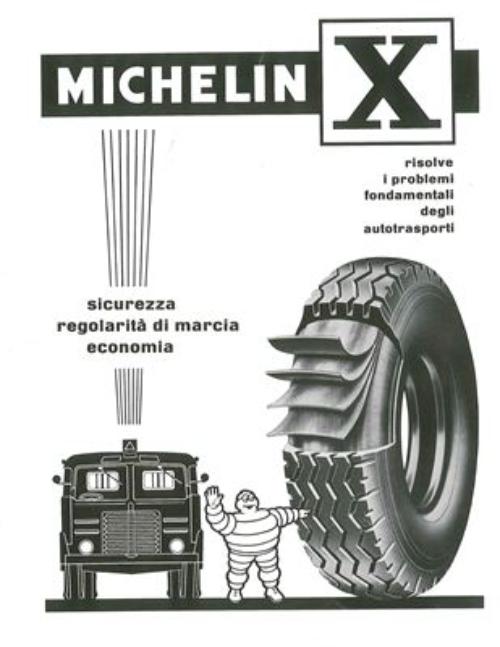
Patented first in 1914 by G.H. Hamilton and T. Sloper in London, the original concepts for radial tires never made it to market. Later, the radial tire was first mass-produced by the Michelin company. Michelin engineer Marius Mignol created the company’s first automobile radial tire, the Michelin X, in 1946.
And as far as bicycles go, John Boyd Dunlop’s innovation was a huge hit. But the main problem was that punctures were quite hard to fix. With the invention of the radial tire in 1946, Michelin cemented its position as a market leader.
The radial tire was far more durable than previous models because it superimposed many layers of rubber. Then Michelin developed a puncture-resistant tire, cementing the company’s position as the industry standard in the history and development of tires.
Later developments in tires
The first rail tire was created in 1929 to equip the Micheline.
Michelin created the first studded tire for use on snowy or icy roads in 1933.
The first radial ply tire, which represented another revolution, was patented by Michelin on June 4, 1946. The Citroen Traction Avant was the first automobile to have it. Edward Brice Killen created the tubeless tire in 1930 which Michelin used it for the first time in 1955.
Tires are becoming more advanced nowadays, with features like siped tires for increased traction in the snow or fuel-efficient tires.