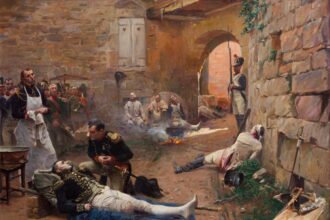
Even today, the phrase “coup de Trafalgar” is used to refer to a disastrous defeat or an “unforeseen incident with unfortunate consequences,” according to the two definitions provided by the CNRTL. “Wait,” he said, pointing to his opponent [during a card game], “I’m setting him up for a ‘coup de Trafalgar,’” wrote Marcel Proust in Sodom (1922).
The expression originates from a decisive naval battle that took place on October 21, 1805, between Vice Admiral Villeneuve’s Franco-Spanish fleet and Vice Admiral Nelson’s British fleet off Cape Trafalgar, in Spanish waters.
The resounding victory of the British, despite being vastly outnumbered, allowed the British Empire to secure its supremacy at sea, which would last for nearly a century.
Who will gain supremacy on the seas?
After the Peace of Amiens in 1802, France—sister to the Batavian Republic and ally of Spain—enjoyed a dominant position in Europe. Napoleon believed he saw a unique opportunity to gain naval superiority in the English Channel against the British fleet, beginning by uniting the fleets of Brest and Toulon. The Toulon fleet, the smaller of the two, commanded by Vice Admiral Villeneuve, then set out to cross the Mediterranean, skirting Spain to reach the Atlantic coast.
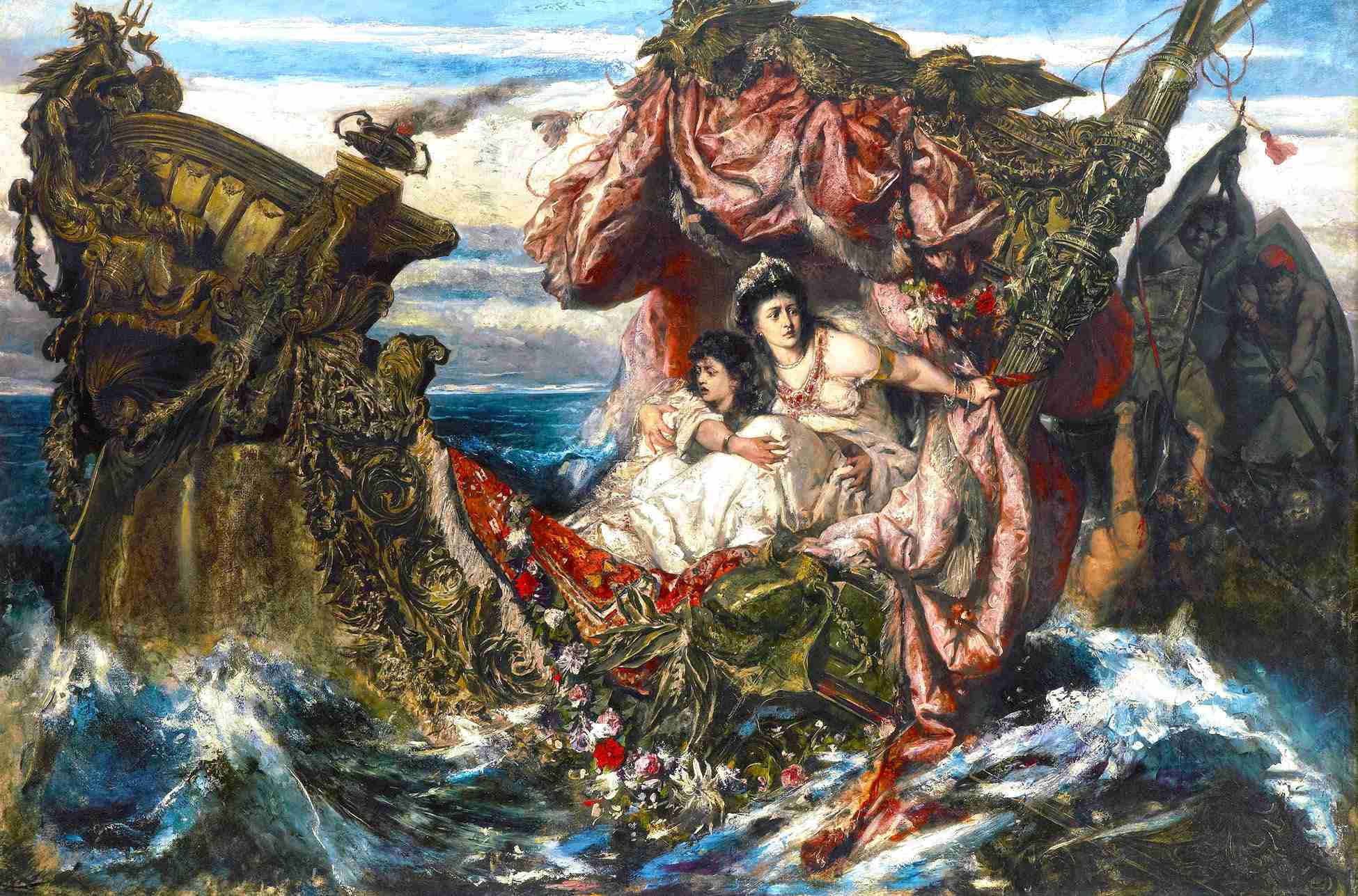
But to do so, Villeneuve must thwart the plans of Vice Admiral Nelson, who commands the British fleet stationed in the Mediterranean. Admiral Nelson had already distinguished himself during the Napoleonic Wars, notably by crushing a French squadron at Aboukir in 1798 and the Danish-Norwegian fleet at Copenhagen in 1801. After five months of pursuit and skirmishes at sea, Villeneuve managed to join a substantial Spanish fleet at Cádiz… still under the watchful eye of Admiral Nelson.
The War of the Third Coalition broke out in 1805, and Napoleon Bonaparte ordered Villeneuve’s fleet to return to the Mediterranean to support military operations in Austria. Upon reaching the southeast of Cape Trafalgar, Villeneuve realized that the British were in his wake. He then ordered his fleet to turn around and form a battle line.
An Epic Battle
The Franco-Spanish side held numerical superiority, with 33 ships of the line and 7 frigates, against 27 ships of the line and 4 frigates on the British side. Admiral Nelson had a famous message hoisted on the flags to galvanize his troops: “England expects that every man will do his duty.” Contrary to the most common strategy at the end of the 18th century—which involved cannon fire between enemy fleets positioned in parallel lines—Nelson ordered his ships to form two columns to break through the Franco-Spanish line.
The course of the battle is well known and has been extensively discussed and taught in naval strategy textbooks. The British columns pounded the Franco-Spanish line, cutting off the vanguard from the battle and isolating the center and rear. Compensating for their numerical inferiority with strategic and material superiority, the British quickly crushed the Franco-Spanish fleet.
The rearguard’s counterattack failed to reverse the balance of power: by 5:30 p.m., it was all over. The British lost no ships, but sank four of Villeneuve’s fleet… and captured 17. At Trafalgar and during the pursuit of the fleeing ships, 4,400 French and Spanish sailors lost their lives, either killed or drowned—the British suffered ten times fewer casualties, but Admiral Nelson was among the dead. The Franco-Spanish fleet was shattered, and the threat of a naval invasion of Great Britain neutralized. The Navy could now reign supreme over the seas.