When an ancient Greek sailor stood on the prow of a wooden trireme in the Aegean Sea, the salty, unpredictable waters beneath his keel belonged to the turbulent Olympian god Poseidon. Yet according to the earliest cosmological maps of Homer and Hesiod, if that sailor rowed westward past the Pillars of Heracles at Gibraltar to the absolute outer edge of the flat or disc-shaped Earth, the salty sea gave way to something far older and more majestic: Oceanus (Okeanos)—not a sea at all, but a colossal, fresh-water world-encircling river flowing in a perpetual circle around the perimeter of the cosmos, personified by the eldest and most peaceful of the twelve original Titans.
The World-Encircling River on the Shield of Achilles
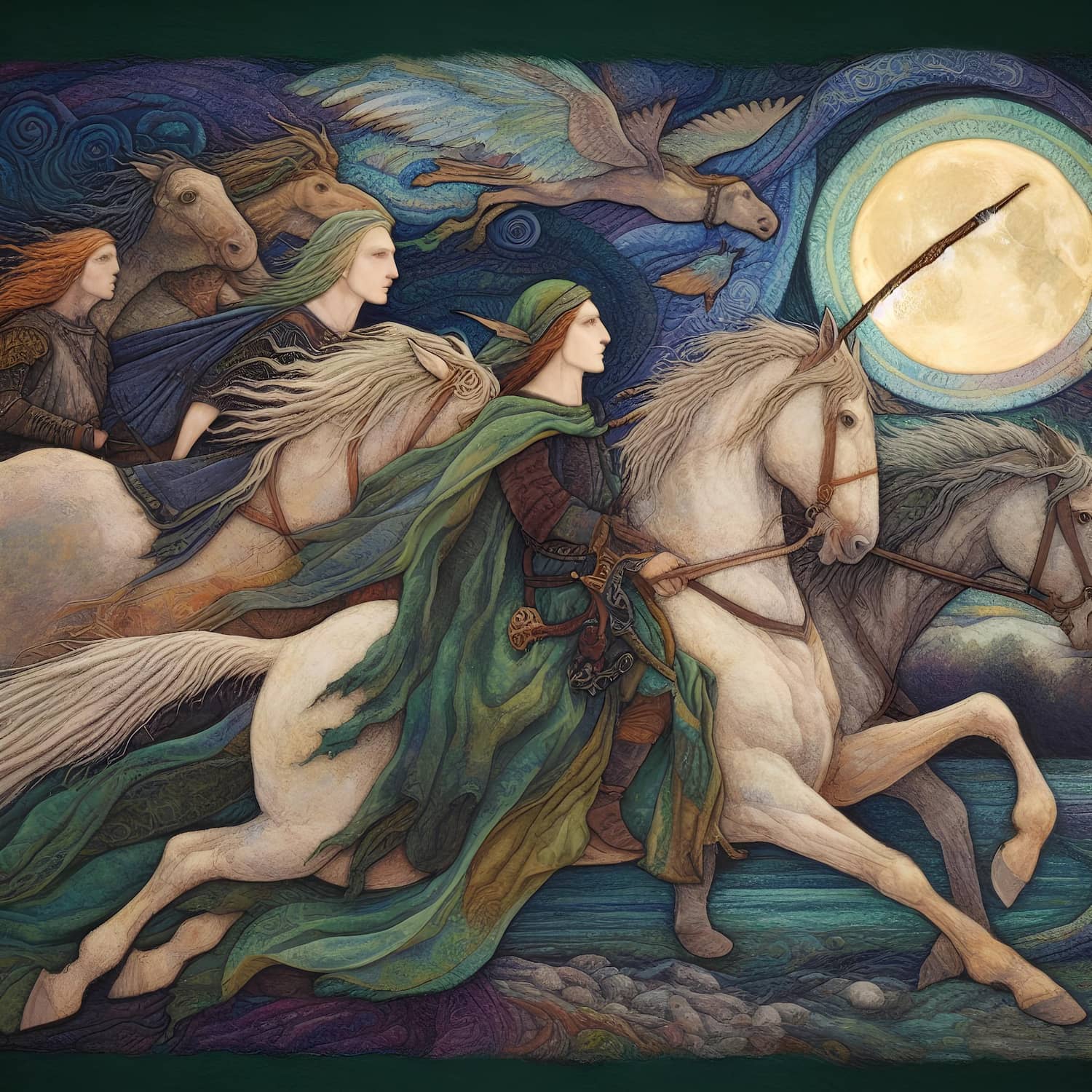
In the archaic Greek worldview, the inhabited landmass of the Earth (Europe, Asia, and Libya/North Africa, with the Mediterranean Sea sitting in the middle) was encircled entirely by the unbroken river stream of Oceanus, which flowed steadily and silently back into itself without a source or an outlet—what Homer called apsorrhoos Okeanos (“back-flowing Oceanus”).
When the smith god Hephaestus forged the magnificent bronze Shield of Achilles in Book Eighteen of Homer’s Iliad, he hammered scenes of war, peace, farming, dancing, and the constellations across the center of the disk, and then ran the mighty river of Oceanus all the way around the outer bronze rim of the shield to seal the cosmos inside. To the ancient Greeks, this cosmic river served three vital physical functions:
- The Cradle of the Sun, Moon, and Stars: Every morning at dawn, the sun god Helios, the Dawn goddess Eos, and the constellations rose directly out of the eastern waters of Oceanus to climb the vault of the sky, and every evening at dusk they plunged back down into the western waters of Oceanus to cool their fiery chariot wheels—except for the constellation Ursa Major (the Great Bear), which Homer noted never bathes in the waters of Oceanus because it circles high around the northern pole all night long.
- The Father of All Fresh Water: In Book Fourteen of the Iliad, Homer went even further than Hesiod, calling Oceanus and his wife Tethys the literal primeval parents of all the gods and living things, because subterranean channels branching off from Oceanus fed every freshwater river, spring, well, and raincloud on Earth.
- The Border of the Afterlife: Beyond the western shore of Oceanus lay the sunless misty land of the Cimmerians, the entrance to the Underworld where Odysseus sailed to speak with ghosts, the Garden of the Hesperides, and the blissful Elysian Fields (the Isles of the Blessed).
The Titan Who Refused to Fight Zeus
In Hesiod’s Theogony, Oceanus was the eldest Titan son born to Uranus (Sky) and Gaia (Earth). Unlike his younger brother Cronus, however, Oceanus possessed a serene, benevolent, and aloof temperament that kept him out of the violent dynastic blood-feuds of heaven.
Twice in mythological history, Oceanus chose peace over rebellion: first, when Cronus took up the flint sickle to ambush and castrate their father Uranus, Oceanus refused to join his brothers in the attack; second, generations later, when Zeus and the young Olympians launched the ten-year war of the Titanomachy against Cronus, Oceanus stayed completely neutral in his distant palace at the edge of the world—even sending his eldest daughter Styx and her children to fight on the side of Zeus, while sheltering Zeus’s wife Hera safely inside his halls during the fighting. Because of his neutrality, when Zeus defeated the Titans and locked Cronus and his brothers inside the dark pit of Tartarus, Oceanus was allowed to keep his ancient domain and royal honors untouched forever.
3,000 Daughters, 3,000 Sons, and the Crab Claw Horns
Together with his sister-consort, the Titaness Tethys, Oceanus presided over the largest family in classical mythology. According to Hesiod, Oceanus and Tethys were the parents of three thousand sons—the Potamoi (River Gods), including every great river of the known world from the Nile and the Danube to the Scamander and the Achelous—and three thousand daughters—the Oceanids, the nymphs who tended every spring, cloud, pasture, and breeze on Earth.
In Hellenistic and Roman mosaic art across the Mediterranean, Oceanus was depicted with an unforgettable visual iconography that distinguished him instantly from Poseidon: a muscular, venerable elder with a long, billowing beard made of swirling waves and seaweed, fish and dolphins swimming through his hair, holding a steering oar or a cornucopia, and sporting a pair of red lobster or crab claws growing directly out of his temples like horns. As Greek and Roman explorers later sailed past Gibraltar into the Atlantic and learned from Alexander’s campaigns about the Indian Ocean, the mythical freshwater river of Oceanus gave its name permanently to the great saltwater oceans of our real-world globe.