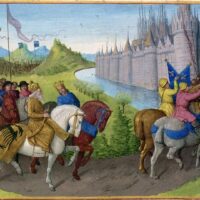
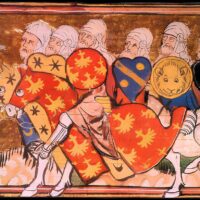
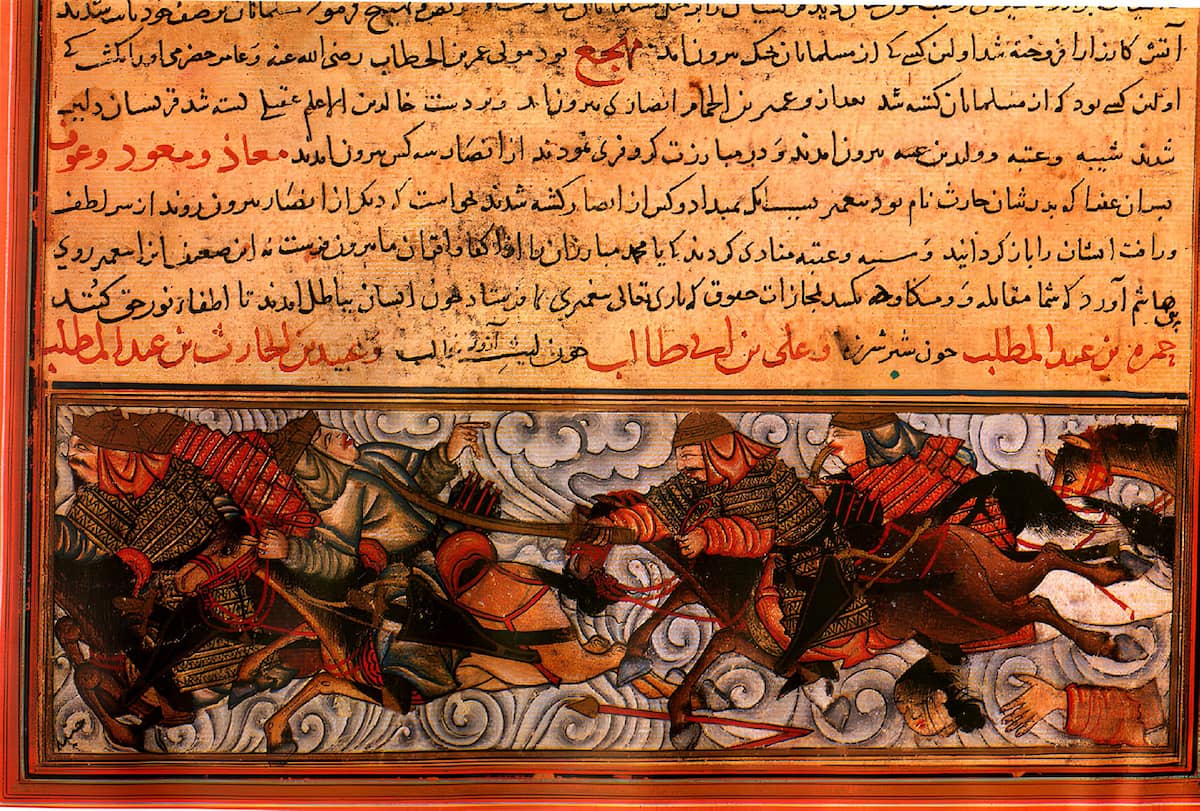
When Pope Urban II launched the First Crusade in 1095, that disorganized expedition of quarrelsome barons without a single crowned king among them had pulled off the military miracle of capturing Jerusalem. Half a century later, when the Second Crusade (1147–1149) was proclaimed, all of Europe expected an even greater triumph: for the very first time in history, the Crusade was led in person by the two most powerful crowned monarchs of Western Christendom—King Louis VII of France and the German monarch Conrad III—preached by the greatest orator of the age, Saint Bernard of Clairvaux, and graced by the legendary Queen Eleanor of Aquitaine riding on horseback. Instead, the main eastern expedition collapsed into one of the most humiliating military disasters of the Middle Ages, shattered in the mountains of Anatolia and outside the orchard walls of Damascus.
The Fall of Edessa on Christmas Eve 1144 and Bernard’s Preaching
For forty-five years after 1099, the four Crusader States in the Levant (the Kingdom of Jerusalem, the Principality of Antioch, the County of Tripoli, and the County of Edessa) had survived only because their neighboring Muslim emirs in Syria and Mesopotamia were bitterly divided against one another. That fragmentation ended with the rise of Imad al-Din Zengi, the ruthless Turkish Atabeg (governor) of Mosul and Aleppo.
In December 1144, while Count Joscelin II of Edessa was away with his army, Zengi laid siege to the vulnerable northeastern Crusader capital of Edessa (modern Şanlıurfa, Türkiye), tunneling beneath its stone towers and storming the city on Christmas Eve, December twenty-fourth, 1144. The fall of the very first Crusader state sent shockwaves of terror across Europe. On December first, 1145, Pope Eugenius III issued the papal bull Quantum praedecessores calling for a Second Crusade, and entrusted the preaching campaign to his former mentor, the charismatic Cistercian abbot Bernard of Clairvaux.
On Easter Sunday, March thirty-first, 1146, on a hillside outside Vézelay in Burgundy, Bernard preached a sermon of such electrifying eloquence before King Louis VII and his fiery twenty-four-year-old wife, Queen Eleanor of Aquitaine, that the crowd ran out of pre-sewn cloth crosses, forcing Bernard to rip his own white monastic habit into strips to hand out! Months later at Speyer Cathedral in Germany, Bernard famously brought the reluctant German King Conrad III of Hohenstaufen to tears, persuading the Germans to march alongside the French.
Anatolian Catastrophes: Dorylaeum and Mount Cadmus (1147–1148)
Because the French and German armies distrusted each other and competed for food along the road through Hungary and the Byzantine Empire (where the nervous Byzantine Emperor Manuel I Komnenos hurried them across the Bosporus as quickly as possible after signing a secret truce with the Seljuk Turks), the two kings made the fatal blunder of marching into Seljuk-controlled Anatolia (Asia Minor) separately:
- Conrad III’s Destruction at Second Dorylaeum (October 25, 1147): Ignoring Byzantine advice to stick to the safe coastal road, Conrad III marched his exhausted, thirsty twenty-thousand-man German army straight onto the dry central Anatolian plateau with only eight days’ food rations. At the exact spot near Dorylaeum where the First Crusaders had triumphed fifty years earlier, the Seljuk Sultan Mas’ud I’s horse-archers executed a classic feigned retreat—luring the heavy German knights away from their infantry and then surrounding and slaughtering nearly ninety percent of the German force in a single day, with a wounded Conrad barely escaping back to Nicaea.
- Louis VII’s Ambush at Mount Cadmus (January 6, 1148): Marching along the winding southwestern mountain roads of Phrygia with the remnants of the Germans, the French army stretched out into a dangerously long column while crossing the steep defile of Mount Cadmus (modern Honaz Dağı near Denizli). When the French vanguard commander, Geoffrey de Rancogne—accompanied by Queen Eleanor’s contingent—disobeyed orders and marched miles ahead to pitch camp on a plateau, leaving an open gap in the column, Seljuk Turks waiting on the ridges above swooped down into the undefended French baggage train and center. King Louis VII himself was cut off alone from his bodyguards: climbing atop a wet boulder with his back pressed against a tree trunk, the King fought off half a dozen Turkish soldiers single-handedly with his bloodstained sword until dusk saved his life!
The Fatal Blunder: Attacking Friendly Damascus (July 1148)
Having lost most of his infantry and horses, Louis VII abandoned the land march at the southern Turkish port of Adalia (Antalya), sailing with his nobles to Antioch (where bitter rumors erupted over Queen Eleanor’s closeness to her dashing uncle, Prince Raymond of Antioch, who begged Louis to attack Zengi’s son **Nur al-Din** at Aleppo). Refusing to help Raymond, Louis dragged a furious Eleanor south to Jerusalem.
In June 1148, at the grand Council of Acre, King Louis VII, King Conrad III, and the teenaged King Baldwin III of Jerusalem made one of the worst strategic decisions in military history. Instead of marching north to recapture Edessa or attack their real enemy, Nur al-Din in Aleppo, the kings voted to attack the wealthy city of Damascus—the single large Muslim emirate in Syria whose ruler, Mu’in al-Din Unur, had actually signed a peaceful defensive alliance with Christian Jerusalem to resist Zengi and Nur al-Din!
The Siege of Damascus (July 24–28, 1148) lasted a pathetic four days:
- Initially fighting their way through the dense fruit orchards and irrigation canals west of Damascus, where the green trees provided water, shade, and food, the Crusaders inexplicably listened to local barons on July twenty-seventh and moved their entire camp to the **arid, treeless eastern plain** outside the strongest section of the city wall—where there wasn’t a single drop of water!
- Pinned in the dust without water while Nur al-Din’s relief army raced southward toward them and the kings bickered over which nobleman would get to keep Damascus once it fell, the Crusader army simply packed up and retreated in disgrace on July twenty-eighth without breaching a single gate.
The Only Bright Spot (Lisbon) and Saladin’s Path to Power
Ironically, the only permanent military success of the Second Crusade occurred thousands of miles away on the Atlantic coast of Iberia: in the summer of 1147, a fleet of English, Flemish, and German Crusaders sailing around Europe toward the Holy Land stopped at Porto and agreed to help the first King of Portugal, Afonso Henriques, besiege and capture the Moorish stronghold of Lisbon on October twenty-fourth, 1147—giving birth to modern Portugal’s capital.
In the Middle East, however, the Second Crusade was an unmitigated disaster: it shattered the myth of Western military invincibility, led directly to the 1152 annulment of the marriage between Louis VII and Eleanor of Aquitaine (who eight weeks later married Henry II of England, handing half of France to the English Crown!), and drove the betrayed city of Damascus straight into the arms of Nur al-Din—whose lieutenant’s nephew, a young Kurdish officer named Saladin, soon united Syria and Egypt to recapture Jerusalem in 1187.