Using water as a source of energy, scientists in the United States have developed a tiny camera capable of taking photographs underwater without the need for recharging or any other maintenance. The gadget is able to do this because of piezo elements, which transform the energy in water vibrations into electricity, and its low power consumption compared to traditional cameras. It uses a passive method of data transmission in which it backscatters an incoming sound wave.
A very small percentage of the oceans have yet to be surveyed and investigated. There hasn’t been much progress made in this area, even after massive censuses like the Census of Marine Life were conducted. The challenge of putting several sensors and cameras in the water without an external power source is a contributing factor. To date, such equipment has relied on either batteries, which have a finite lifespan, or cables from ships, which can only provide power for a limited duration.
Potential energy from vibrations
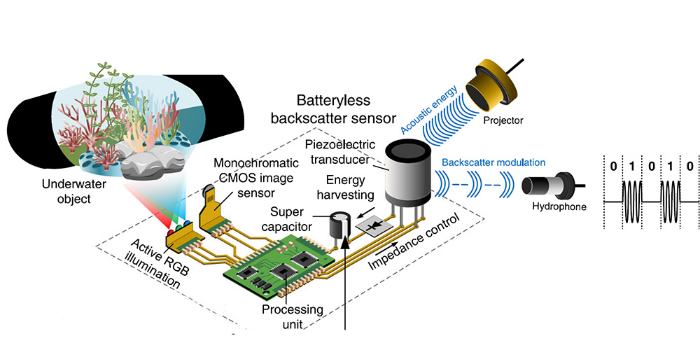
But now, MIT graduate student Sayed Saad Afzal and his colleagues have developed an underwater camera that doesn’t need any external power source to operate. There are two technologies that work together to make this happen. The first is the use of piezoelectric elements, which can transform mechanical vibrations into electricity. This is achieved by shifting charges in the element generated by the vibrations.
Now, a ship’s horn, a marine mammal’s snort, or even a sonar may cause the water to vibrate and, therefore, strike the piezoelectric transducer, producing electrical energy that can charge a tiny supercapacitor. The camera is powered by this current. Unfortunately, regular color cameras aren’t very power-efficient; therefore, particular consideration was given to this aspect of the design.

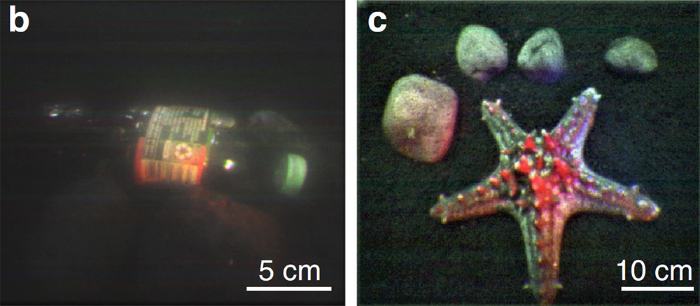
Image captured by a monochrome camera sensor
The researchers had to be creative to reduce the hardware footprint as much as feasible. Color photos were preferred, but the most cost-effective digital image sensors only create monochrome (black and white) photos. To see anything at all in the dim underwater environment, the camera has to be able to shine a light on its targets, which also demands electricity.
The researchers solved this issue by integrating a black-and-white image sensor with red, green, and blue light-emitting diodes. The sensor takes one picture of an item as each of the three colored LEDs lights up in succession. The three monochrome pictures are distinct from one another because the color elements are absorbed and reflected differently depending on the color of the object. Recombining them using specialized software allows for the recreation of a full-color picture, conceptually analogous to that of an LED television.
Backscattering is used to send information
The data transfer from the underwater camera to the ocean surface was another obstacle that needed to be addressed. The team at MIT employed a method that has already been used in battery-free mobile phones and LED billboards. The new camera uses backscatter technology, which encrypts its data by absorbing or reflecting an acoustic signal aimed at it, rather than actively creating radio waves or other signals to transport the data.
The camera is then radioed by the receiver (which can be a buoy floating on the water’s surface) to the depths below. The zeroes and ones of digital image data are imprinted on the signal by the camera’s piezoelectric module, which reflects the signal back for 0 and absorbs it for 1. The reflected signal can be picked up by the receiver buoy’s submerged microphone and decoded.

A single switch is all that’s needed to toggle between absorption and reflection in this setup. The underwater camera without battery or cable consumes just one-hundred-thousandth of the power required by conventional submerged communication systems.
Successful results from the first round of testing
Initial field testing of the scientists’ new battery-free camera included using it to document the plastic debris lying at the pond’s bottom. High-resolution photographs of a starfish were captured, and the camera also caught the development of the aquatic plant Aponogeton ulvaceus over the course of a week. All of these evaluations were carried out with the prototype camera fully underwater, functioning independently, and without a battery or power cord.
Researchers think that autonomous and low-cost underwater cameras will open up new avenues for studying the ocean. In addition to monitoring fish in aquaculture, they might be used to investigate marine pollution and look at uncommon species. The researchers are already working on increasing the battery-less camera’s storage capacity and range (which is now just 130 feet or 40 meters) so that it can be used in such applications. Source: Nature Communications, 2022; doi: 10.1038/s41467-022-33223-x.