There may be six times as much water (although bound, not free) in the transition zone between the upper and lower mantle as there is in all the world’s seas. Tiny ringwoodite inclusions in a diamond discovered at a depth of 660 kilometers now demonstrate that the layer is definitely rich in water. Researchers reveal in Nature Geoscience that the transition zone’s high water content significantly affects plate tectonics and volcanic mantle plumes.
Jules Verne wrote of a massive ocean located far below the surface of the Earth. Actually, he wasn’t completely off base. Long thought to be devoid of water due to the extreme temperatures and pressures, the mantle of the Earth may actually hold more liquid. Seismic evidence originally suggested this, showing rock melting at the boundary between the upper and lower mantle. The hydrous mineral ringwoodite was found in diamond inclusions from this 660-kilometer-deep region in 2014.
Wadsleyite and ringwoodite, two common transition zone minerals, have the potential to hold six times as much water as the world’s seas do.
Unfortunately, the size of the studied diamond prevented scientists from learning anything about the mineral make up of the area where it was found. Because of this, it was not obvious if the water of crystallization seen in ringwoodite was an out-of-the-ordinary anomaly or typical of the whole transitional zone of the Earth’s mantle.
Ultra-rare diamonds inside Earth
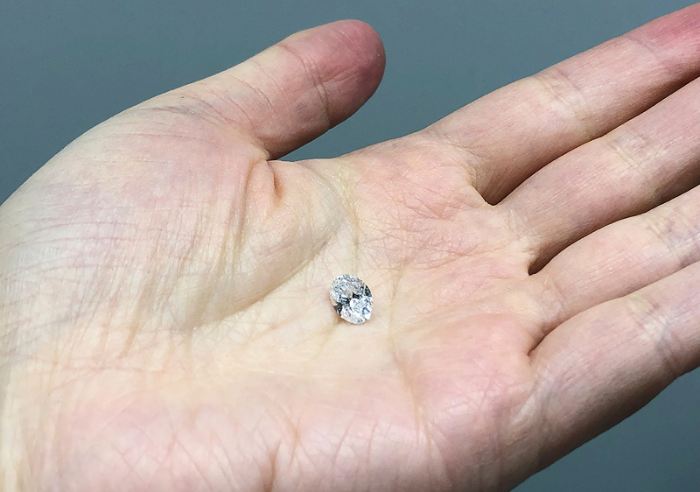
Another, larger diamond has now emerged from this depth, which sheds light on the situation. Tingting Gu of the Gemological Institute of America in New York and her colleagues analyzed the 1.5-carat diamond for its composition and mineral inclusions after it was discovered at the Karow mine in Botswana. Since these inclusions occur in the crystal where the diamond was formed, they might include minerals from very deep inside the ground.

According to the results, this diamond, like many other renowned gemstones, was not created in the top mantle of the Earth but rather at the border between the upper and lower mantle. Thus, the Karow diamond and its inclusions were created at a depth of 660 kilometers, in a region where temperatures of 1,650 degrees Celsius and pressures of 23.5 gigapascals dominate.
Including usual mantle minerals and bound water
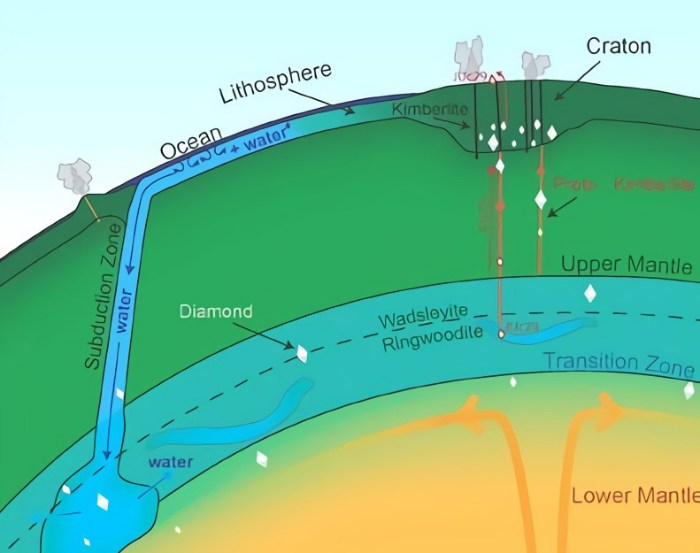
Inclusions in the diamond reflect the harsh circumstances that formed it; its mineral make up indicates a scenario in which ringwoodite starts to transition into ferropericlase and bridgmanite at this border. The transition zone to the lower mantle often undergoes this kind of alteration. This, together with other chemical characteristics, proves that the diamond and its mineral inclusions are not some rare anomaly, but rather are representative of the ordinary conditions in this region, according to the team.
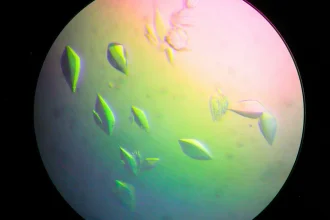
However, studies utilizing laser-based Raman spectroscopy indicated that the inclusions contain bound water. This H2O is partially held in place by the mantle mineral brucite and the crustal mineral ringwoodite. The formation of brucite from hydrous ringwoodite upon cooling in water-saturated circumstances has been experimentally confirmed in diamond cells. Simply said, this diamond and its inclusions can’t have come from a dry source layer, instead, they have come from a water-rich area, like a hidden ocean inside Earth’s mantle.
Now that bound water has been found in diamond inclusions, the minerals of this boundary layer hold significant quantities of water, like an ocean.
An ocean inside Earth’s mantle, but not visible
As such, the discovery of this diamond from Botswana proves the existence of a vast underground water supply under the surface of the Earth’s mantle. This research shows that the transition zone is not a dry sponge but instead can absorb and retain large quantities of water. Wadsleyite and ringwoodite, two common transition zone minerals, have the potential to hold six times as much water as the world’s seas do.

Now that bound water has been found in diamond inclusions, it is certain that the minerals of this boundary layer hold significant quantities of water. This is also consistent with the theory proposed by Jules Verne that there was a vast ocean under the surface of the Earth. However, unlike other “oceans,” this one is invisible because its water is confined in the rock rather than freely flowing through the earth’s core.
Relevance on a wide scale
The effects of the high water content in the Earth’s mantle transition zone are far-reaching. This is because the presence of water modifies the physical characteristics of the rock, making it more pliable than dry rock, according to the researchers. Because of this, the barrier layer and the mantle regions above it are softer and more dynamic than they otherwise would be. This, in turn, affects the ascent and descent of mantle rock masses. This allows plumes of mantle material from lower levels to more readily ascend into the upper mantle and the Earth’s crust.
Plate tectonics and the destiny of Earth’s sinking tectonic plates at subduction zones can now be better understood by analyzing the water content of the transition zone. The dipping plates carry the sediments from the deep oceans as they sink deeper into the Earth. A lot of water and carbon dioxide may be stored in these sediments. It was previously unknown, however, what percentage of this really made it to the transition zone as the more stable hydrous minerals and carbonates. Now scientists have evidence that suggests a substantial amount of this water sinks to the ocean floor.