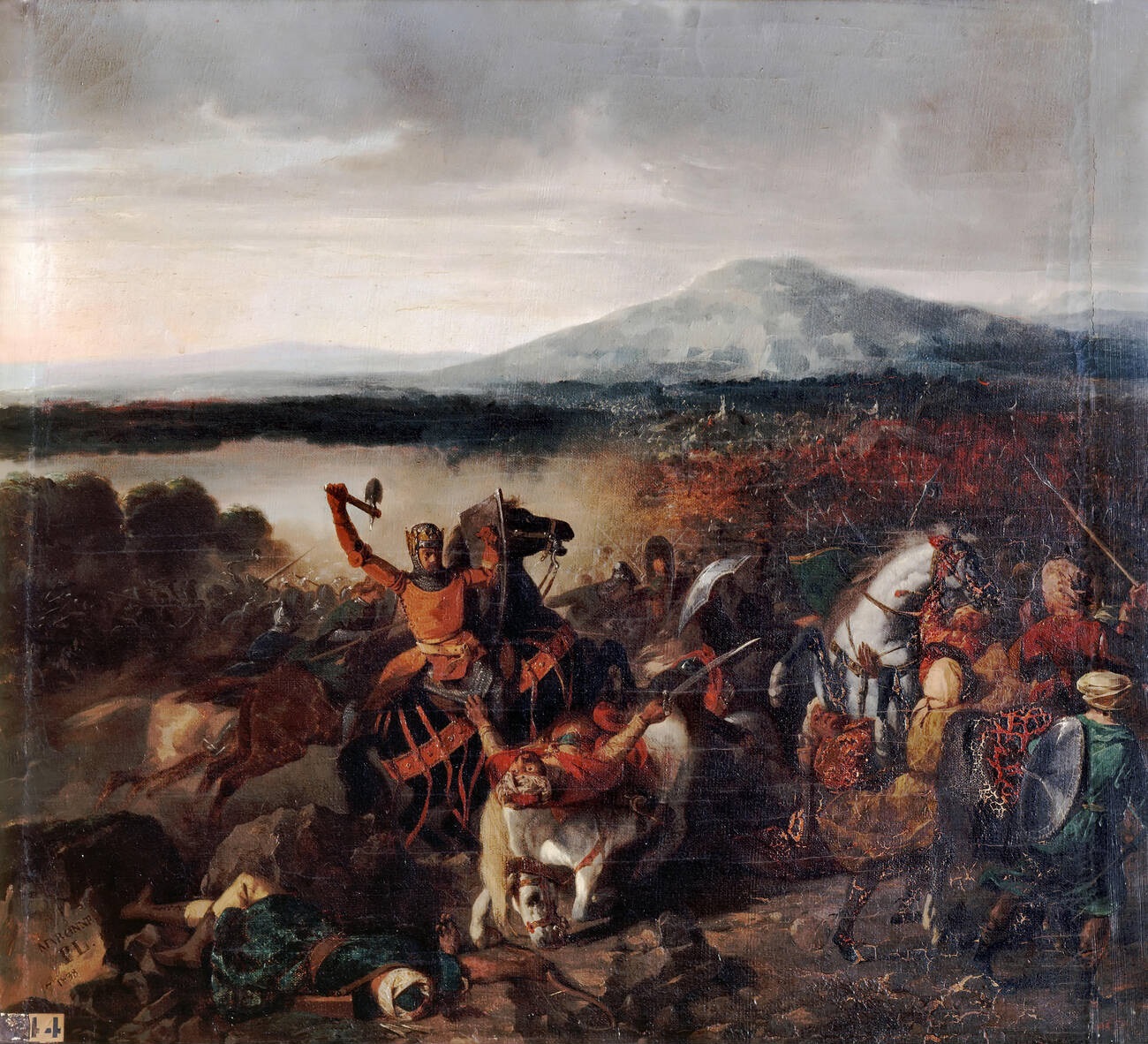
After Julius Caesar was assassinated in 42 BC, three men established a coalition they termed the Second Triumvirate. A trio including Mark Antony, Octavian, and Lepidus. After a few years, however, Lepidus was overthrown, leaving Octavian and Mark Antony to vie for leadership. The clash was inescapable which took place in 31 BC during the naval Battle of Actium. Although Mark Antony’s ally, the Egyptian queen Cleopatra (whom he also loved), helped propel him to victory, it was Octavian who ultimately prevailed, with the help of general Agrippa. A triumph that would happen soon after the tragic deaths of Mark Antony and the stunning Cleopatra.
Causes of the Battle of Actium
The murder of Julius Caesar in 42 BC set the stage for what would become the Battle of Actium. A trio of men, including his adoptive son and grandnephew Octavian, Lepidus, and Mark Antony, shared authority after his death. The Second Triumvirate was now formed. Tensions occur as each claim authority over a different region of the Roman Empire. First, they have to get rid of Sextus Pompey, who had his sights set on becoming the fourth emperor of the Roman Empire.
In 36 BC, in the Battle of Naulochus, Sextus Pompey met his end. When Lepidus’ own army turned against him and supported Octavian, he was finally able to be removed from power. So Mark Antony was left, and for the sake of stability, he was compelled to wed Octavia, brother Octavian’s sister. However, he ended up rejecting Octavia because of his feelings for Queen Cleopatra. From that point on, a conflict between the two men over the Empire’s leadership was unavoidable.
Who participated in the Battle of Actium?
Octavian (Octavianus) was born in the year 63 BC. He was Julius Caesar’s grandnephew on his mother’s side, and he became his adopted son following his death to honor his wishes. He finally removed Lepidus and Mark Antony as a member of the Second Triumvirate to control the Roman Empire alone. In 27 BC, he took the name Augustus and founded a new Empire, a new governmental structure that replaced the Republic and gave him complete control. He passed away in 14 AD.

Roman statesman Marcus Vipsanius Agrippa was also a well-respected commander. After Caesar’s death, he switched sides and supported Octavian all the way to the end. He went as far as to marry into the family by weding one of his nieces. Victorious in Actium with Emperor Octavian’s fleet, he became a legend.
83 BC marked Mark Antony (Marcus Antonius)’s birth. He joined the triumvirate that was established following Julius Caesar’s murder after having fought beside him. Later, he reigned over a considerable portion of Gaul and the East. His contact with the Egyptian queen altered the course of his life. He took a like to her, and their romance is still regarded as one of the most well-known in history. It came to an end on August 1, 30 BC, when he killed himself, believing Cleopatra had died, soon after Octavian had defeated him at the Battle of Actium.
Cleopatra VII‘s birth year was 69 BC. Known to have been Julius Caesar’s consort, she ascended to the throne in 51 BC and called their son Caesarion after the Roman dictator. In the wake of Caesar’s death, she began a relationship with Mark Antony, with whom she had three additional children. She was on his side while he fought Octavian. On August 12, 30 BC, she took her own life by poisoning herself with a snake after Mark Antony’s death and refused to take part in Octavian’s victory.
Where and when was the Battle of Actium?
On September 2, 31 BC, on the Greek island of Corfu, the naval battle known as the Battle of Actium took place. In particular, the combat occurred near the southern part of the island, in the Gulf of Ambracius. Plutarch (“Parallel Lives”), Virgil (“Aeneid”), and Dion Cassius (“Roman History”) are only a few of the ancient historians who wrote about this significant event. Considering the battle’s antiquity, estimates of the number of participants often differ.
Mark Antony commanded a fleet of 300 ships, to which you must add the 200 ships Cleopatra supplied. He was in charge of a legion of 75,000 soldiers, including 12,000 horsemen and 20,000 allies. In contrast, Octavian’s forces had 400 ships and some 132,000 troops under the command of general Agrippa, including 80,000 land soldiers and 12,000 cavalry.
Who won the Battle of Actium?
The troops of Octavian and Antony were reorganized in preparation for an imminent battle. Mark Antony, who is based in Greece, plans to trap Octavian there, but Octavian’s general Agrippa sees through this and deals him numerous crushing losses. The fleet of Mark Antony and Cleopatra is ultimately cornered in the Ambracian Gulf. The passage of weeks, the lack of food, and the illnesses, especially the malaria, weaken their forces.
Mark Antony resolved to break the siege and fought a massive naval war on September 2, 31 BC. General Agrippa, armed with less strong but more agile ships, achieved a spectacular victory for Octavian thanks to his skill as a tactician. Virgil and Plutarch, two ancient authors, both confirm that Mark Antony and Cleopatra were able to escape. Even though Egyptian queen was successful in protecting her treasure, the country’s decline began with a crushing setback.
The aftermath of the Battle of Actium
If you lost the pivotal naval battle of Actium, you would have felt the repercussions very immediately. Mark Antony watched as his supporters fled to join Octavian. Despite this, he was able to seek sanctuary in Egypt with Cleopatra. But on August 1, 30 BC, he pierced himself with a sword after concluding that she had committed suicide.
A few days later, on August 12th, 30 BC, Cleopatra did the same. The Egyptian queen’s suicide has been remembered down the ages as a selfless gesture of love. But it is possible that she wanted to refuse to witness the triumph of Octavian, and to see Egypt and its riches fall into his hands. Octavian was fully empowered after his victory at the Battle of Actium. In 27 BC he was officially named Augustus. Soon after, he proclaimed the Roman Empire and thus ended the Republic.
Key dates of the Battle of Actium
November 11, 43 BC: Second Triumvirate in Rome
The Roman Senate chose Mark Antony, Lepidus, and Octavian to rule as a triumvirate. To prevent a civil war between Mark Antony, Caesar’s faithful lieutenant, and Octavian, Caesar’s nephew and adoptive son, a new triumvirate was formed. A trifurcation of the Roman Empire was thusly inevitable. Mark Antony would get the East, Octavian the West, and Lepidus the African continent.
42 BC: Mark Antony meets Cleopatra
Mark Antony and Cleopatra initially met each other in 42 BC. Above all else, it was a political act, since he represented the Roman triumvirate and ruled over the Eastern regions. But he swiftly had an affair with the Queen of Egypt after falling in love with her.
However, he married Octavia, Octavian’s sister, in an effort to defuse their growing tensions, only to abandon her in 35 BC. Even if political and power considerations were unquestionably crucial in the dispute between the two men, this was another motive in Octavian’s hatred against Mark Antony.
September 2, 31 BC: The Battle of Actium
Octavian’s force halted Mark Antony and Cleopatra’s fleet just south of Corfu after months of avoiding direct battle on land or water. They attempted to withdraw after a blockade that lasted months, but Octavian’s fleet, headed by General Agrippa, scored a magnificent victory.
Even though Mark Antony and Cleopatra managed to get away, they eventually killed themselves. After putting an end to all his competition, Octavian declared himself Emperor and took the name Augustus which meant “sacred.”
August 12, 30 BC: Cleopatra commits suicide
After Mark Antony’s death, Cleopatra VII supposedly committed suicide because she was so overwhelmed by grief over Mark Antony’s death. However, his death took place on August 1—almost two weeks before she actually killed herself.
It’s more likely that the Egyptian queen, secure in her Alexandria palace, opted to terminate her life upon hearing of Octavian’s arrival and his plans to submit her by forcing her to attend his triumph in Rome. In regards to Cleopatra’s suicide, ancient historians are in agreement that she utilized a venomous snake.
30 BC: Egypt comes under Roman rule
Octavian’s victory was complete when Mark Antony and Cleopatra committed suicide. After becoming Caesar Augustus, he ordered the murder of Caesarion, the son of Caesar and Cleopatra. The offspring of Mark Antony and the Egyptian queen were among those he saved.
At this point, Egypt ceases to exist as an independent nation and instead becomes a Roman province fully incorporated into the Empire. A dominance that persisted for generations, yet which allowed Egyptian cults to endure.
Bibliography:
- Kellum, Barbara (September 2010). “Representations and Re-presentations of the Battle of Actium”. Oxford Scholarship Online. pp. 187–203. doi:10.1093/acprof:oso/9780195389579.003.0012. ISBN978-0-19-538957-9. Retrieved 16 October 2020. doi:10.1093/acprof:oso/9780195389579.003.0012
- White Singer, Mary (1947). “Octavia’s Mediation at Tarentum”. The Classical Journal. 43 (3): 174–175. JSTOR 3293735 – via JSTOR
- Pelling, C.B.R., ed. (1988). Plutarch: Life of Antony. Cambridge University Press. ISBN 0-521-24066-2.
- Potter, D.S. (2009). Rome in the Ancient World: From Romulus to Justinian. Thames & Hudson. ISBN 978-0500251522.
- Scullard, H. H. (2013). From the Gracchi to Nero: A History of Rome 133 BC to AD 68. Routledge. ISBN 978-1136783876.