Cooked by fire: As early as 780,000 years ago, early humans cooked their food by fire, as findings from Israel now prove. They are the earliest clear evidence of cooking among our ancestors. These are fossil fish teeth that show changes in their structure typical of controlled heating. This suggests that the early humans living in this area caught and cooked these fish in the nearby lake – presumably in some kind of earth oven, as the archaeologists report.
For the development of our ancestors and their increasingly large brains, nutrition and the use of fire played a crucial role. This is because cooked food is easier to digest, and the body can better tap into the nutrients. Early humans were therefore able to get more energy from cooked or roasted meat, fish, and plant foods. They thus needed less time to obtain food and had free resources for cultural development.
However, it is unclear since when early humans specifically cooked their food. It is true that there are one million-year-old traces of fireplaces of Homo erectus. However, it is disputed whether the bones and plant remains found in them were only burned or cooked in a controlled manner. Clear evidence of cooking was around 170,000 years old at the earliest and comes from Neanderthals and Homo sapiens.
Relics of thousands of fish
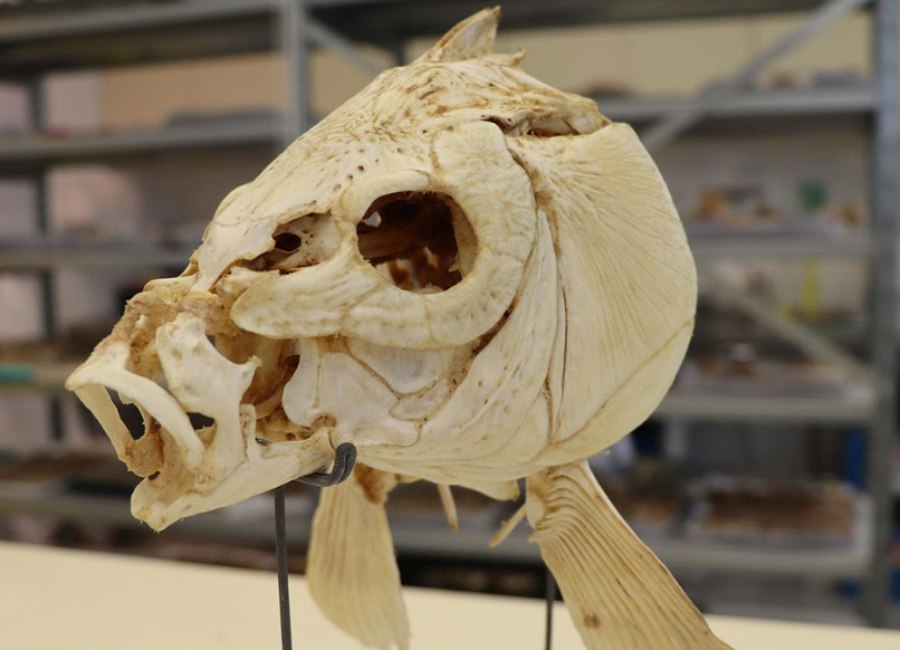
But now, for the first time, archaeologists have found clear traces of cooking as early as the time of Homo erectus. The fossil evidence for this was discovered by Irit Zohar of Tel Aviv University and her team at the Gesher Benot Ya’aqov site in northern Israel. Stone tools, traces of fire, and food remains from hunter-gatherers from around 780,000 years ago have been found there. In addition to animal bones, the remains of thousands of fish that were caught in nearby Lake Hula and then consumed are found there.

What is striking is that the more than 40,000 fish remains come primarily from only two fish species – the two large, particularly nutritious barbel species, Luciobarbus longiceps and Carasobarbus canis. Curiously, however, the research team found hardly any bones of these fish species, although they would normally be preserved, but almost exclusively the pharyngeal teeth of these barbels.
Traces of moderate heat
In search of an explanation, Zohar and her team examined the fish teeth more closely using X-ray diffraction analysis. The crystal structure of the enamel thus made visible can reveal, among other things, whether the teeth were once heated and to what extent. In fact, it showed that a large proportion of the fish teeth found near the fireplaces had been exposed to temperatures of 570 to 930 degrees Fahrenheit (300 to 500 degrees Celsius).
“The enlargement of the apatite crystals in the enamel of the fish teeth shows us that the fish were only exposed to moderate heat and were not burned,” explains co-author Jens Najorka of the Natural History Museum in London. This suggests that early humans cooked the lake-caught fish in a controlled way in the fire. “We can refute an alternative explanation that people consumed the fish fresh or dried and then only burned the remains, because then the enamel would have been more altered,” the researchers said.
Cooking the fish could also explain why hardly any fish bones were preserved. Cooking softened the bones, which caused them to disintegrate more quickly over time.
First evidence of controlled cooking
According to the researchers, their findings suggest that early humans on the shores of Lake Hula ate cooked or steamed fish as early as 780,000 years ago. It’s the earliest evidence that our ancestors cooked their food in some way. Fish prepared in this way were not only nutritious and filling, but they were also available year-round, unlike many wild foods.
The hominids of Gesher Benot Ya’aqov thus had an abundant source of food, even in winter. The ability to cook their food, marked an important milestone in evolutionary development, because it enabled the optimal use of available food resources. It’s quite possible that early humans at that time cooked not only fish, but also various animal and plant foods.
Cooked in an earth oven
Because no fossil remains of the early humans of Gesher Benot Ya’aqov have been found so far, it is still unclear whether they were representatives of Homo erectus or another species. Also, still puzzling is the cooking method they used. No traces of cooking utensils have survived, either at this site or elsewhere, from this period. However, archaeologists suspect that the people at that time cooked their fish in a kind of earth oven, as is still common today among some primitive peoples. (Nature Ecology & Evolution, 2022; doi: 10.1038/s41559-022-01910-z)