Frogs have to remove insects like flies and crickets from their sticky tongues before they can ingest them. The process by which cane toads accomplish this feat has recently been determined by scientists. As the research shows, sophisticated tongue gymnastics are necessary to get the victim far enough into the pharynx to be gutted. The hyoid bone, which has never before been linked to swallowing, is also crucial.
Frogs will stick their lengthy tongues out of their mouths while pursuing flying insects. Insects often attach to this and then fall into the amphibian’s mouth if the strategy is successful. The specifics of how frogs extend their tongues and utilize them to grab prey have been studied extensively. Studies have shown, for instance, that frog tongues are not sticky until they are in touch with food.
However, according to Rachel Keeffe of Mount Holyoke College, whose team has investigated what occurs following prey acquisition, almost everything that occurs after the mouth shuts has remained a mystery.
What’s Happening Inside
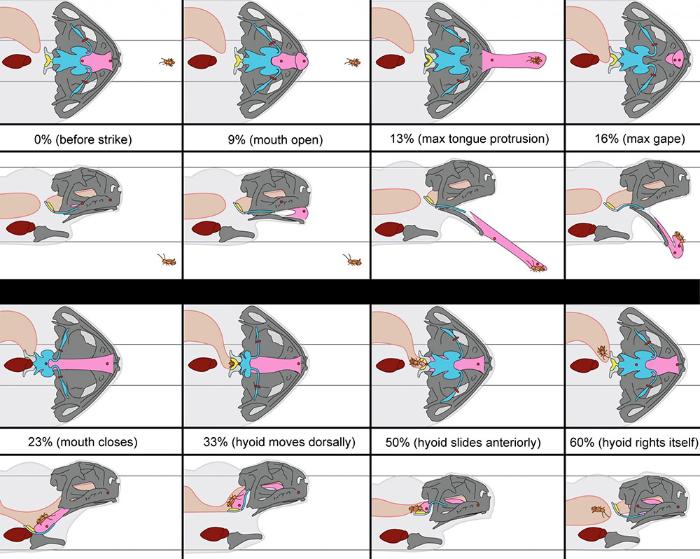
Keeffe and her colleagues videotaped cane toads eating to get insight into the process by which frogs remove food from their tongues before swallowing it. Because of their size (cane toads may grow to be as long as 5.9 inches or 15 cm), the inside workings of their mouths are easily studied. Keeffe and her colleagues kept the animals in a Plexiglas enclosure and fed them crickets during the research.

The tongues of cane toads can grow to be as long as 80% of their heads.
They used a high-speed camera and X-ray footage to capture the action on film. They were able to see what was happening inside the toads. Metal beads were placed in strategic places in the toads’ mouths to enhance the visibility of the necessary structures under X-ray.
The resultant video material was then recreated by Keeffe into 3D animations so he could examine the movement patterns more closely. She used the animations to create a detailed flow chart that describes the whole feeding cycle of a cane toad, from the time it first spots the cricket until the time it dies in the toad’s stomach and the toad returns to its original condition.
The Hyoid Retracts Into the Neck
Researchers were taken aback by the findings, which revealed a more complicated system than anybody had anticipated for how a toad removes its prey before shoving it down its throat. The so-called hyoid bone played a pivotal role. The frog’s tongue is attached to the hyoid, a cartilaginous plate located near the mouth’s base. The hyoid retracts into the neck when the frog strikes its target with its tongue, bringing the tongue and the prey back into the mouth.
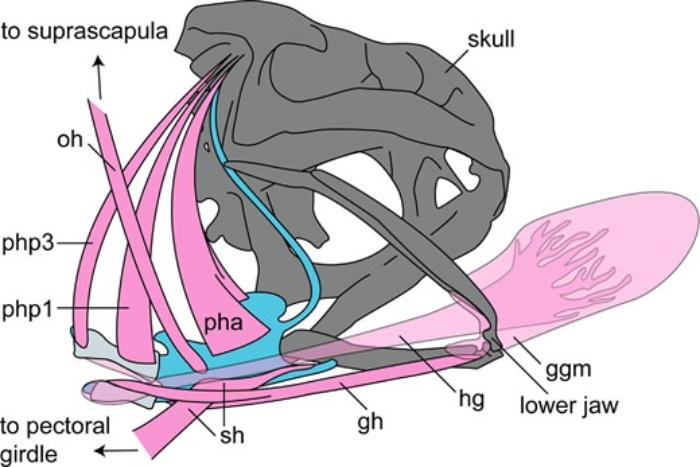
The recordings showed that during this recovery motion, the tongue slides much farther into the throat than it does during prey acquisition. This procedure involves a network of cartilage and muscle that extends so far back into the toad’s throat that it touches the organ that pumps blood throughout the body. The next movement involves the hyoid bone shooting forward, which causes the tongue to be pushed against the hard palate of the mouth and retracted from the pharynx.

In this way, the esophagus receives the prey that had been attached to the tongue. Keeffe speculated that frogs’ palatine grooves or extra rows of teeth assist in the scraping action necessary to remove prey from the frogs’ sticky tongues. Given that the purpose of the grooves and little teeth had been a mystery up until this discovery, this is a very interesting development. She also mentioned the hyoid bone, which was not previously linked to swallowing.
It Takes Less Than Two Seconds
It takes less than two seconds for the toad to go from seeing the cricket to its original form. This is still far longer than was anticipated. The time it takes to acquire prey is much less than two seconds.
It was also intriguing to see the toad’s intricate swallowing process in action, both when it successfully caught the cricket and when it failed to do so. In any event, experts believe that the toad’s tongue has to make its way back down the throat before it can start a new feeding cycle.
Keeffe suggests that future studies should investigate whether or not the swallowing technique of cane toads is shared by other frogs, or whether or not they use other methods of digestion.