What did Attila the Hun look like? It is believed that the Greek and Latin accounts written by the Huns’ opponents about the appearance of Attila the Hun are usually prejudiced. But they are the only ones that provide a comprehensive description of Attila the Hun’s look. Because only a few texts recorded by Attila’s contemporaries have made it to our times. Priscus was the only individual who was known to have documented Attila the Hun’s physical characteristics.
Priscus on Attila the Hun’s look
Attila the Hun’s physical characteristics were only documented by Priscus in his book, “At the Court of Attila“. As part of an embassy dispatched by the Eastern Roman Empire to Attila’s court in the 5th century AD, the Greek historian and rhetorician Priscus was there too. The diplomat Priscus describes Attila as having a simple and clean look, down to the latchets of “his Scythian shoes” and the unadorned bridle on his horse.
Multiple sources agree that the Scythians were culturally and linguistically similar to the Turkic steppe tribes from whence they originated. This gives us a better idea of how Attila the Hun probably looked like a Turkic or Central Asian person of the period.
In contrast to the lavish supper provided on silver plates to the other guests, Priscus said that Attila ate just meat on a wooden (rather than silver) trencher and was temperate in his habits.
Jordanes on Attila’s look
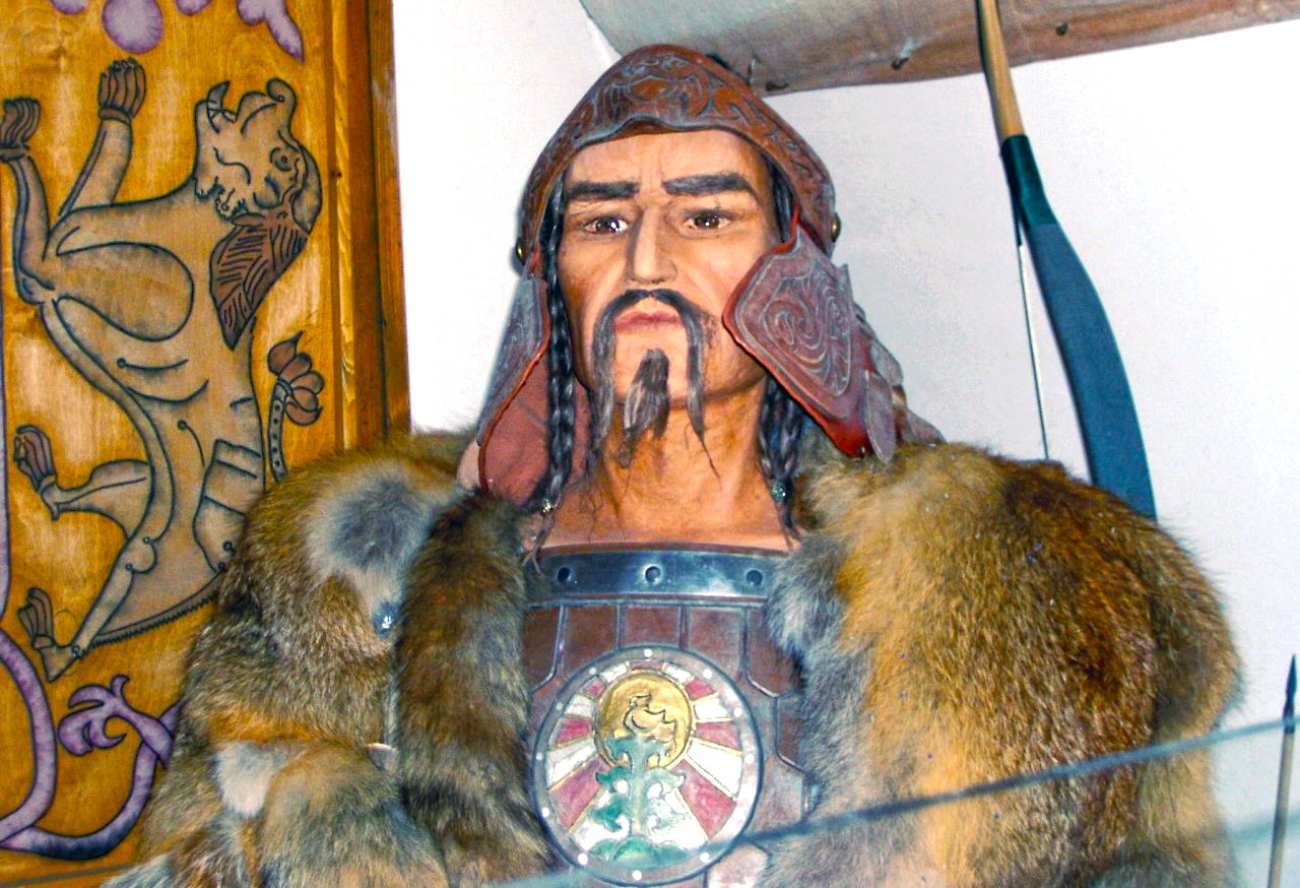
Jordanes gives us the most prominent description of how Attila looked like in his book named The Origins and Deeds of the Goths, also known as “Getica“.
There are some crucial details on Attila’s appearance in Jordanes’ book: He was “short in stature,” had a “broad chest,” a “large head,” “small eyes,” a beard “thin and sprinkled with gray,” “a flat nose,” and “a swarthy complexion.” Jordanes added that Attila the Hun had a “proud spirit” and was “haughty in his walk,” “rolling his eyes hither and thither.”
Jordanes also mentions that Attila’s dress was simple and clean that his sword, latchets, and bridle were not adorned with gold or gems.
Procopius on Attila
Procopius (c. 500–565) and Jordanes, two historians who lived in the sixth century, relied heavily on Priscus on the look of Attila.
The Byzantine historian Procopius (c. 500–565) described Attila the Hun in his book History of the Wars. Procopius describes Attila as a merciless conqueror who inspired terror in the hearts of his subjects. He says that Attila looked ferocious and intimidating, with a stern and harsh face. Attila’s ferocity and ruthlessness, in addition to his incredible power, are characteristics lauded by Procopius. Procopius paints a dark picture of Attila, focusing on the ruthless and cruel aspects of his character because he was biased.
Why did Europeans make Attila look like a European ruler?
The painters often portrayed historical characters in ways that mirrored the prejudices and assumptions of their own culture. It’s conceivable that painters in Europe chose to portray Attila as a European king because they found such representation to be more comfortable or culturally meaningful. In this way, the European painters tried to adopt Attila the Hun into their own culture, rather than the Turkic or Central Asian culture.
The extent to which Attila and the Huns interacted with and impacted European cultures and civilizations may also have contributed to these portrayals. The way historical people are pictured in art doesn’t always match how they looked in real life or how they behaved at the time. As a powerful and successful leader, Attila was not an exception.
The ethnicity of Attila and the language he spoke
The Huns, a nomadic group from Central Asia who eventually became Attila’s forebears, started conquering sections of Europe in the 2nd century AD. Where Attila was born and raised, to the north of the Danube, was where they made their home.
The Turkic language family, which includes Turkish and other languages spoken in Central and Eastern Europe, is thought to be what the Huns spoke based on the evidence. The Altaic and Mongolic language families, as well as others, are connected to the Turkic language family, which has its roots in Central Asia.
Overall, Attila spoke a Turkic language, which was spoken throughout Central and Eastern Europe in the 4th and 5th century AD by the Huns and other nomadic peoples.