Displayed inside a glass case at the Louvre Museum in Paris, gleaming with a solid gold hilt set with cabochon gemstones and entwined winged dragons, rests Joyeuse, the legendary personal sword of Charlemagne and the official coronation sword of the Kings of France for nearly six centuries. Meaning “Joyful” in Old French, this weapon stands at the crossroads of medieval epic poetry, royal legitimacy, and modern metallurgical forensics, uniting the eighth century empire of the Franks with the pageantry of the French monarchy down to the nineteenth century.
Joyeuse in the Song of Roland and Changing Colors
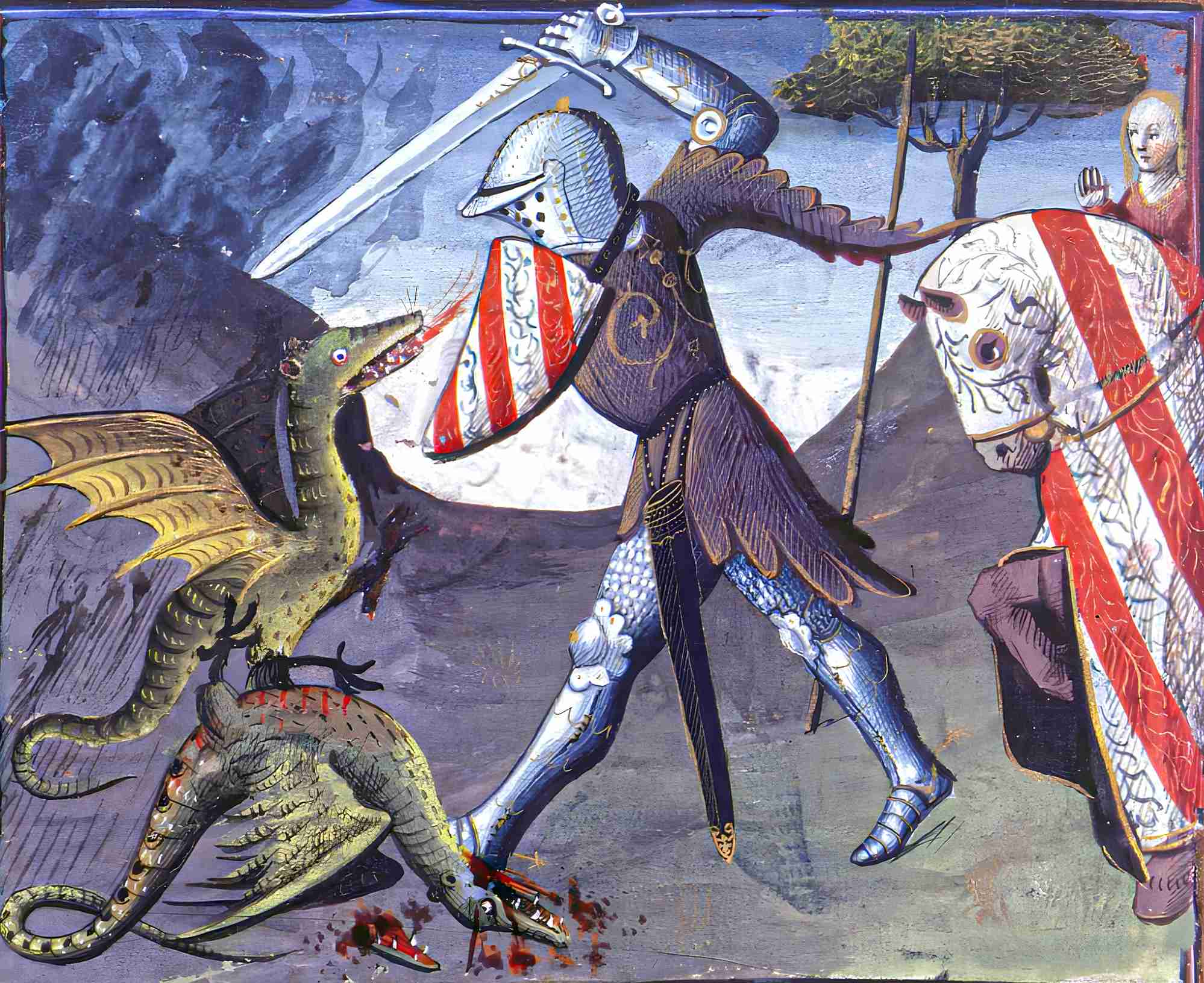
While historical annals confirm that Charles the Great, crowned Emperor of the Romans in 800 AD, carried magnificent presentation and battlefield blades during his campaigns across Saxony, Lombardy, and Spain, the supernatural mystique of Joyeuse was immortalized in the eleventh century Old French epic poem The Song of Roland (La Chanson de Roland). In the poem, Charlemagne wears the sword into battle to avenge the death of his nephew Roland after the ambush at Roncevaux Pass, using the blade to cleave the armor and steed of the Saracen Emir Baligant in a single blow.
Medieval troubadours attributed extraordinary miraculous properties to the weapon. According to the verses of the Song of Roland, Joyeuse was so radiant that its polished steel changed color thirty times every single day, shining brighter than the midday sun and blinding enemies who dared look directly upon its edge. Even more sacred to medieval listeners was the claim that the golden pommel of the sword served as a reliquary housing the tip of the Holy Lance, the Roman spear that had pierced the side of Christ at the Crucifixion, granting the Frankish emperor invincible divine protection and inspiring the royal French battle cry, Montjoie Saint Denis.
Coronation Pageantry from Philip the Bold to Charles X
Beginning at least as early as the coronation of King Philip III the Bold at Reims Cathedral in 1270, and continuing unbroken until the coronation of Charles X in 1825, the sword housed in the treasury of the Abbey of Saint Denis north of Paris was revered as the authentic Joyeuse of Charlemagne and played a central constitutional role in the making of a French monarch. Prior to each coronation, the Benedictine monks of Saint Denis carried the sword in a solemn procession to Reims.

During the opening stages of the ceremony inside the cathedral, the Sword of Charlemagne was carried naked and vertical before the king by the Constable of France as the visible symbol of royal military justice and the defense of the Church. When the French Revolution erupted in 1789 and radical crowds melted down many of the ancient royal crowns and scepters at Saint Denis, Joyeuse was spared destruction because the revolutionary Convention transferred the blade in December 1793 to the newly established museum at the Louvre as a priceless national monument of art and history. In 1804, Napoleon Bonaparte even had the sword brought out for his own imperial coronation at Notre Dame, ordering his court goldsmith Martin Guillaume Biennais to wrap the scabbard in green velvet embroidered with golden Napoleonic bees before the Bourbon restoration later removed the bees and returned the scabbard to traditional royal blue velvet covered in golden fleurs de lis.
What Modern Metallurgy Reveals About the Louvre Blade
When twentieth century curators, art historians, and metallurgists at the Louvre examined the coronation sword under microscopes and X ray fluorescence, they uncovered a fascinating composite history: rather than dating entirely to the lifetime of Charlemagne, who died in 814 AD, the sword of the Louvre is an archaeological palimpsest assembled from centuries of medieval craftsmanship.
The flat, double edged steel blade itself, measuring eighty three centimeters long with a wide central fuller, is an authentic medieval Oakeshott Type XII knightly blade forged between the late tenth and early thirteenth centuries, though some earlier scholars suggested the core iron might have been reworked from an older late Carolingian or Viking era blade. The heavy gold pommel, decorated in high relief with opposing birds and foliage inside a beaded border, dates on stylistic grounds to the tenth or eleventh century. The striking crossguard, cast in gilded silver and gold in the shape of two slender winged dragons with diamond eyes facing toward the grip, was crafted in the twelfth century, while the diamond patterned gold wire grip and the gem encrusted scabbard fittings were refurbished specifically for the 1270 coronation of Philip III. Far from diminishing its value, this layered construction proves how succeeding dynasties continuously renewed and adorned the sacred symbol of Charlemagne’s authority across a thousand years of French history.
The Mystery of the Second Sword in Vienna
Interestingly, the Louvre is not the only European museum claiming to hold a sword associated with Charlemagne. Inside the Imperial Treasury (Kaiserliche Schatzkammer) at the Hofburg Palace in Vienna rests the Sabre of Charlemagne, a slightly curved, single edged horseman’s saber decorated with tenth century Magyar or Kievan Rus gold and silver geometric inlays that formed part of the Imperial Regalia of the Holy Roman Empire. According to eleventh century German chronicles, Emperor Otto III opened Charlemagne’s tomb at Aachen in the year 1000 AD and took a sword from the burial chamber, though modern historians recognize the Vienna blade as a masterpiece of tenth century Eastern European steppes smithing gifted to the German emperors, leaving the golden dragon hilted Joyeuse in Paris as the undisputed icon of Carolingian legend.