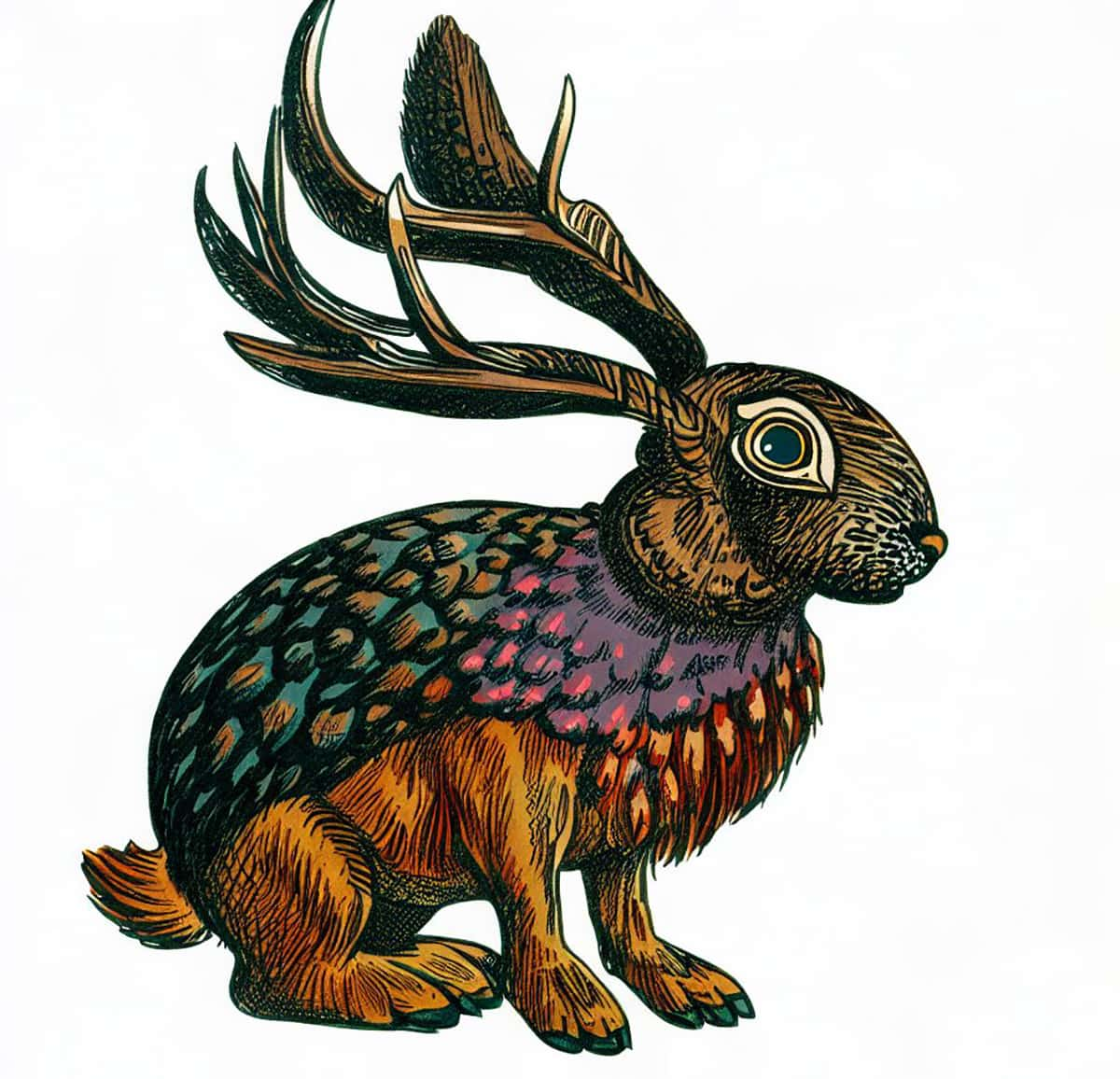
High on the vertiginous limestone pastures of the French Savoy, the Swiss Valais, and the Italian Aosta Valley—where mountain slopes pitch downward at angles of forty-five degrees—alpine villagers have spent over a century recounting the natural history of a remarkable mountain ungulate: the Dahu. Resembling an ordinary Alpine ibex or chamois at first glance, the Dahu possesses one extraordinary evolutionary adaptation to life on steep cliffs: the two legs on one side of its body are noticeably shorter than the two legs on the other side, allowing the animal to stand completely level while grazing horizontally along sheer mountain faces.
Anatomy and Subspecies: Dextrogyrus vs. Levogyrus
Because the Dahu’s asymmetrical leg lengths prevent it from walking comfortably on flat valley floors, alpine folklore—often presented with deadpan scientific solemnity in local natural history museums—classifies the animal into two distinct behavioral subspecies depending on which side of its body bears the shorter limbs:
- Dahu Dextrogyrus (Clockwise Walker): Possesses shorter right legs and longer left legs, forcing the animal to walk exclusively in a clockwise circle around the peak of a mountain with its right flank always facing the uphill slope.
- Dahu Levogyrus (Counterclockwise Walker): Possesses shorter left legs and longer right legs, circling the mountain exclusively in a counterclockwise direction.
This strict directional anatomy creates hilarious reproductive bottlenecks in local storytelling. If a clockwise male Dahu encounters a counterclockwise female Dahu walking toward him on the exact same narrow mountain ledge, the two animals cannot mate—or even pass each other—without one of them turning around, which immediately places its long legs on the uphill side and sends the poor creature tumbling down into the valley.
The Midnight Sack Hunt: A Rite of Passage for City Tourists
In reality, the Dahu is the quintessential Alpine cousin of the North American “snipe hunt” or the Scottish “wild haggis”—an elaborate, affectionate communal prank played for generations by mountain villagers, ski instructors, and summer camp counselors on gullible city tourists (known in France as les Parisiens or les badauds).

The traditional Dahu hunt follows a carefully staged script on a freezing, moonless night in the mountains:
- The Setup: After an evening of fondue and white wine at an alpine chalet, veteran mountaineers convince the newcomer that tonight is the prime season to catch a Dahu alive, explaining that guns are forbidden because the rare creature is protected.
- The Burlap Sack and the Whistle: The gullible hunter is handed a large empty burlap potato sack and a wooden stick, marched half a mile up a steep, icy forest slope in the dark, and told to crouch at the bottom of a gully holding the mouth of the sack wide open while the veteran hunters climb higher to “drive” the Dahu down toward them.
- The Turn-Around Trick: According to the guides, the secret to catching a Dahu is to wait until the creature walks right behind you on the slope and then blow a sharp whistle or bang two stones together. Naturally inquisitive, the Dahu will turn its head and body 180 degrees to see what made the noise—putting its short legs on the downhill side of the cliff so it loses its balance and rolls straight down the mountain into the waiting burlap sack.
Once the earnest tourist is left shivering in the dark holding the open sack and whistling into the wind, the mountain guides quietly slip down a side trail and head back to the warm village tavern for another glass of wine, waiting an hour or two for the frozen “hunter” to finally figure out the joke and walk back down the hill.
Museum Exhibitions and Cultural Immortality
Far from fading away in the internet age, the Dahu has become a cherished cultural mascot across the Western Alps. In the year 2000, the official Museum of Natural History in La Chaux-de-Fonds, Switzerland, staged a full-scale, deadpan scientific exhibition dedicated to the Dahu—complete with asymmetrical taxidermied chamois mounts, anatomical skeletons, footprint casts, and scholarly wall plaques—while the town of Reignier in Haute-Savoie erected a public statue in its honor, keeping the spirit of Alpine mountain humor alive for the next generation of unsuspecting hikers.