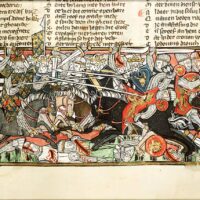
On the afternoon of November twenty-fifth, 1177, across the rolling plains of southern Palestine near the mound of Tell Gezer, one of the most astonishing upsets in medieval military history unfolded. Marching into the Crusader Kingdom of Jerusalem at the head of twenty-six thousand hardened Muslim cavalrymen, Sultan Saladin assumed the Christian cities lay completely defenseless. Instead, emerging through the coastal mist came a tiny strike force of fewer than five hundred armored knights and a few thousand infantry led in person by the sixteen-year-old King Baldwin IV of Jerusalem—a teenager so crippled by advanced leprosy that he had to have his sword tied to his bandaged hand. What followed at the Battle of Montgisard was a thunderous heavy cavalry charge that annihilated Saladin’s army and nearly cost the famous Sultan his life.
The Leper King and the Strategic Trap at Ascalon
When Baldwin IV ascended the throne of Jerusalem in 1174 at the age of thirteen, his royal tutor and chronicler, William of Tyre, had already noticed a chilling symptom: the young prince felt no pain when fellow noble boys pinched or scratched his right arm. Diagnosed with lepromatous leprosy, a disfiguring and fatal bacterial infection that gradually destroyed his nerve endings, eyesight, and extremities, Baldwin refused to surrender his royal duties to a regent. Meanwhile, to the south and north, the brilliant Kurdish commander Salah ad-Din Yusuf ibn Ayyub—known to the West as Saladin—had united both Fatimid Egypt and Zengid Syria under his banner, encircling the Crusader states in a strategic vise.
In November 1177, learning that the bulk of the Kingdom of Jerusalem’s military strength had marched far north to besiege Harim in Syria alongside the Count of Flanders, Saladin saw a golden opportunity to strike at the undefended heart of the kingdom. Leading roughly twenty-six thousand troops—including his elite yellow-clad personal Mamluk bodyguard—across the Sinai Desert from Egypt, Saladin bypassed Gaza. Hearing of the invasion, the sixteen-year-old Baldwin IV rode out of Jerusalem with every fighting man he could scrape together—barely three hundred and seventy-five mounted knights and eighty Knights Templar under Grand Master Odo de St Amand—and threw himself into the coastal fortress of Ascalon to block Saladin’s path. Looking at the tiny Christian force inside Ascalon, Saladin made a fatal mistake of overconfidence: leaving just a small screening detachment outside Ascalon’s walls, he marched his main army straight toward an undefended Jerusalem, allowing his troops to scatter across the countryside in disorganized groups to pillage towns like Ramla and Lydda.
Breaking Out of Ascalon and the March to Montgisard
Inside Ascalon, Baldwin IV and his fiercely aggressive field commander, Raynald of Chatillon—Lord of Oultrejordain, who had recently been released after sixteen years in a Muslim dungeon in Aleppo—refused to stay bottled up behind stone walls while Jerusalem fell. Issuing an emergency call for every healthy Christian male in the kingdom to assemble, the King and the Templars slipped past Saladin’s careless screening force along the coast and marched rapidly northeast to intercept the Sultan’s column.
Joined by the royal constable Humphrey II of Toron, Baldwin and Balian of Ibelin, and a few thousand hastily raised foot soldiers, Baldwin’s total army numbered fewer than four thousand men in all, carrying at its head the True Cross held aloft by the Bishop of Bethlehem. Late in the afternoon of November twenty-fifth, the Feast Day of Saint Catherine of Alexandria, the Crusaders caught Saladin completely by surprise at the hill of Montgisard near Ramla. At that exact moment, Saladin’s army was stretched out for miles: a large portion of his troops was off looting nearby villages, their baggage train was bogged down crossing a muddy ravine stream, and their horses were exhausted.
The Charge of the Leper King and the Rout of the Mamluks
Before Saladin could sound his war drums and pull his scattered wings back into a coherent defensive line, King Baldwin IV dismounted from his horse, knelt in the sand before the True Cross with tears streaming down his face to pray for victory, and was lifted back into his saddle with his right hand heavily bandaged. Raising the royal banners, the three hundred and seventy-five royal knights and eighty Templars formed a tight, unbroken wall of couched lances and charged straight into the center of Saladin’s scrambling army.
The impact of the heavy Frankish cavalry was devastating. Fighting at the very front of the melee despite his half-paralyzed arm, the sixteen-year-old leper king and Grand Master Odo de St Amand smashed directly through Saladin’s center toward the Sultan’s personal tent. Surrounded on all sides, Saladin’s elite thousand-man Mamluk bodyguard—commanded by his brave nephew Taqi ad-Din—fought to the death to shield their Sultan, almost all of them falling under the Crusaders’ heavy broadswords. Only by mounting a swift racing dromedary camel did Saladin himself narrowly escape capture on the battlefield.
Ten Days of Rain and the Aftermath
As darkness fell across the plains of Montgisard, Saladin’s shattered army fled southward in total panic across the Sinai Desert, abandoning every single supply wagon, tent, and pack animal on the field. To make the disaster complete for the retreating survivors, ten days of torrential winter rain turned the desert tracks into freezing mud while Bedouin tribes raided the stragglers. Of the twenty-six thousand soldiers who had marched out of Egypt with Saladin two weeks earlier, contemporary chroniclers recorded that fewer than one-tenth made it back to Cairo alive, while Crusader losses totaled roughly one thousand one hundred killed and seven hundred and fifty wounded.
To commemorate the miracle, Baldwin IV ordered a Benedictine monastery erected on the battlefield dedicated to Saint Catherine of Montgisard. Although Saladin rebuilt his Egyptian army over the following decade and ultimately conquered Jerusalem at the Battle of Hattin in 1187—two years after Baldwin IV succumbed to his illness at the age of twenty-four—the triumph at Montgisard bought the Crusader kingdom a decade of life and immortalized the teenage Leper King as one of history’s most indomitable commanders.