In the folklore of northeastern France, Belgium, and western Switzerland, the arrival of the holiday season brings not only the benevolent generosity of Saint Nicholas but also the ominous shadow of Pere Fouettard. Translating literally to Father Whipper, this grim companion functions as the strict moral enforcer of winter traditions. While Saint Nicholas rewards virtuous and studious children with sweets, oranges, and toys on the sixth of December, Pere Fouettard stands directly behind him to dispense switches, coal, and stern warnings to those who have misbehaved throughout the year.
The 1552 Siege of Metz and the Effigy of Charles V
One of the most historically grounded origins of Pere Fouettard dates back to the autumn of 1552, during the military siege of the French city of Metz by the troops of the Holy Roman Emperor Charles V. As the imperial army surrounded the fortifications and threatened the inhabitants with starvation and destruction, the tanners guild of Metz devised a theatrical way to mock the invader and boost civic morale on Saint Nicholas Eve. They constructed a grotesque, life sized effigy of Emperor Charles V wearing heavy boots, carrying leather whips and chains, and dragged it through the streets of the city.
When the imperial forces finally abandoned the siege in January 1553, the citizens of Metz credited Saint Nicholas with protecting their walls. The following year, the tanners revived the caricature of the defeated emperor, marching a costumed actor alongside Saint Nicholas during the December procession. Over generations, the political satire faded from collective memory, transforming the chained and whip wielding figure of Charles V into the folkloric punisher known across the Lorraine and Alsace regions as Pere Fouettard.
The Dark Legend of the Three Boys and the Evil Butcher
Alongside the military history of Metz exists a much older medieval ecclesiastical legend that cemented Pere Fouettard in the popular imagination. According to traditional ballads sung across France, three wealthy young boys traveling to a religious boarding school sought shelter for the night at a roadside butcher shop. Driven by greed, the sinister butcher murdered the children in their sleep, robbed them of their gold coins, and hid their remains inside a large wooden salting tub in his cellar.
Seven years after the crime, Saint Nicholas passed through the village and knocked on the butcher’s door, asking for lodging and demanding to be served the meat kept inside the specific cellar barrel. Realizing his crime had been supernaturally exposed, the butcher confessed in terror. Saint Nicholas raised his hand in blessing over the salting tub, restoring the three boys to life completely unharmed. Rather than executing the murderer, the saint condemned the butcher to eternal penance, forcing him to walk in his shadow forever as Pere Fouettard, forever reminding unruly children of the consequences of wicked behavior.
Visual Appearance and Regional Traditions
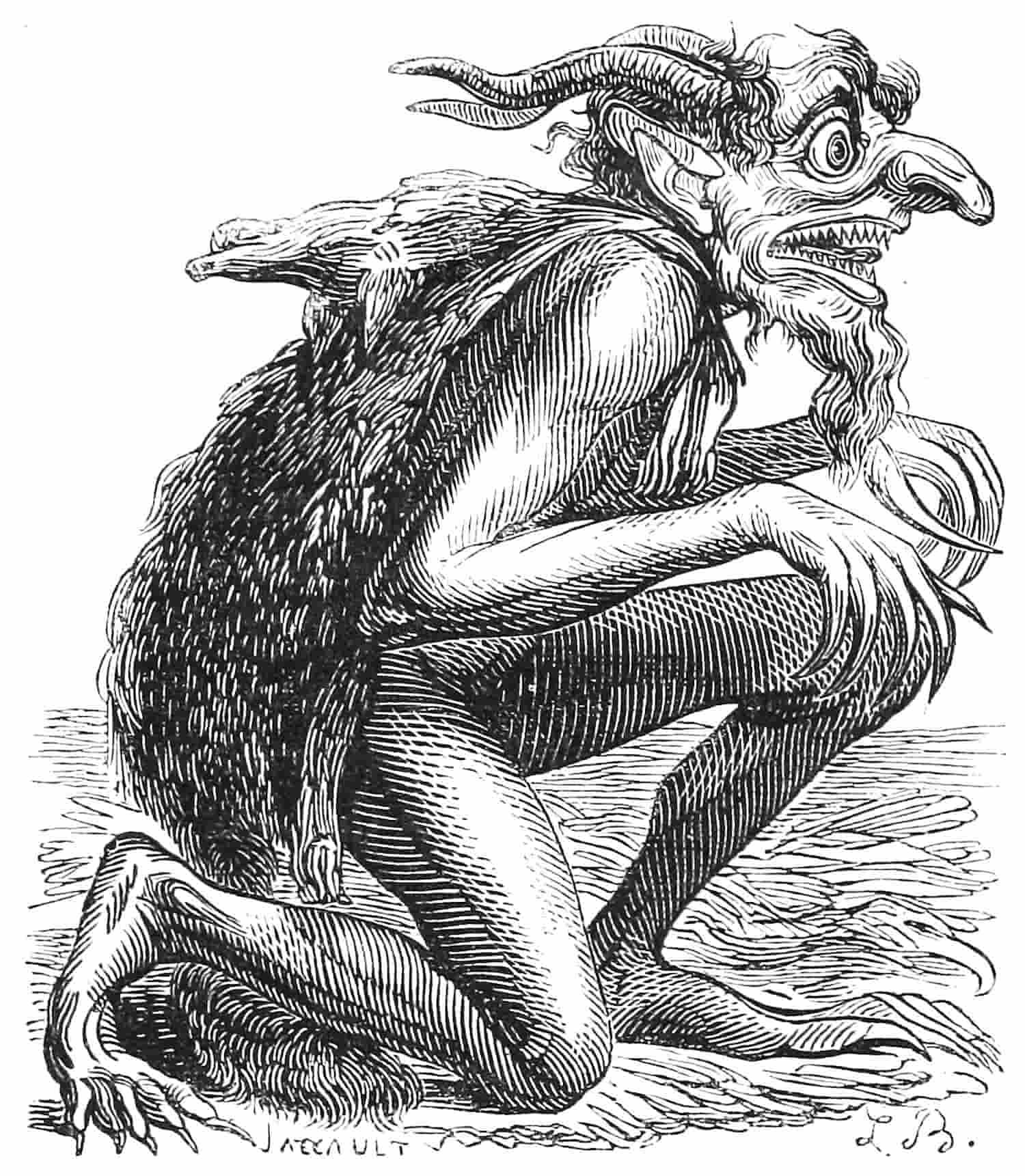
In traditional December sixth pageants in cities like Nancy, Metz, and Strasbourg, Pere Fouettard presents a striking visual contrast to the golden mitre and crimson robes of Saint Nicholas. He is depicted with a weathered, soot covered face, a long tangled dark beard, and wild hair peeking out from beneath a fur hood or a tattered dark cloak. Slung across his back is a large wicker basket capable of carrying away disobedient children, while his hands hold a bundle of birch twigs known as a martinet.
Across the European continent, Pere Fouettard shares strong anthropological roots with other winter companions of Saint Nicholas, such as Krampus in the Alpine valleys of Austria, Knecht Ruprecht in Germany, and Schmutzli in German speaking Switzerland. In the twentieth century, French immigrants even carried the character across the Atlantic to the American Midwest, where he became known in parts of Ohio and Pennsylvania as Belsnickel or Father Fuddle. Today, while modern parents rarely use the figure to genuinely terrify toddlers, Pere Fouettard remains an essential theatrical pillar of the Lorraine Saint Nicholas festivities, preserving centuries of regional storytelling and winter morality plays.