Víðópnir (or Vidofnir) is the rooster or falcon from Norse mythology who sits atop the Mimameidr tree, an analog to the world tree Yggdrasil. The bird gleams like a thunderstorm and has a brilliant hue. The stability of this planet tree is under its watchful eye as a virtually eternal protector. Hence, the gigantic Surtr of the Fire World Muspelheim and the giantess Sinmara of the Ice World Niflheim view Víðópnir with dread (Fjölsvinnsmál 24).
— Did you know?
The rooster as a mythological figure may not be popular in our modern understanding of Nordic mythology, but this might have been different back in the day. For instance, Jacob Grimm compared the roosters on Maypoles, the weathervanes on crosstrees, and the weathervanes on church towers and considered it possible that Christian missionaries reinterpreted this pagan symbol and placed it on their church spires.
Víðópnir’s Story
Menglöð, the lady guarded by the dogs Geri “Greedy” and Gifr “Violent” in the Víðópnir story, can be identified with Freya, the goddess of thunder and lightning. Distracting the dogs is the only way for humans to get to her. One way to accomplish this is to give them some food—specifically the two roasted wings of Víðópnir.
Nevertheless, the only weapon capable of killing Víðópnir is Lopt’s (Loki, “the Airy”) branch, Laevateinn, (meaning “Damage Twig”). Sinmara watches after this weapon underneath the gates of Hel. According to Fjölsvinnsmál (13–18, 23–30), she will only let someone use Laevateinn in combat if they bring her a tail feather that was formerly on Víðópnir.
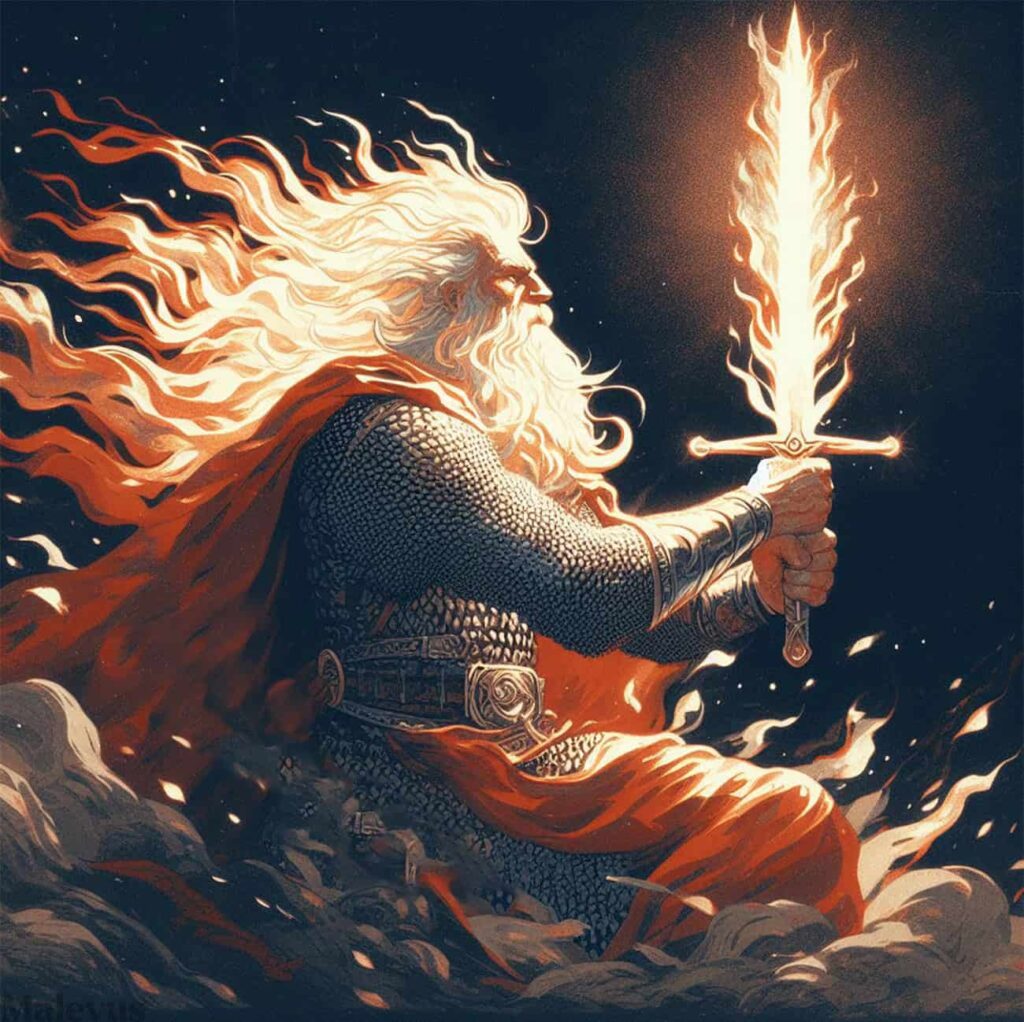
This task is practically impossible. If one can subdue a bird to the point that it drops a tail feather, they probably have what it takes to make it harmless as well. In order to capture the heart of the heroine, Menglöð, the hero must endure a number of difficult challenges, much as in traditional fairy tales and ancient hero sagas.
Appearance
On rare occasions, Víðópnir may be seen perched on the head of a different celestial bird. In these depictions, it occupies the space between the cosmic eagle Hraesvelgr‘s eyes, and it is depicted like a falcon rather than a rooster. Hraesvelgr is an eagle-shaped jötunn in Norse mythology, the originator of the winds.
Víðópnir’s literal meaning of “Weaver of Winds” suits this depiction.
This is reminiscent of a similar hawk-eagle depiction popularly known as “Veðrfölnir and eagle.”
Víðópnir in Nordic Literature
A manuscript from the pagan late era of Iceland contains a song named Fjölsvinnsmál and this song features Víðópnir, which is also a component of the Old Norse poem Svipdagsmál (“The Lay of Svipdagr”). It is believed to be pure poetry (irreducibly poetic)—in the manner of the Eddic poems—which is believed to be from the 13th century.
Fjölsvinnsmál
The stanzas of Fjölsvinnsmál is describing the expansive Mímameidr tree covering all known land. When Svipdagr queries the watchman Fjölsviðr about the name of the shiny, golden rooster on “the highest branch,” Fjölsviðr confirms it is called Víðópnir:
“Vithofnir his name, and now he shines
Henry Adams Bellows translation.
Like lightning on Mimameith’s limbs;
And great is the trouble with which he grieves
Both Surt and Sinmora.”
Aside from the Fjölsvinnsmál, Viðópnir is also mentioned in Icelandic historian Snorri Sturluson’s Eddu-brot, guarding the gate to the realm of Hél, near the 20-foot-high Icelandic waterfalls of Gjallandi, meaning “the yelling.”
The Meaning of the Old Norse Name
When the Old Norse name Viðópnir or Vidofnir was translated by certain scholars, they explained it to mean “Weaver of Winds.” According to the poem Alvíssmál 12, the Norse fertility deities known as Vanir reside in heaven called Viðópnir or Vidofnir.
The rooster is often associated with the elements of fire and sunshine. When it crows at dawn, it represents watchfulness and the triumph of light over darkness. For the Germanic people, it became a sign of rebirth and a wayfinding object for the afterlife. Because of its aggressive character, it also stands for bravery and war. It is also linked to fertility.