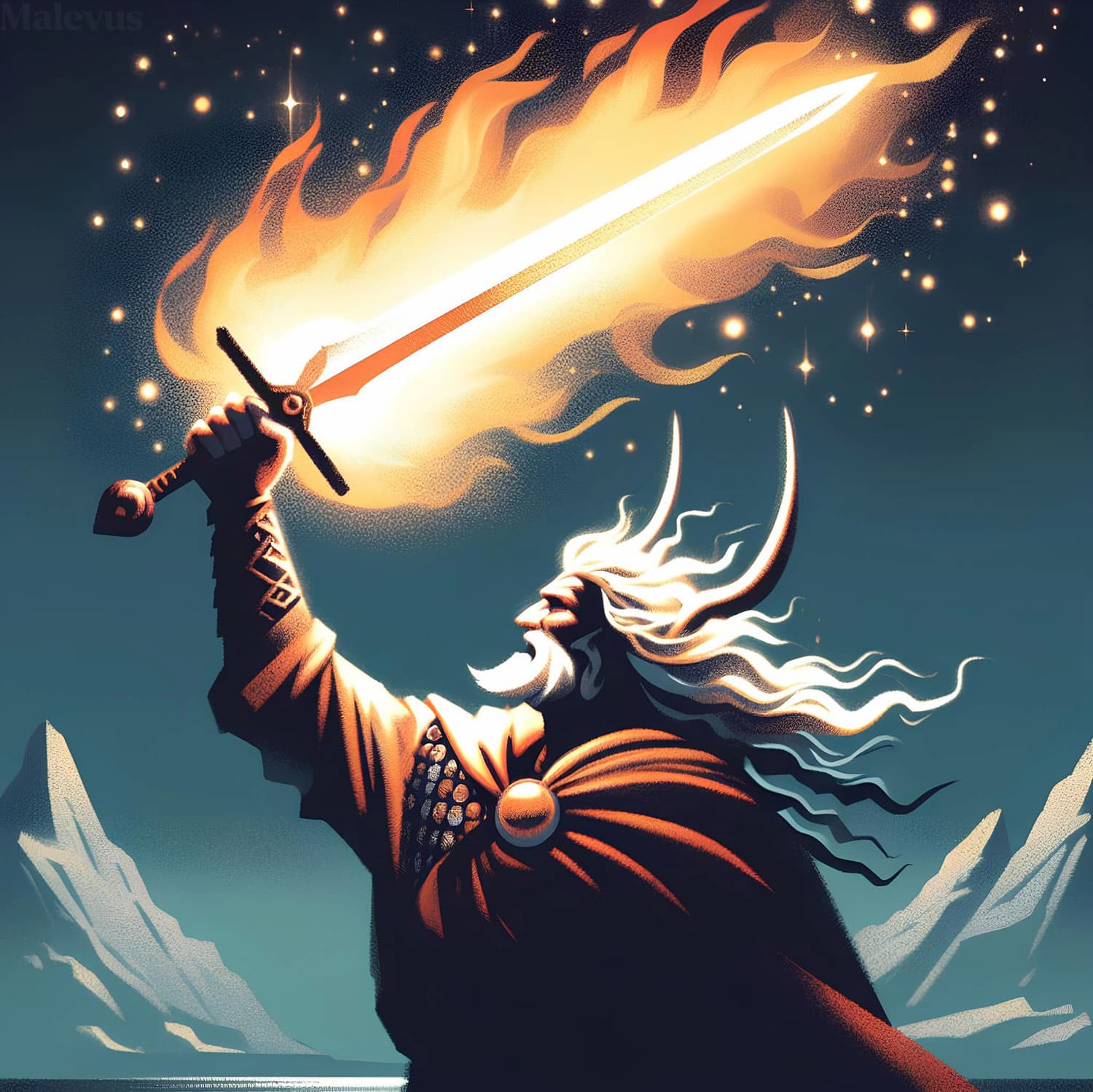
Einherjar are the spirits of warriors who died in battle and were brought to Valhalla by valkyries. The word einherjar means “those who fight alone” or “lone fighters” in Old Norse. They are the elite army of Odin, the chief god of Norse mythology.
The Einherjar are the honored and chosen warriors who reside in Valhalla, a majestic hall in Asgard. They are part of the divine army that will fight alongside the Aesir gods during Ragnarök.
Historical and Mythological Context
Einherjar are part of the Norse cosmology, which consists of nine realms connected by the world tree Yggdrasil. These mythical beings are part of the Germanic people’s history and legends, most notably the Vikings, representing the values and beliefs of Norse culture that embrace courage, honor, loyalty, and glory.
In Norse culture, Einherjar epitomizes the ideal warrior. They receive the highest reward for dying bravely in battle: a seat in Valhalla, where they feast and prepare for Ragnarok. They are symbols of hope and resilience for the Norse people, who encountered numerous difficulties and foes throughout their history.
A Day in the Life of an Einherjar
Einherjar are endowed with supernatural strength, speed, and endurance. They are skilled in various weapons and combat techniques, such as swords, axes, spears, shields, bows, and horses. They are also proficient in magic, poetry, and strategy, as they learn from Odin and other gods in Valhalla.
Valkyries are the female servants of Odin, who fly over the battlefields and choose the slain warriors who are worthy of becoming Einherjar. They escort the einherjar to Valhalla, where they serve them mead and food. They also act as their lovers and companions, as some of them are married or betrothed to einherjar.
Each morning, the rooster Gullinkambi awakens the warriors of Odin, who then proceed to the sizable field of Iðavöllr in the middle of Asgard to engage in merry and lethal combat with one another. The lovely Valkyries feast on everyone who has gathered at Odin’s banquet as dusk falls, bringing the dead back to life and healing the wounded.
They partake in the mead flowing from the udders of the goat Heidrun, perched on the roof of Valhöll. Andhrímnir, the gods’ cook, prepares a meal in the cauldron Eldhrímnir with the flesh of the boar Sæhrímnir. The gods’ animals all have names, underscoring the significance they attribute to their companions. They are so concerned about their well-being that they even resurrect them when consumed.
Thus, the generous boar Sæhrímnir comes back to life every morning to be consumed each evening. Thor, on occasion, has preserved the bones of one of his goats that he was compelled to eat in order to bring it back to life as quickly as possible.
Recruitment and Selection
Valkyries are the ones who decide who among the fallen warriors are worthy of becoming einherjar. They look for qualities such as bravery, skill, honor, and loyalty in the warriors. They also consider the fate and destiny of the warriors, as determined by the Norns, the goddesses of fate. They sometimes intervene in the battles, either to protect or to kill the warriors, depending on Odin’s will and their own preferences.
The main criterion for becoming an einherjar is to die in battle, either by the weapon of an enemy or by one’s own hand. The warriors must also die with honor, meaning they must not flee, surrender, or betray their comrades. The warriors must also have faith in Odin and the gods, and follow their laws and customs.
The Norse society was based on a warrior culture, where fighting and dying in battle was considered the highest honor and duty. The warriors belonged to different social classes, such as kings, nobles, freemen, and slaves, but they all shared the same aspiration of becoming einherjar. The warriors followed a code of conduct, known as the Viking Age laws, which regulated their behavior in war and peace, such as the rules of dueling, raiding, and revenge.
Training and Preparation
Einherjar undergo rigorous training regimens in Valhalla, where they practice their combat skills and learn new ones. They fight with each other every day, using real weapons and inflicting real wounds. They do not fear death, as they know they will be healed and revived every night. They also train with the gods, such as Odin, Thor, Tyr, and Freyr, who teach them the secrets of magic, poetry, and strategy.
Einherjar use various weapons and combat skills, depending on their personal preference and the situation. The most common weapons are swords, axes, spears, and shields, which are made of metal and wood. Some of them also use bows, daggers, and clubs. The most common combat skills are close-range fighting, throwing, and riding, which are based on strength, speed, and agility. Some of them also use magic, stealth, and deception.
Einherjar also undergo spiritual and mental conditioning in Valhalla, where they develop their faith and loyalty to Odin and the gods. They participate in rituals and ceremonies, such as sacrifices, prayers, and oaths, which bind them to the divine will and the cosmic order. They also cultivate their courage and wisdom, which enable them to face any challenge and overcome any fear.
Role in Ragnarök
Einherjar are destined to participate in the final battle of Ragnarök, the doom of the gods and the world. They will fight alongside Odin and the gods against the forces of chaos, such as the giants, the monsters, and the traitors. They will face their enemies with valor and honor, knowing that they will die but also that they will fulfill their destiny.
Einherjar are the loyal sons and followers of Odin, the king and father of the gods. They share a bond of blood and spirit with Odin, who gave them a place in Valhalla and a role in Ragnarök. They will fight for Odin and Valhalla, the symbols of order and glory, against the enemies of the gods and the world.
Einherjar are the symbols of the Norse eschatology, the worldview and beliefs about the end of the world and the afterlife. They represent the cycle of death and rebirth, as they die in battle and are resurrected in Valhalla, and as they die in Ragnarök and are reborn in the new world. They also represent the balance of chaos and order, as they fight against the forces of chaos in Ragnarök, but also cause the destruction of the world and the gods.
Attestations
Einherjar is mentioned in several texts, both ancient and modern, that deal with Norse mythology and culture. Some of the most important texts are:
- The Poetic Edda, a collection of Old Norse poems from the 13th century, contains many references to the einherjar and their role in Valhalla and Ragnarok. Some of the poems that mention the einherjar are Vafþrúðnismál, Grímnismál, Helgakviða Hundingsbana I, and Eiríksmál.
- The Prose Edda, a manual of Norse mythology and poetics written by the Icelandic scholar Snorri Sturluson in the 13th century, describes the einherjar as the adopted sons of Odin and the valkyries as their choosers and companions. The Prose Edda also gives a list of valkyrie names and their meanings.
- Heimskringla, a history of the Norwegian kings written by Snorri Sturluson in the 13th century, contains a poem called Hákonarmál, composed by the skald Eyvindr skáldaspillir in honor of King Hákon the Good, who died in battle and was welcomed by the einherjar and the valkyries in Valhalla.
Ragnarök in Christian Texts
Christian authors, often identified as euhemerist, systematically reinterpreted all Nordic pagan texts. They sought to diminish and denigrate the pagan gods, transforming them into mere mortals, Asian magicians originating from Troy.
The expedient approach was to dispose of pagan gods by reducing them to ordinary mortals. Christian clerics asserted, in sagas either written or rewritten (palimpsests) centuries after the Viking era, that the Einherjar were preparing for a final and fatal battle against the Nordic gods.
Numerous historical sources affirm that Ragnarök is a Christian invention—an amalgamation of a pagan foundation manipulated by Christians. Historians cast doubt on the sincerity of the Ragnarök authors, who aimed to eradicate pagan beliefs and gods. R. Boyer advocates for the rediscovery of the authentic pagan text beneath Christian reinterpretations, suggesting that the text most likely obscured is that of the eternal battle.
The Grímnismál details Valhöll, specifying that this palace possesses 640 doors. Each door accommodates 800 warriors walking abreast, with the term “hundrað” in Old Norse possibly denoting either 100 or 120.
Legacy and Influence
Einherjar are widely represented in the literature and art of the Norse and other Germanic peoples, as they are the subjects and themes of many works. They appear in the poetic and prose eddas, the sagas, the skaldic poetry, and the runic inscriptions, which are the main sources of Norse mythology and history. They also appear in the visual and decorative arts, such as the carvings, paintings, sculptures, and jewelry, which are the expressions of Norse culture and identity.
Einherjar have many contemporary references and adaptations, as they are popular and relevant in modern culture and media. They are featured in various genres and forms of entertainment, such as novels, comics, movies, games, and music, which are inspired by or based on Norse mythology and history. They are also used as symbols and metaphors in various fields and contexts, such as politics, sports, and spirituality, which are related to or influenced by Norse culture and identity.