Lugh is one of the most important and revered deities in Celtic mythology. His name translates to “the luminous” or “the brilliant,” and he is associated with the sun, light, fire, lightning, and magic. Lugh is the master of all arts and skills, possessing great power and wisdom. He is the god of war, sovereignty, travel, trade, currency, craftsmen, poets, musicians, physicians, and druids. Lugh is the protector of his people, the Tuatha Dé Danann, and the leader of the gods in the battle against the Fomorians, the monstrous enemies of the Celts.
—> “Lugh” refers to a prominent figure in Celtic mythology, often associated with the epithet “Lugh Lamfada,” meaning Lugh of the Long Arm.
Lugh is a pan-Celtic deity, present in all Celtic pantheons, from Ireland to Gaul, through Britain, Spain, and other regions. His worship spread across Europe and merged with that of other deities, such as Roman Mercury, Norse Balder, or Gallic Lugus. His presence can be traced in numerous place names, like Lugdunum (Lyon), Londinium (London), Lugo, Lugones, Llugás, or Ligüerre. His festival, Lughnasadh (Lughnasa or Lúnasa), is celebrated on August 1st, marking the beginning of the harvest and the end of summer.
A druid foretold that Lugh would be born to Cian, a Tuatha Dé Danann prince, and Ethniu, Balor’s daughter and the king of the Fomorians. The prophecy foretold that Cian and Ethniu’s son would kill Balor and free the Tuatha Dé Danann from the Fomorians. Balor imprisoned his daughter in a crystal tower, with twelve maidens on duty to prevent this. However, Cian managed to bypass the vigilance and impregnate Ethniu with Lugh. Learning of this, Balor ordered the child to be cast into the sea, but the baby was rescued by his maternal grandfather, the sea god Manannán mac Lir, who raised and instructed him in the secrets of magic.
Lugh grew into a handsome, intelligent, and brave young man, gifted in all talents. Proficient in weapons, musical instruments, poems, healing, craftsmanship, negotiation, and rituals, his favorite weapon was a magical spear that never missed its target and returned to his hand after being thrown. His symbol was a crow, accompanying him on all his adventures, while his sacred animal was the dog, representing fidelity and courage.
—> The Spear of Lugh is a legendary weapon associated with Lugh. It is said to have magical properties and is sometimes considered one of the treasures of the Tuatha Dé Danann.
When Lugh arrived at the Tuatha Dé Danann court, where King Nuada presided over the people after losing an arm in a conflict with the Fomorians and having the tyrant Bres, a mix of both races, take his place, Lugh offered to serve Nuada. Demonstrating proficiency in any occupation or art, Lugh became Nuada’s advisor, earning the title of Samildanach (equally skilled in all the arts), skilled in multiple arts. Lugh organized the resistance against the Fomorians, rallying heroes and gods, including Cú Chulainn, the great warrior and Lugh’s son known for his combat prowess and fury.
Lugh encountered his grandfather on the battlefield while leading the Tuatha Dé Danann in the Battle of Mag Tuired against the Balor-led Fomorians. He hurled his magical spear, piercing Balor’s eye and killing him. With Balor’s death, the Fomorians were demoralized and fled, pursued, and annihilated by the Tuatha Dé Danann. Lugh became the hero and savior of his people and he was proclaimed the king of the gods. Under his reign, the Tuatha Dé Danann experienced an era of peace, prosperity, and happiness.
Representation and Symbolism of Lugh
The Irish deity Lugh possesses or utilizes several magical objects:
- The yew wood spear called Gae Assail (Spear of Assal), or Ar-éadbair (Areadbhair).
- The sling-shot called cloich tabaill, or lía tailm, or Tathlum.
- The hound Failinis.
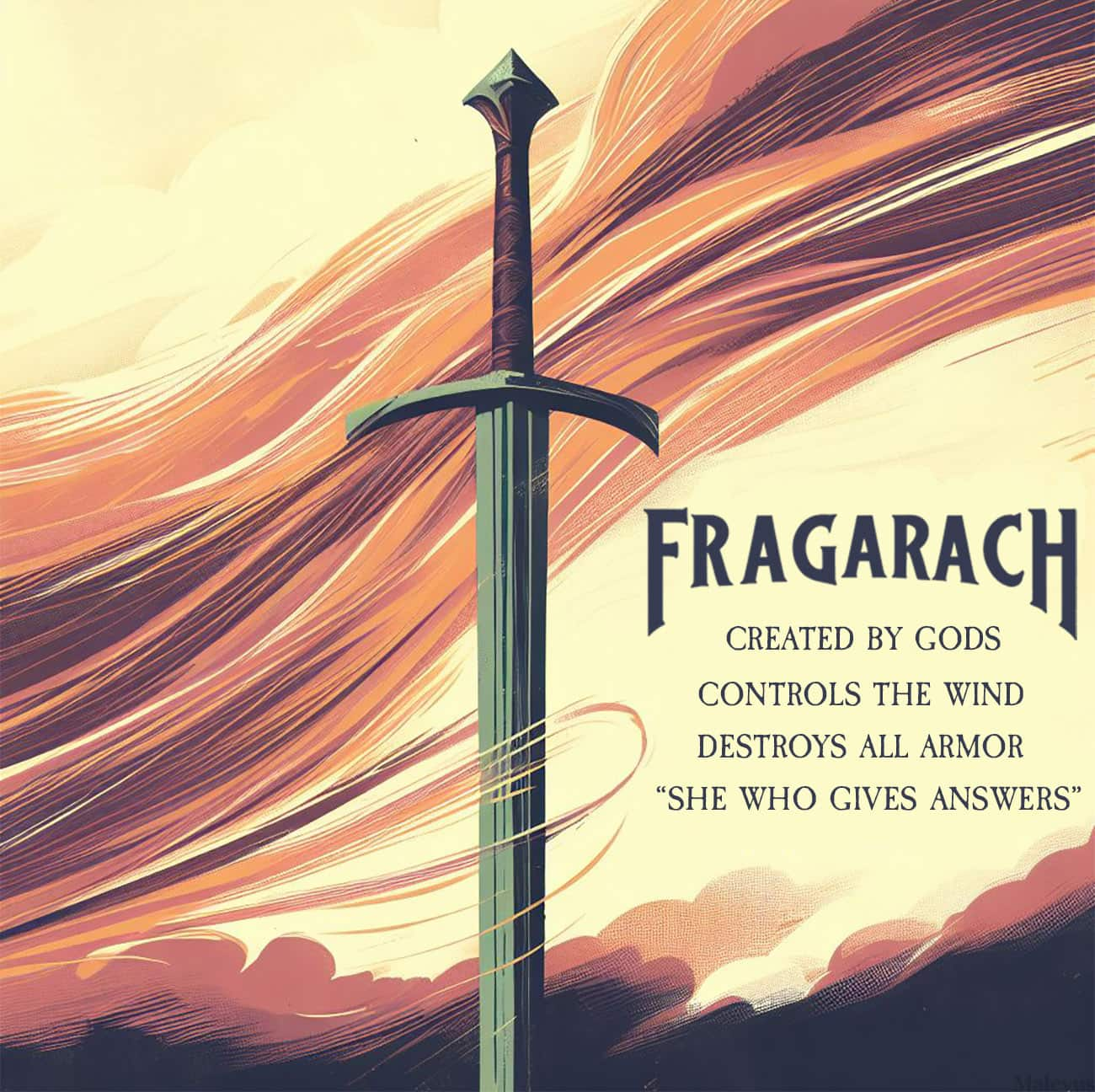
- The sword Freagarthach or Fragaragh, lent by Manannan Mac Lir.
- The horse Aenbharr (Enbarr), also lent by Manannan Mac Lir.
- The boat Scuabtuinne or Sguaba Tuinne, also lent by Manannan Mac Lir.
He is also symbolized with a harp (as he is a harpist at the banquet at Tara), a boar, a hand, or an oversized arm—depicted on coins—due to being called lamfada “with the long arm” or Llaw Gyffes “with the skillful hand.”
Lugh is likely the deity associated by the ancient Celts in their iconography with a tree of life guarded by two dragons, a warrior emblem that spread throughout Celtic Europe in the 4th and 3rd centuries.
—> In Welsh Celtic mythology, Lugh is referred to as Lleu Llaw Gyffes, translating to “the fair-haired one with the skillful hand.” He is featured in the Mabinogion tales. Llefelys (Llevelys), also known as “Lugus with honeyed words,” plays the role of advising and assisting his brother Lludd Llaw Eraint in restoring order to his threatened kingdom.
In the Culture
Lug is one of the numerous gods mentioned in the Asterix comic book series. Lug served as inspiration for the legendary Pokémon Lugia. In the 2017 album “Evocation II: Pantheon” by the Swiss folk metal group Eluveitie, which invokes several Gaulish gods, Lug is featured in a dedicated track titled “Lugus.”
In the second season of the TV series “American Gods,” it is revealed that the leprechaun Mad Sweeney was formerly King Lúg, a deity associated with the sun. Pablo Schreiber portrays Mad Sweeney.