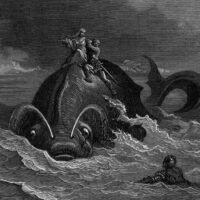
In late September 1808, fierce autumn gales battered the Orkney Islands off the rugged northern coast of Scotland, tearing kelp from the seabed and hurling Atlantic waves against the rocky shoreline of the island of Stronsay. When the storm subsided at Rothiesholm Head, a local tenant farmer and carpenter noticed seagulls flocking over a colossal, decomposing carcass wedged among the tidal rocks. Measuring fifty-five feet in length—longer than any known shark or northern predatory whale—and appearing to possess a long slender neck, a small head, a bristled mane, and six paw-like limbs, the Stronsay Beast triggered one of the earliest and most fascinating forensic debates in the history of marine biology.
Discovery on the Rocks and the Eyewitness Measurements
The rotting carcass was first spotted lying below high-water mark by John Peace, a local farmer, and subsequently dragged higher onto the shore by tempestuous waves days later, where it was examined and measured with a foot-rule by three respected residents of Stronsay: a carpenter named Thomas Fotheringhame, a farmer named John Foulis, and the factor of the island estate, George Sherar. Because nineteenth-century refrigeration and photography did not yet exist, and because winter waves soon broke the decaying body apart, science had to rely on the sworn testimonies these islanders gave weeks later before Orkney magistrates, along with a few salvaged vertebrae, cartilage fragments, and clumps of fibrous “mane” bristles sent south to Edinburgh.
According to the measurements taken on the beach with a ruler, the creature measured exactly fifty-five feet from the crown of its head to the tip of its tail, though the tail appeared to have had its very tip broken off on the rocks. Around its thickest middle section, the body had a circumference of roughly ten feet. Most shockingly to the islanders, the front fifteen feet of the animal consisted of what looked like a long, narrow neck only a foot or two thick, topped by a narrow head the size of a seal’s that lacked teeth. Along the ridge of its back ran a mane of round, glowing fibrous bristles that shone like phosphorus in the dark when wet, and protruding from the underside of the torso were three pairs of five-toed, four-foot-long limbs—six legs in total—arranged from front to rear.
Dr. John Barclay and the Naming of Halsydrus Pontoppidani
When reports and specimen fragments reached the Wernerian Natural History Society in Edinburgh in November 1808, the Scottish scientific community was electrified. Just fifty years earlier, the Danish Bishop of Bergen, Erik Pontoppidan, had published famous accounts of the Great Sea Serpent of Norway in his Natural History of Norway, and Scottish naturalists wondered if an authentic specimen had finally washed ashore on British soil.
The leading anatomical advocate for the creature’s novelty was Dr. John Barclay, a prominent Edinburgh anatomist, alongside the society’s secretary, Patrick Neill. After examining the salvaged vertebrae and drawings crafted from the islanders’ descriptions, Neill and Barclay concluded that the Orkney carcass was indeed an unknown species of giant marine serpent. In the society’s proceedings, they formally proposed a scientific binomial name for the animal: Halsydrus pontoppidani, translating to “Pontoppidan’s Sea-Snake.” For a brief moment in 1809, the legendary sea serpent had been granted an official place in British zoological taxonomy.
Sir Everard Home and how Basking Sharks Pseudo-Plesiosaurs Form
The triumph of Halsydrus pontoppidani did not last long once the physical bone and cartilage specimens arrived in London at the Royal College of Surgeons. There, they were examined under the microscope by Sir Everard Home, one of Britain’s foremost comparative anatomists. Home immediately recognized a fatal flaw in the sea serpent theory: the “vertebrae” pulled from the Stronsay Beast were not made of solid calcified bone like those of a reptile or a mammal, nor did they possess interlocking ball-and-socket joints like a snake; instead, they were composed of calcified cartilage with conical cavities at each end, identical in every anatomical detail to the spine of a basking shark (Cetorhinus maximus).
How could a harmless, filter-feeding basking shark transform into a fifty-five-foot, six-legged, long-necked monster? As marine biologists later confirmed through dozens of similar strandings—most notably the famous Zuiyo-maru carcass hauled up by a Japanese fishing trawler off New Zealand in 1977—when a giant basking shark dies at sea and decomposes, the first parts to rot and fall completely off the body are the heavy, porous cartilage of the giant gill arches and the massive lower jaw. Once the gills and jaws drop away, only the narrow upper braincase (chondrocranium) remains attached to the long, slender forward section of the vertebral column, creating the exact visual illusion of a small plesiosaur head at the end of a fifteen-foot neck. Meanwhile, the rotting collagen fibers of the shark’s skin fray into long, hair-like strands called elastoidin that look just like a horse’s mane, and the frayed pectoral, pelvic, and clasper fins resemble three pairs of clawed legs.
The Unsolved Mystery of the 55-Foot Length
In the modern era, geneticists led by Professor Yvonne Simpson made efforts to extract DNA from the surviving two-hundred-year-old Stronsay vertebrae preserved in ethanol inside the National Museums of Scotland in Edinburgh, though two centuries of chemical preservation fluids degraded the genetic strands too severely for definitive sequencing. Anatomically, virtually all zoologists agree with Sir Everard Home that the Stronsay Beast was a decomposing basking shark.

Yet one intriguing mystery refuses to vanish completely: the fifty-five-foot (16.8-meter) measurement recorded with a carpenter’s rule on the beach in 1808. The largest verified basking shark ever measured in modern marine history topped out at just over forty feet (roughly twelve meters) in length. Unless the three Orkney witnesses accidentally measured two separate shark carcasses lying end to end in the surf, or the decaying cartilaginous spine stretched dramatically as waves battered it across the rocks, the Stronsay Beast was either the most colossal basking shark ever to swim the North Atlantic or remains one of the most compelling maritime puzzles in Scottish history.