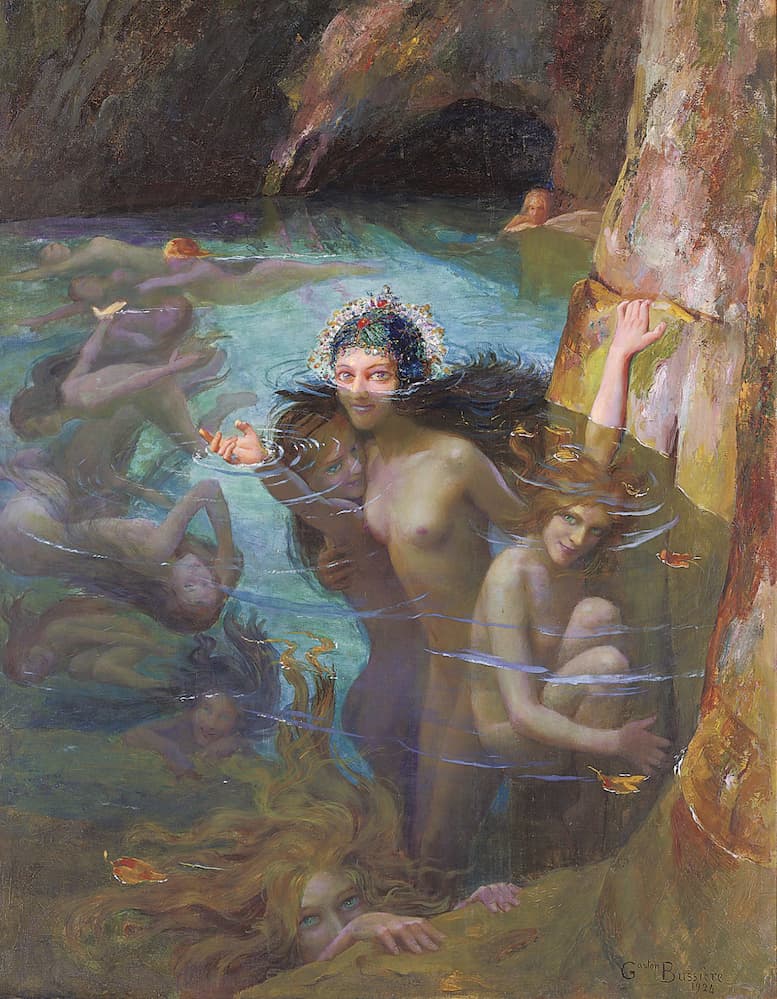
In ancient Greek religion, the nymph (in ancient Greek, νύμφη, nymphē, ‘maiden’, ‘bride’) was a deity associated with nature. Divine powers of the forests, mountains, waters, and springs, of the trees, but also of regions, cities, or states, nymphs were immortal beings, although sometimes considered mortal in later times, but nonetheless with long lives.
The nature of the Nymphs corresponds to the realm of the divine power of Αἰδώς (Modesty), hence to the reserve and wonder in the face of what is immaculate and therefore silent. They were: Oreads, mountain nymphs; Nereids, sea nymphs; Naiads, spring nymphs; and Dryads, tree nymphs. Companions of the goddess Artemis, herself referred to as Αἰδώς, they are characterized, like the goddess, by unparalleled beauty.
When the god Pan plays the divine flute, echoing the harmony of primordial silence, the Nymphs dance, wandering on the mountains and singing melodiously. The Nymphs are the powers of a river, a sea, or a lake, and even when their divine power resides on land, their connection with water remains foundational.
Always in the form of maidens, they often formed part of the retinue of a god, such as Dionysus, Hermes, or Pan, or of a goddess, usually the huntress Artemis. Greek mythology includes many nymphs, whose appearance as beautiful, eternally young maidens attracted many mortal men and heroes.
There is a wide variety of myths about them; these stories often associate them with satyrs, of whom they were frequent targets, giving rise to the modern term for the nymphomania sexual tendency.
Etymology
Nymphs are personifications of creativity and nurturing activities of nature, most often identified with the life-giving flow of watercourses following floods:
“The idea that rivers are gods and nymphs their associated divinities is deeply rooted, not only in poetry but also in common belief and rituals; the worship of these deities is limited only by the fact that they remain inseparably identified with a specific locality.”
Observation by Walter Burkert
The Greek word νύμφη (nýmphe, “maiden”) has the same root as the Latin verb nubere, “to take a husband” (from which our “nubile” derives). Other scholars relate the word (and also Latin nubere and German Knospe) to a root expressing the idea of “swelling” (according to Hesychius of Alexandria, one of the meanings of νύμφη is “rosebud”).
Myth
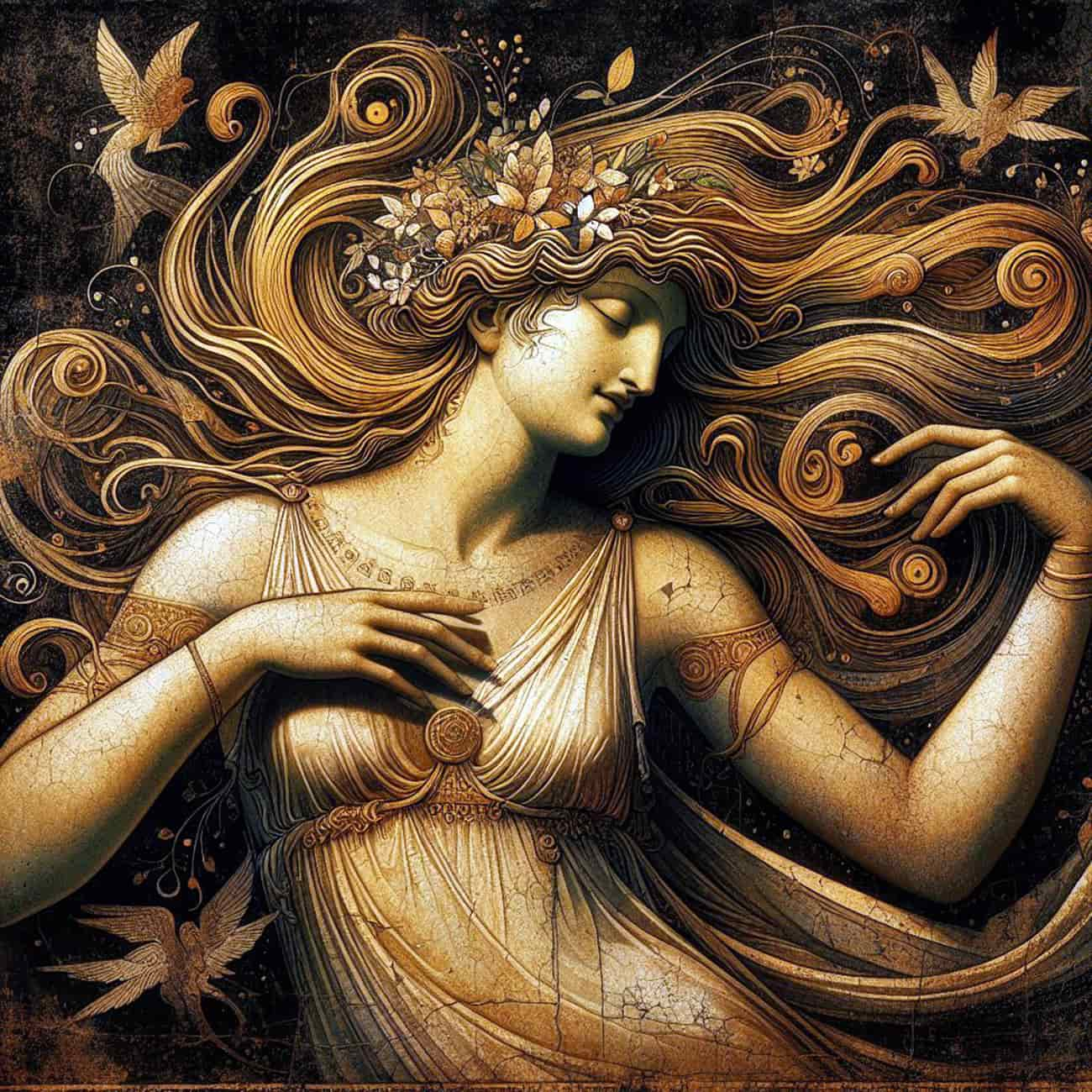
In the Greek conception, nymphs are beautiful and slender young girls, with graceful movements, heads adorned with flowers, and light, fluttering garments, rarely naked. They are benefactors and make nature fertile. They protect engaged couples who bathe in their springs, inspire humans, and some of them, especially the Naiads, are healers of ailments and wounds. Lovers of both gods and common mortals, nymphs sing happily in their consecrated place. Many demigods and heroes were born from their unions with mortals. In theory, they could also mate with deities, and in such cases, immortal children would be born.
Among the most famous nymphs, one can mention Echo, the nymph of Mount Helicon; Hera took away her ability to speak, so Echo could only repeat the last words spoken by others. Another famous, mortal nymph was Eurydice, the wife of Orpheus (related to Orphism).
The nymph Calypso, mentioned in the Odyssey, is well-known; she detained Odysseus for seven years on the island of Ogygia. In Roman mythology, the nymph Egeria was the secret adviser to King Numa Pompilius.
Also remembered are the Naiads who abducted the young Argonaut Hylas. Greek nymphs were later assimilated into the Roman deities of fountains, springs, and rivers.
Genealogy and Classification
The nymphs, whose number is incalculable, are classified into three main categories: terrestrial nymphs, aquatic nymphs, and celestial nymphs, a division already present in Homer and the oldest poets. As the mythologist Herbert Jennings Rose asserts, all the names for the various classes of nymphs are feminine plural adjectives agreeing with the noun nymphai, and there was no single type of classification that could be seen as canonical and exhaustive.
Thus, the classes of nymphs tend to partially overlap, complicating the task of precise classification. Rose speaks of dryads and hamadryads as tree nymphs in general, meliae as nymphs of ash trees, and naiads as water nymphs, but he does not add any others in particular. The Melian nymphs were daughters of Uranus, and their myths are linked to major deities such as Artemis, Apollo, Poseidon, Demeter, Dionysus, Pan, Hermes, or minor deities like Fontus.
Depending on the natural environment in which they live, they are specifically distinguished:
Epigeae: terrestrial nymphs:
- Agrostine, of the fields
- Aloniadi, ravines, cliffs, deep valleys.
- Oreades, of the mountains
- Napee, valleys and meadows
- Auloniadi, river valleys and mountain pastures
- Limniades, meadow nymphs
- Coricides
- Alseids, small trees and woods
- Anthuse, of flowers
- Hamadryads, trees. They were tied to a specific tree
- Dryads, each of which lived in an oak tree or in any case in a plant
- Meliades, ash trees
- Epimelids, protectors of apple and sheep trees
- Ileori, fir and other conifers
- Daphnaie, of the laurel tree
- Egeiro, in the black poplar
- Ampelo, in the vine
- Balans, in the oak
- Caria, in walnut, hazelnut or chestnut
- Craneia, in dogwood or cherry
- Morea, in the mulberry tree
- Ptelea, in the elm
- Siche, in the fig tree
- Querquetulanae, of the oak groves
- Driope, of the Maidenhair plant
- Pleiades, poplars
Hydriads: Aquatic nymphs:
- (Oceanine, sea and river currents. They are proper goddesses, sisters of the Potamoi)
- Aliades, of the coasts
- Psamides
- Nereids (daughters of an oceanina, of the sea
- Naiads, freshwater springs
- Eleades, of the marshes
- Avernali, Lake Avernus and the infernal rivers
- Ithaches, naiads in the sacred caves of Ithaca
- Mysias, naiads of Lake Askanios in Bithynia. They were responsible for the kidnapping of Ila
- Ortigia, naiad or naiads of the springs of the Island of Ortigia, near Syracuse
- Potamides, of rivers
- Limniades, lakes and ponds
- Creneids and Pegee, of the springs (fountain, well and spring)
- Pharmacy, nymph of a poisonous spring in Attica and playmate of Orizia
- Camene, archaic nymphs of the springs
- Pegasids, nymphs of natural wells, connected to Pegasus
- Deliads, daughters of Inopus, god of the river of the same name on the island of Delos
- Spercheids, daughters of the river Spercheus, in Thessaly
Celestial Nymphs:
- Aurae, of the breeze
- Hesperides or “Western Nymphs”: they guard the garden of the Hesperides at an unspecified point in the extreme western limits of the world
- Pleiades; Daughters of Pleion
- Hyades, stars, constellations, rain, woods, springs, and swamps
- Nephele, of the clouds
- Alcinoids
- Clouds, cloud nymphs
Other Nymphs:
- Lamps, nymphs of the underworld, companions of Hecate.
- Tiades, companions of Dionysus, also called Maenads or Bacchae by Hesiod.
- Care, nurturing babies.
- Cirtonians, local nymphs of the town of Cyrtones, Boeotia
- Hyperboreae, nymphs of archery: Hecaerge, representing distance; Losso, representing the trajectory; UPI, representing the intention
- Mint, nymph of the passage to the underworld, on the mountain of the same name
Offerings and Sacrifices
The rituals of offering to the nymphs included sacrifices of lambs and kids, but predominantly these offerings consisted of milk, oil, honey, fruits, and rustic offerings.
Modern Sexual Connotations
Due to the representation of mythological nymphs as females who mate with men or women of their own will and are completely outside male control, the term is often used for women perceived to behave in a similar manner (for example, the title of the 1956 Perry Mason detective novel “The Case of the Negligent Nymph” by Erle Stanley Gardner is derived from this meaning of the word).
The term nymphomania was created by modern psychology to refer to a “desire to engage in human sexual behavior at a level significant enough to be considered clinically meaningful,” with a nymphomaniac being a person suffering from such a disorder. Due to the widespread use of the term among laypeople (often abbreviated to nympho) and the associated stereotypes, professionals nowadays prefer the term hypersexuality, which can refer to both males and females alike.
The word nymphet is used to identify a sexually precocious girl. The term became famous in Vladimir Nabokov’s novel Lolita. The main character, Humbert Humbert, uses the term many times, usually in reference to the title character, a barely thirteen-year-old girl he is strongly infatuated with.
In the Arts
Iconography in Visual Arts
In visual arts, nymphs are usually depicted as beautiful maidens, generally nude and crowned with flowers. Water nymphs, in particular, are shown holding jars or pitchers on their heads (see, for example, Ingres’s “The Source”). Famous works of art from antiquity include some statues by Praxiteles, a marble group by Arkesilaos, and reliefs executed by various masters.
- Francesco Albani: Venus with nymphs and cupids
- Jacob Jordaens: Nymphs at the Fountain of Love
- Jacob Jordaens: Nymphs and Cupid in Sleep
- Lucas Cranach the Elder: Lies of a nymph
- Peter Paul Rubens: Diana and her nymphs surprised by a Faun
- Rembrandt: Diana’s Bath and Actaeon and Callisto
- Arnold Böcklin: The Play of the Naiads (and many other images)
- Jean-Baptiste-Camille Corot: Dance of the Nymphs
- Jean-Baptiste-Camille Corot: A nymph plays with Cupid
- Wilhelm Neumann Torborg: Faun and Nymph (1890)
- Édouard Manet: Surprised by the Nymph (1861)
- Auguste Rodin: Faun and Nymph (1886)
- Titian: Nymph and Shepherd (1570)
- Henryk Siemiradzki: The play of the Naiads (1880)
- Paul Aichele: Nymph (1891)
Music
The French composer Jean-Philippe Rameau composed the opera “Platée” in 1745, a musical comedy. The innocence of a nymph is used by Jupiter to make his wife Juno jealous.
The French composer Claude Debussy composed the piece “Syrinx” for flute in 1913. The short piece refers to the legend of Pan and Syrinx; the nymph escapes the advances of the lustful god and transforms into a reed that plays in the wind.
Pan then invents the musical instrument that bears his name.
The Finnish composer Jean Sibelius composed the orchestral tone poem in 1894, Op. 15, “Skogsrået” (The Nymph Wood).
“Rusalka” by Antonín Dvořák is the most successful opera by the composer. The libretto dates back to popular Slavic myths about Rusalki (water spirits, mermaids) and is similar to the German tale “Undine” by Friedrich de la Motte Fouqué and Hans Christian Andersen’s fairy tale titled “The Little Mermaid.”
The Italian composer Claudio Monteverdi composed in 1614 “Lagrime d’amante al Sepolcro del Amata,” the funeral lament of the shepherd Glaucus in front of the tomb of his beloved nymph Corinna.
Literature
The figure of the nymph appears countless times, especially during the Renaissance and Romanticism.
In his novel “Lolita” (Nabokov), Vladimir Nabokov invents the terms “nymphet” and “Lolita” (term) to indicate a type of precocious and sexually attractive young girl.
Fantasy
In Licia Troisi’s books, nymphs are beautiful girls made of water. They have pure eyes and very long hair. In the Legends of the Emerged World, it is revealed that their blood is immune to the disease, which affects other peoples of the world.
In the novels of the Chronicles of Narnia, nymphs are nature deities: they are graceful and slender; inhabitants of springs (Naiads) and trees (Dryads and Hamadryads); they are the daughters of gods and goddesses; they serve Aslan. In the book, there are also girls associated with nymphs who are actually female creatures of the forests (like treewomen).
In Geronimo Stilton’s books, there are Forest Nymphs: Alena, one of the protagonists in his books, is the first Forest Nymph to become a Knight of the Silver Rose.
They can also be represented as elements of nature, made of water, air, and light. In “Paranormalcy,” a book by Kiersten White, Evie’s boyfriend’s mother is the equivalent of a nymph: she resides in a lake, is made only of water, and practices magic.
In Rick Riordan’s books—the Percy Jackson and the Olympians series and later, the Heroes of Olympus series—there are several appearances of nymphs, often interacting and assisting the main characters. There are forest nymphs, water nymphs, and even air nymphs. Notable is, for example, the dryad Juniper, the girlfriend of the satyr Grover. She is described as entirely green, including her eyes, which have streaks—veins—of chlorophyll. Many of them are shy and end up transforming into plants (each different depending on the nymph) to hide.
Another example is a nymph who is part of the Hesperides, the mythological daughters of Atlas. This is Zoe Nightshade.
In the animated series Winx Club, Bloom’s sister, Daphne, is the Supreme Nymph of the nine nymphs of Magix, all-powerful fairies who control the Magical Dimension. Guardian of the Dragon Flame until her sister’s birth. She lost her body due to the Three Ancient Witches, who cursed her Sirenix power. Later, her sister, Bloom, broke the curse, restoring her life. Another Nymph of Magix is Politea, who transforms into a monster due to the Three Ancient Witches after abandoning Daphne. She will later disappear when the Trix drain her Sirenix power.