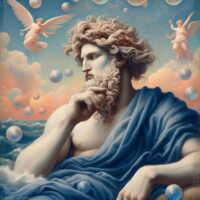
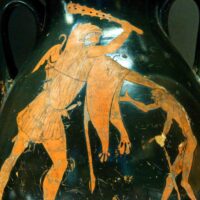
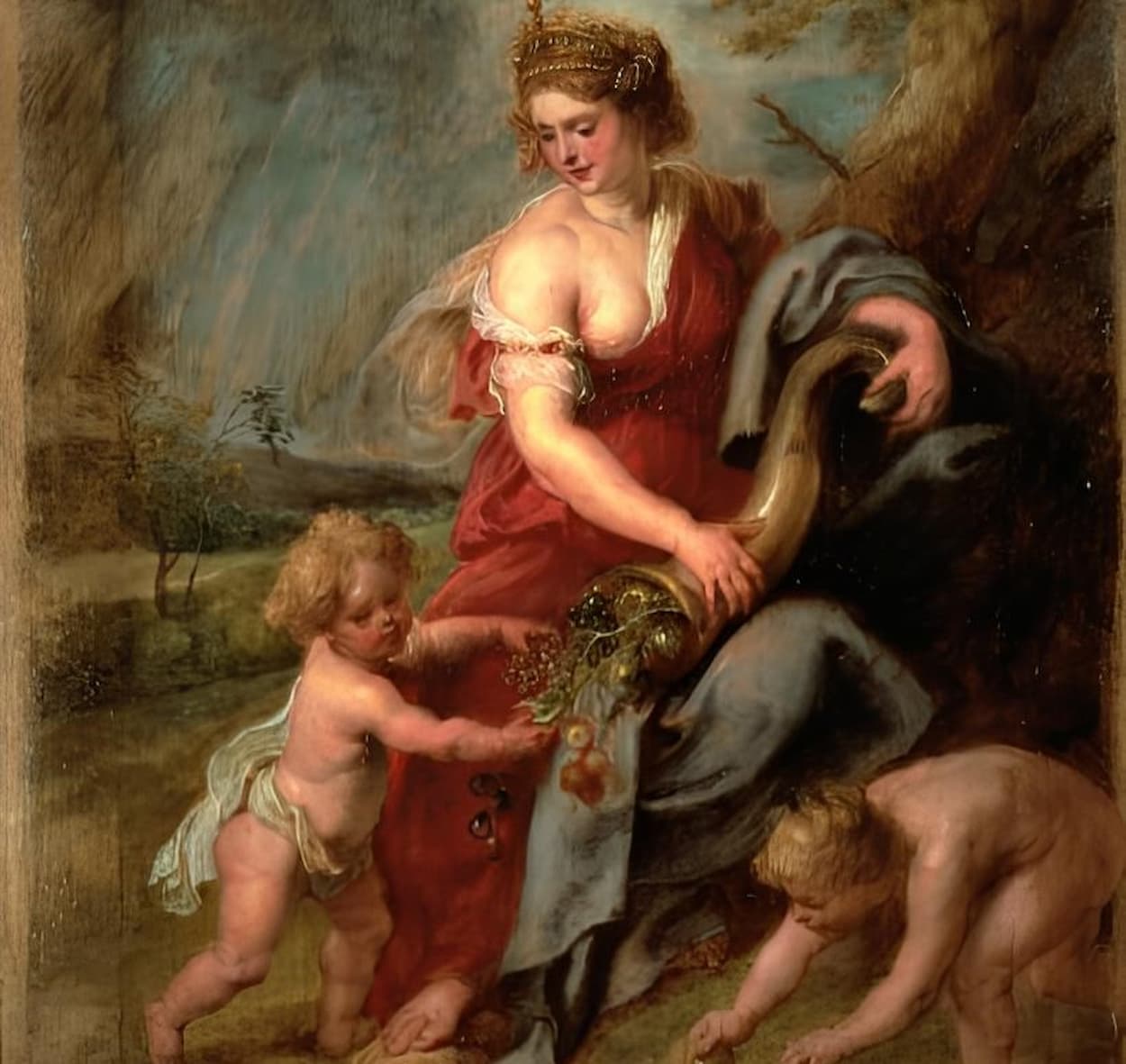
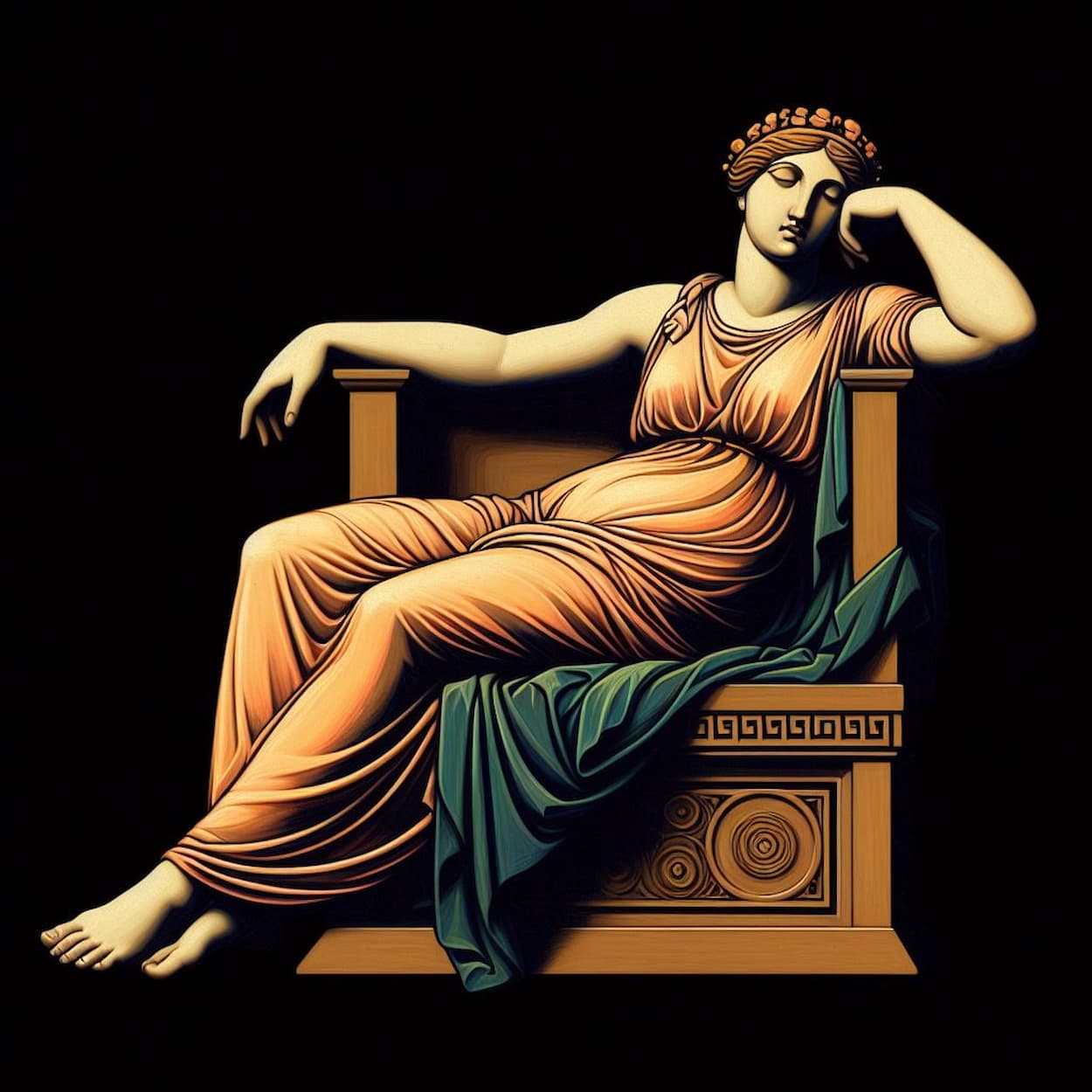
Hemera (in Greek: Ἡμέρα, “Day”) or Amara (Αμαρα, “Day”), in Greek mythology, was the daughter of Nyx (the night) and Erebus (the darkness), a primordial entity and the personification of daylight and the morning cycle. According to the Roman poet Hyginus, she had a romance with her brother Aether and bore three children with him: Gaia (Earth), Uranus (Latin: Coelus, the sky), and Thalassa (the sea).
She was born alongside Aether and the Hesperides. In Roman mythology, Hemera’s equivalent was Dies.
Family Ties
Hyginus’s list attributes to her children from her union with Dies (Hemera), Terra (Gaia), Coelum (Uranus), and Mare (Thalassa), and later with Terra, offspring like Dolor (pain), Dolus (deceit), Ira (anger), Luctus (mourning), Mendacium (lies), Jusiurandum (oath), Ultio (punishment), Intemperantia (intemperance), Altercatio (altercation), Oblivio (forgetfulness), Socordia (laziness), Timor (fear), Superbia (pride), Incestum (incest), and Pugna (strife). Cicero attributes paternity over Uranus to Hemera. Aristophanes also considers him the father of the Nephelae, cloud nymphs.
Some traditions only consider Aether and Hemera as the parents of Uranus and Gaia, thus being the “grandparents” of almost all Greek gods. According to mythology, just before Hemera conceived Uranus and Gaia, loud noises were heard throughout the universe, as if the sky were being influenced by the goddess (it is mentioned that this is because Hemera has a strong connection with Aether). After the Titanomachy, Hemera joined the retinue of Helios, the sun god, alongside the Hesperides.
She was also the guardian of thresholds and portals between the world of light and the world of darkness.
Location
According to Hesiod, Hemera resides with her mother, Nyx, beyond the Ocean, in the far west. There, a great wall separates the gates of the underworld from the visible world. Behind the wall stands an imposing palace where both reside, but they are never seen together.
When Hemera goes out, her mother waits until her daughter returns to greet her and goes out to cast the veil of night over the world. When Nyx returns to the palace, she greets her daughter and gives her permission to go out with Helios and the Hesperides to illuminate the earth until the evening, and the cycle begins again.
As Hesiod says, “The palace never closes with both inside.”
Hemera possesses great beauty, not as immense as Aphrodite’s but enough to be considered a goddess of persuasion and deceit, who, through cunning, can manipulate both mortals and other gods with some ease. She has always been associated with the god Apollo and could even have a relationship as “brothers at heart,” as Apollo is considered a morning solar deity.
In the book “The House of Hades,” from the Heroes of Olympus saga written by Rick Riordan, Hemera is mentioned as the daughter of Nyx.
Eos and Hemera
Although in the Theogony, Hemera and Eos are distinct goddesses, some Greek poets and artists confused Hemera with Eos (Dawn). For instance, Pausanias mentions her kidnapping of Cephalus. He makes this identification with Eos after examining the tiles of the royal portico in Athens, where the myth of Eos and Cephalus was illustrated. He repeats this identification in Amyclae and Olympia, having observed statues and images depicting Hemera (Eos) pleading for the life of her son Memnon. A commentator on the Odyssey specifies that, according to Euphorion, Hemera fell in love with Orion and abducted him for herself.
Hemera, as the goddess of the day, emerged from Tartarus just as Nyx entered it, and Hemera returned when Nyx departed. This is depicted in the Theogony:
In that place, Night and the Day’s Light (Hemera) draw near and greet each other, passing alternately through the grand bronze vestibule. When one is about to enter, the other is already heading towards the door, and never do both find themselves within the palace walls simultaneously. Instead, one always roams the Earth outside the palace, while the other waits in the dwelling until the moment for her journey arrives.
Family tree
- Nix
- Erebus
- Aether (mythology)
- Hemera
- Uranus
- Gaia
- Thalassa
Eponymy
- The asteroid 9671 Hemera is named after him.
- Hemera has given its name to an audiovisual production company in Canada.