Toads and Diamonds or The Fairies (Fr. Les Fées), is a tale by the French writer Charles Perrault. The work was first published in 1697 in the collection “Mother Goose Tales.” The tale tells of the gifts bestowed by a fairy upon a good girl and the curses upon an evil one, and what happened afterward.
Characters
- “The Fairy” — a enchantress who bestows wonderful qualities upon people.
- “Younger Daughter” — a good and beautiful girl.
- “Older Daughter” — a wicked girl.
- “Widow” — a malicious and arrogant woman, mother of both daughters.
- “Prince” — the son of the local king; he lives nearby.
Plot
Once upon a time, there was a widow who had two daughters. The older daughter resembled her mother in many ways: in temperament, manners, and appearance, so much so that everyone who met her mistook her for her mother. Moreover, both daughters were so unpleasant and arrogant that it was impossible to live with them. The younger daughter, however, was like a true portrait of her father: friendly, honest, and one of the most beautiful girls in the world.
As is natural for most people, the mother lavished her care on her older daughter (her princess), while harboring a terrible aversion to the younger one (as if she were a stepdaughter). She forced her to eat in the kitchen and work without rest. Among other things, this poor child had to go to the forest twice a day for water. It was very far from the house, and she had to carry a large jug of water as well.
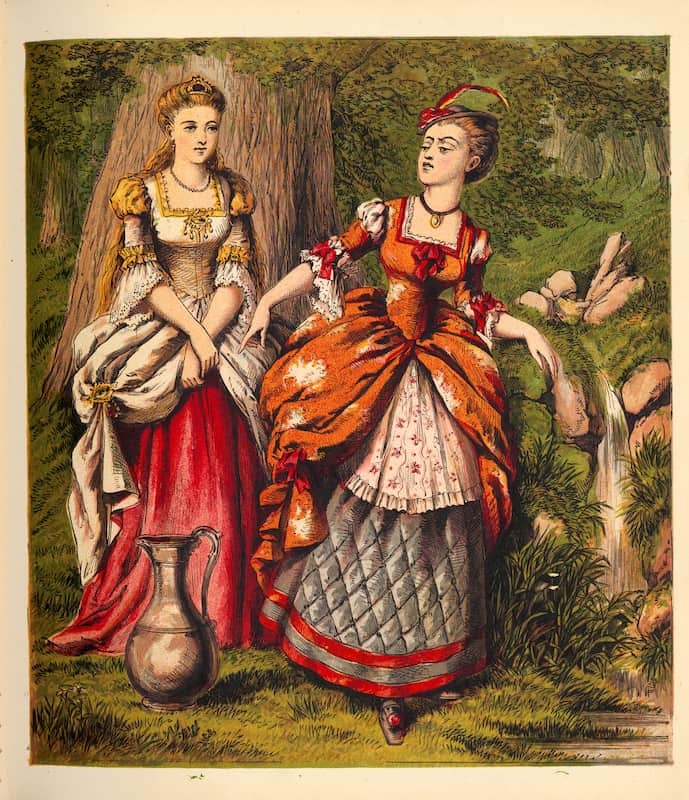
One day, when she went to the spring for water as usual, a poorly dressed woman approached her and asked for a drink. The girl agreed: after rinsing the jug, she scooped water from the cleanest part of the spring and held the jug so that it was easier for the woman to drink.

After drinking, the woman praised the good girl for her obedience — her politeness, kindness, and attentiveness.
It turned out that she was a fairy enchantress, who had disguised herself as a poor woman and intended to test the girl’s kindness. Convinced that it was genuine, she decided to bestow upon the girl a magical gift: “For every word you speak from this moment on, a flower or jewel will fall from your lips.” And after saying this, the fairy disappeared, leaving the girl astonished. She filled her jug with water and headed home.
When the girl returned home, her mother scolded her for taking so long at the spring. The girl lowered her head and apologized to her mother: “Forgive me, mother, for delaying,” and with these words, two roses, two pearls, and two large diamonds fell from her lips. Seeing such a wonder, the wicked mother was greatly surprised and, for the first time in her life, called her “my daughter” and began to inquire why this had happened. And the poor girl sincerely told her woodland encounter (and the diamonds and pearls continued to fall from her lips).
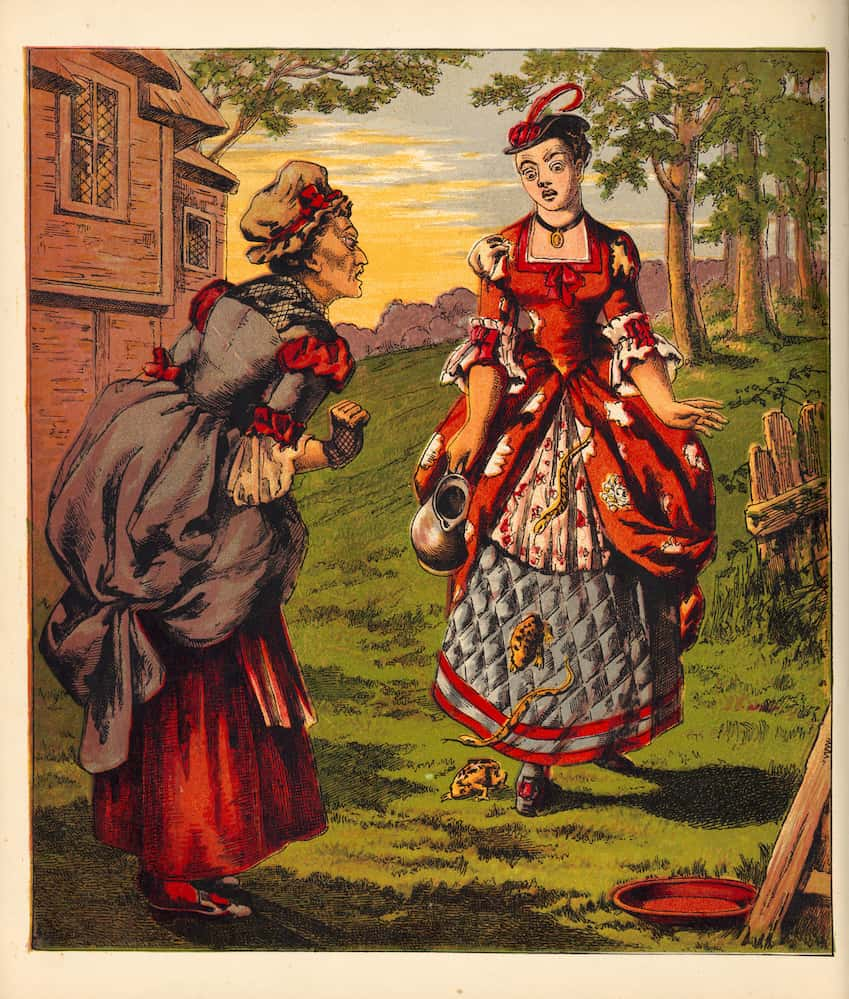
“This is how it is,” thought the cunning widow to herself and she decided to send her beloved daughter to the stream spring this time so that the fairy would bestow such precious gifts upon her. But the spoiled daughter had no intention of going anywhere; she threw tantrums and refused to leave home. Nevertheless, her mother forced her to go out. So, she took the best silver jug, dressed herself as nicely as possible, and left the house.
When the girl approached the stream, she was met by a finely dressed lady. It was the same fairy, only this time she adorned herself as if she were a princess, to reaffirm the girl’s integrity. And now the fairy-lady asked for a drink again, to which she received a stern reply from the girl: “As if I came here just to serve you drinks! Perhaps you think I deliberately brought a silver vase to give you a drink, madam? Well, fine, drink if you so desire.” Upon receiving such a rude response, the fairy decided to bestow upon this girl, in accordance with her virtues: “From now on, with every word from your mouth, a snake will crawl out or a toad will jump forth.” And after saying this, the fairy immediately disappeared, and the girl herself went home.

As soon as the mother saw her favorite, she immediately rushed to her, questioning how everything had unfolded. But the daughter muttered, “Oh, mother, why do you care?” and immediately two snakes and two toads fell from her mouth. Witnessing such an occurrence, the mother was horrified and concluded that it was all the younger daughter’s trickery, and hastily went after her daughter to scold her.
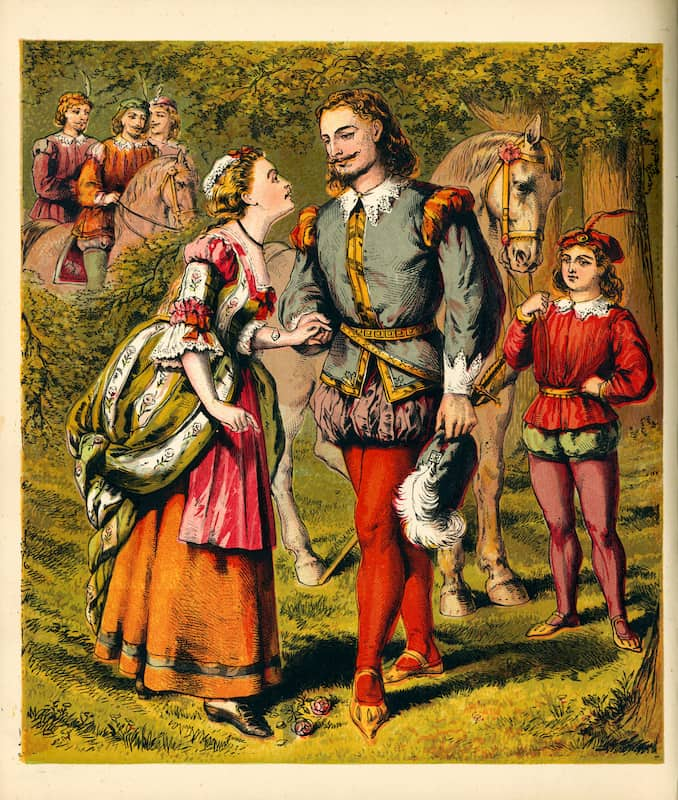
The poor girl barely managed to break free and fled into the forest to hide there. And it just so happened that as she wandered through the woods, the king’s son returned from hunting and was greatly surprised to see such beauty amidst the forest. He asked her what she was doing there all alone and who had wronged her, causing her to cry so bitterly.
“Oh, kind sir, my mother has driven me out of the house!” said the girl, and once again, from her mouth, five or six pearls and as many diamonds fell. Astonished, the prince asked her to tell him her entire story. As the girl recounted her hardships, the prince fell more and more in love with her. Therefore, he took her to his father’s palace and proposed marriage, and when his father rejoiced in this girl, especially with such a dowry (pearls, diamonds).
Meanwhile, her sister remained at home, becoming even more malicious and hateful to everyone, so much so that her own mother had driven her out. And the brute, finding no shelter with anyone, perished in the forest…
Background and Moral
It is known that Charles Perrault wrote his fairy tales under the influence of contemporary works and retellings, which were popular in European aristocratic circles. The most famous collection was the fairy tale anthology “Pentamerone,” also known as the Neapolitan “Lo cunto de li cunti overo lo trattenemiento de peccerille” (The Tale of Tales, or Entertainment for Little Ones), compiled in the Italian regions of the time and published by the court poet Giambattista Basile.
It was from this collection that Perrault adapted his retellings; in the collection, there is a tale (IV-7 “Les Deux Gâteaux”) with a similar plot, which Perrault reworked and published as a new version, now considered a vivid example of literary fairy tales (works written by an author based on plots from folk tales). In the Italian narrative, the younger brother suffers at the hands of his older sister, and throughout the tale, it is shown how the brother, for his virtues, was endowed with roses, pearls, and diamonds, while the sister received “nuts” — toads and snakes.
Similar fairy tale plots are found in many folk tales, and they all have the same moral: kindness is always rewarded, regardless of its outward appearance, while pride and pettiness are condemned. These tale narratives served as educational tools for the children of the time (over 5-7 centuries); through tales, parents sought to teach children virtues and proper behavior. Therefore, pride and arrogance were always ridiculed and presented in literature in a derogatory form (often such heroes were portrayed as ugly, fearful, and dishonest), while moral virtues were often associated with kindness and physical beauty (such heroes were often depicted as young, beautiful, and good).
Similarity in Plot of Tales
In addition to its source material (“Pentamerone” by Giambattista Basile), Charles Perrault’s tale “The Fairy” echoes its plot with many folk and literary tales:
- “Frau Holle” — Brothers Grimm
- “The Twelve Months” — (Soviet) Samuil Marshak
- Kallikantzaros — Anatolian folklore
Publications and Adaptations
The tale was first printed in 1697 with the involvement of the publisher Claude Barbin in Paris, where Charles Perrault’s collection of eight tales was released under the title “Tales of Mother Goose, or Stories and Tales of Bygone Times with Morals.” It should be noted that it was signed with the name of his youngest son, Armancour.
Researchers believe that Charles Perrault did this because he, a well-known figure in society, felt it inappropriate to engage in writing children’s tales. Over the years, some researchers have expressed other hypotheses regarding authorship or co-authorship between father and son Perrault.
Due to their popularity, “Charles Perrault’s Tales” were published numerous times, both in France and in all countries of the world.
There are numerous reprints and translations of the tale in various fairy tale collections published worldwide. The most significant are considered to be the first reprint-book collections:
- “Les Fées,” Claude Barbin’s edition (1697)
- “Les Fées,” Leon Cramer’s edition (1843)
- “Les Fées” in “Les Contes de ma mère l’Oye avant Perrault” (1878)