For more than sixty years since the dawn of the Space Age, astrophysicists have stared at our home star and wrestled with two fundamental mysteries that defied classical thermodynamics: why is the Sun’s outer atmosphere—the corona—hundreds of times hotter than the glowing surface directly beneath it, and how does the solar wind suddenly accelerate to supersonic speeds of over a million miles per hour as it streams outward into the solar system? By plunging headfirst through the blinding glare and million-degree plasma of the solar atmosphere itself, NASA’s Parker Solar Probe and the European Space Agency’s Solar Orbiter have finally “brushed” the face of the Sun and uncovered the hidden magnetic engine driving our star.
Surviving the Inferno: How Parker Solar Probe Touches the Star
Launched from Cape Canaveral in August 2018 and named in honor of Eugene Parker—the visionary University of Chicago astrophysicist who first predicted the existence of the solar wind in 1958 when critics called the idea absurd—the Parker Solar Probe was engineered to perform the most extreme close-up flybys in the history of space exploration. Using repeated gravitational slingshot maneuvers past the planet Venus to tighten its orbit, the car-sized spacecraft dives to within less than four million miles of the Sun’s surface—more than seven times closer than any previous spacecraft in human history—while hurtling through space at a record-shattering velocity of over four hundred and thirty thousand miles per hour (fast enough to fly from New York to Tokyo in under a minute).
To prevent its delicate scientific instruments from vaporizing as it flies straight through the solar corona, the spacecraft hides behind a revolutionary Thermal Protection System: an eight-foot-wide, four-and-a-half-inch-thick hexagonal heat shield constructed from two panels of reinforced carbon-carbon composite sandwiching a lightweight core of ninety-seven-percent-air carbon foam, coated on the sun-facing side with brilliant white ceramic aluminum oxide paint to reflect radiant heat. While the front face of the shield endures blistering temperatures approaching one thousand four hundred degrees Celsius (two thousand five hundred degrees Fahrenheit), the spacecraft body sitting in the shadow just inches behind it remains at a comfortable room temperature of thirty degrees Celsius.
Crossing the Alfvén Critical Surface and Finding “Switchbacks”
In April 2021, during its eighth close perihelion pass, the Parker Solar Probe achieved a historic milestone by crossing the Alfven critical surface—the invisible boundary roughly eight million miles above the photosphere where solar gravity and magnetic fields are no longer strong enough to hold plasma tied to the star, marking the exact border where the Sun’s atmosphere ends and the free-streaming solar wind begins. For the first time ever, a human-made machine had literally entered the atmosphere of a star.

Inside that boundary, the probe’s magnetic field and plasma sensors recorded something completely unexpected that stunned solar physicists: instead of magnetic field lines radiating smoothly outward like the spokes of a wheel, the solar atmosphere was violently whipping back and forth with thousands of sharp, S-shaped kinks in the magnetic field known as “magnetic switchbacks.” In a fraction of a second, the magnetic field would suddenly flip nearly one hundred and eighty degrees backward toward the Sun, whip a jet of plasma forward like a cracking bullwhip, and then snap straight again.
Interchange Reconnection at the Supergranule Funnels
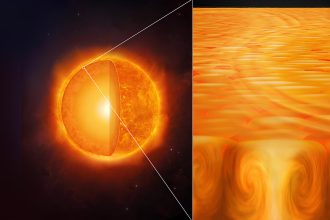
By combining the in-situ measurements of the Parker Solar Probe diving right through the plasma with high-resolution remote imaging from the ESA-NASA Solar Orbiter spacecraft, scientists led by Stuart Bale and Justin Kasper traced these mysterious magnetic switchbacks directly down to their birthplace on the solar surface. They discovered that the switchbacks are not scattered randomly; they occur in distinct clusters or patches that align precisely with the edges of the giant thirty-thousand-kilometer convection cells on the Sun’s surface known as supergranules.
Where these supergranule convection currents sweep magnetic fields into concentrated funnels inside dark coronal holes, closed loops of magnetic field collide with open magnetic field lines stretching out into space. In a violent process called “interchange magnetic reconnection,” the magnetic lines snap, break, and reconnect in a new configuration—releasing bursts of stored magnetic energy and launching Alfvén waves and supersonic jets of charged particles outward at hundreds of kilometers per second. Rather than boiling off the Sun like steam rising gently from a kettle, the fast solar wind is literally shot out of thousands of magnetic “showerheads” anchored in the Sun’s supergranule network.
Solving the Coronal Heating Puzzle and Protecting Earth
This discovery provides the missing link to the sixty-year-old coronal heating paradox. While the visible surface of the Sun (the photosphere) simmers at a relatively modest five thousand five hundred degrees Celsius, the tenuous outer corona soars past one to two million degrees Celsius because the relentless snapping of magnetic reconnection and the turbulence of damping switchback waves pump mechanical and magnetic energy directly into the outer plasma, heating it from the outside in.

Beyond pure astrophysics, understanding how these magnetic funnels and switchbacks launch the solar wind has vital practical value for twenty-first-century civilization on Earth. Because massive coronal mass ejections and solar storms can cripple GPS satellites, disrupt aviation communications, endanger astronauts on future lunar missions, and overload continental electrical transformers, decoding the exact magnetic trigger at the Sun’s surface gives humanity the physics needed to forecast dangerous space weather days before a solar storm ever reaches Earth’s orbit.