Botticelli: A Student Under Influence
The painter’s early religious-themed works exhibit characteristics reminiscent of the pictorial technique of his first master, Fra Filippo Lippi, under whom he studied for three years until 1467. Lippi favored a linear composition with highly refined and elaborate decorations. Filippino Lippi, the son of his master, would later become Botticelli’s most renowned pupil.
- Botticelli: A Student Under Influence
- From a Modest but Not Impoverished Family
- Botticelli’s Close Ties to Humanist and Neoplatonist Thinkers
- A Painter Obsessed with the Pursuit of Absolute Perfection
- A Celebrated Painter, but Unrecognized in Rome
- Celibate, Romantic Lover, or Homosexual?
- Simonetta, Botticelli’s Venus
- Venus and Mars: The Victory of Love Over War?
- Botticelli, A Devoted Admirer of Dante
- A Religious Fanatic, Crippled and Forgotten
From a Modest but Not Impoverished Family
His father, Mariano Filipepi, worked as a tanner, ensuring the family’s livelihood. Young Botticelli displayed an insatiable curiosity for culture and art. He initially trained as a goldsmith, like one of his brothers, before fully dedicating himself to painting. His pictorial style was heavily influenced by his mastery of manual arts such as goldsmithing and chiseling, evident in his keen attention to contours and intricate details.
Botticelli’s Close Ties to Humanist and Neoplatonist Thinkers
Gaining quick renown in Florence, Botticelli moved within an elite intellectual circle. He interacted with Neoplatonists and was inspired by the dominant humanist movement at the Medici court.
These influences are reflected in his paintings, which incorporate Greco-Roman mythology and a linear grace that emphasizes purity and virtue.
A Painter Obsessed with the Pursuit of Absolute Perfection
As both a humanist thinker and a man of faith, Botticelli sought the sacred. He did not dwell on human weaknesses but instead depicted an idealized moral journey where goodness and beauty merged. His canvases abound with Madonnas, goddesses, rich colors, and delicate transparencies.
However, amidst this languid perfection, occasional glimmers of anxiety and doubt emerge, hidden within an enigmatic gaze or a darker background. In his relentless pursuit of the absolute, Botticelli eventually became almost fanatical and reclusive.
A Celebrated Painter, but Unrecognized in Rome
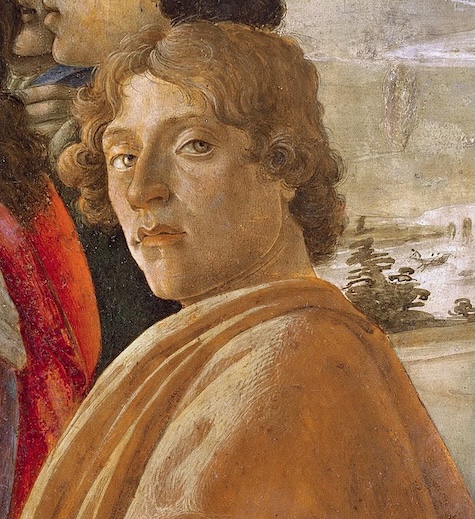
Probable self-portrait of Botticelli, in his Adoration of the Magi (1475).
As a protégé of the Medici, Botticelli enjoyed significant fame during his lifetime in Florence. Pope Sixtus IV summoned him to Rome to contribute to the decorations of the Sistine Chapel alongside other renowned painters. Between 1481 and 1482, he painted three frescoes illustrating various biblical episodes in the medieval tradition. However, his work was not well received, possibly due to the ongoing rivalry between Florence and Rome. Disheartened, the artist decided never to leave his native city again.
Celibate, Romantic Lover, or Homosexual?
Botticelli never married, dedicating himself entirely to his art. Contemporary rumors suggested he had little interest in women and was widely believed to be homosexual. However, he did form a platonic and romantic attachment—akin to that of a painter to his muse—to Simonetta Vespucci.
Simonetta, Botticelli’s Venus
Simonetta Vespucci was considered the most beautiful woman in Florence at the time. She arrived in the city at 15 and married Marco Vespucci before becoming the lover of Giuliano de’ Medici. Botticelli also fell under her spell and began sketching portraits of her. Tragically, she died at just 23. The painter immortalized her as a flower nymph in Primavera and as the ethereal Venus in The Birth of Venus, capturing her alabaster skin and flowing Venetian blonde hair. Upon his death, Botticelli was buried at his request near his muse.
Venus and Mars: The Victory of Love Over War?
Using Simonetta as his model and Giuliano de’ Medici as Mars, Botticelli painted Venus and Mars in 1483. The artwork depicts the god of war in a languid state of rest while Venus watches over him, her gaze slightly anxious.
With her long, braided hair and a translucent white gown adorned with golden trim, she embodies the purity of love. Yet, the painting carries an undertone of sensuality, with her lover’s idealized nude form sculpted by the painter’s brush.
Botticelli, A Devoted Admirer of Dante
Botticelli deeply admired the works of the Italian poet Dante Alighieri. He spent years creating drawings to illustrate The Divine Comedy, including The Map of Hell with its various levels of damnation. He also attempted to write a book on Dante, but the project remained unfinished.
A Religious Fanatic, Crippled and Forgotten
By the 1490s, Botticelli became a follower of Savonarola, the Dominican friar who led Florence in a religious purge, burning anything deemed vain, including mirrors, paintings, and ornaments. Under this influence, Botticelli’s work took on a mystical tone, reflecting his growing religious fervor. Throughout his life, he had been reckless with money, and he eventually found himself destitute and physically infirm. His artistic style became outdated with the rise of new masters like Leonardo da Vinci, Michelangelo, and Raphael. Botticelli’s work faded into obscurity for centuries until the 19th century, when the Pre-Raphaelites and Romanticists revived his legacy.