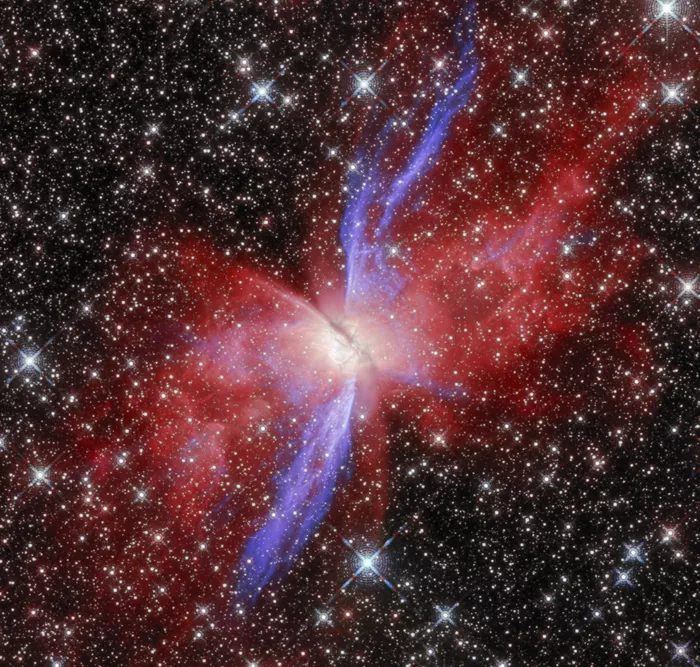
The NGC 6302 nebula displays two magnificent lobes, reminiscent of a butterfly’s wings, hence its name “Butterfly Nebula.” Located just 3,400 light-years away, it is one of the most studied planetary nebulae in the Milky Way, particularly thanks to the Hubble Space Telescope. But it was with Hubble’s successor, the JWST space telescope, and the Alma radio antenna array, that the team led by Mikako Matsuura from Cardiff University revealed how this dying star produces dust and carbonaceous matter that enriches the interstellar medium.
Contrary to what their name suggests, these nebulae have nothing to do with planets. This is a terminological legacy from 18th-century astronomers—a designation proposed by William Herschel, who had observed that the NGC 7009 nebula had a spherical shape, similar to a planet. Beyond this confusion, these nebulae are not always spherical. These objects are born when a star with a mass between 0.8 and 8 times the Sun’s mass has consumed all its hydrogen. As the star becomes a red giant, it expels large quantities of gas at speeds on the order of 20 to 30 kilometers per second, forming an expanding cloud. This cloud can be spherical, but sometimes it consists of two lobes like NGC 6302. The origin of the two lobes is not known with certainty, but one of the most plausible scenarios involves a binary star system whose dynamics channeled the gas expulsion along a preferred axis.
In any case, nebulae are ephemeral and eventually dissipate over a few tens of thousands of years. They are an important source of gas and dust for the interstellar medium, where this matter then contributes to the formation of a new generation of stars, accompanied by their disks where planets are born.
However, the mechanisms of interstellar medium enrichment were poorly understood until now, because the heart of planetary nebulae is difficult to access for observations and proves more complex than previously thought. This is what Mikako Matsuura and her colleagues demonstrated by closely studying NGC 6302.
In Hubble images, NGC 6302’s two wings are separated by a dark cloud of gas and dust (the butterfly’s body) which actually forms a torus around the central star and hides it from our view; the cloud is opaque to visible light. The JWST and Alma teams combined their observational capabilities, at high resolution and at different wavelengths, to zoom in on the central part of the nebula and pierce through the dusty cloud. The researchers thus identified 200 spectroscopic signatures of neutral atoms, ions, or molecules. They identified different structures traced by the presence of various chemical elements, such as carbon monoxide.
First, the team revealed the central star, with a temperature of 220,000 kelvins, a record for this type of nebula. The star illuminates the entire nebula and, more particularly, the innermost part, bounded by the torus. The latter is the system’s main dust reservoir (on the order of 0.8 to 3 times the Sun’s mass). Due to its density, the torus would help channel the star’s energy toward the two lobes. It is rich in micrometer-sized silicate grains, irregular or in the form of quartz crystals. This grain size is typically large compared to the average of those found in the interstellar medium. This suggests that stable chemical processes are at work in the torus, which have time to form such large grains.
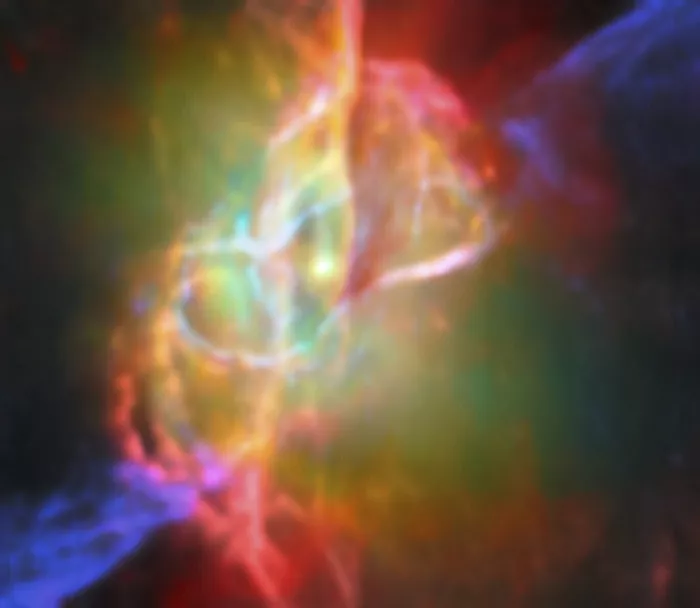
Beyond the torus, signatures of iron and nickel trace two jets that emerge from the star in opposite directions (in purple in the image) and toward the lobes.
Finally, in the zone inside the torus, the team observed the presence of carbonaceous molecules, PAHs—polycyclic aromatic hydrocarbons—which, on Earth, are found in soot during wood combustion or in overly toasted bread. In the nebula, PAHs are detected in circular structures and interconnected filaments (in red in the image). These molecules are probably synthesized when bubbles of wind emitted intermittently by the central star burst in the surrounding gas.
Quartz crystals, carbon monoxide, PAHs—all complex elements found in the interstellar medium. These discoveries reveal formation mechanisms for these key molecules, important for both the chemistry of stellar nurseries where stars are born and that of protoplanetary disks.