We simply put ourselves and all sorts of other things on the scales to determine their weight. The mass of a planet is not quite so easy to determine. Over time, people have developed highly diverse types of scales – there are spring scales, beam scales, inclination scales, and many more. However, the basic principle is the same for all of them: Scales measure the weight force acting on the body lying on them. Since this weight force is proportional to the mass and the constant of proportionality is known – it is the acceleration due to gravity on the earth – the mass can be calculated from the weight force. Conveniently, most scales do not show the weight force in the unit of Newton, but rather the mass in pounds or kilograms.
However, the acceleration due to gravity varies minimally from place to place. This is because it depends not only on the gravitational pull of the Earth but also on the centrifugal force acting at the respective location due to the Earth’s rotation. In addition, the planet is not an exact sphere but is slightly flattened. And the Earth’s surface is not smooth but has all kinds of unevenness with mountains and valleys. All this means that the gravitational acceleration is not the same everywhere. But in everyday life, these differences do not play a significant role, since they are only in the per mille range.
In addition to scales, another method used to determine masses is the measurement by volume, like with a measuring cup. If the density of a substance is known, the mass is simply the volume multiplied by the density. There are different measuring cups for different substances which are adapted to the respective density. While both measuring methods work well for all kinds of living beings and objects on earth, they are not suitable to weigh the planets and other celestial bodies in space.
Newton and His Law of Gravity
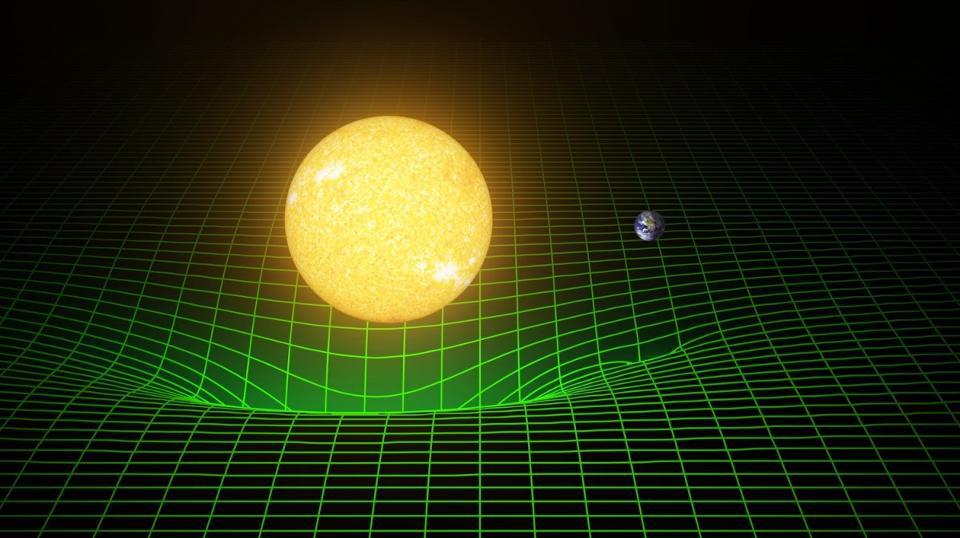
But physics also offers a solution here. The basis of weighing a planet or star is the law of gravitation discovered by Isaac Newton: It is the force of attraction that two masses exert on each other. According to Newton, the force is proportional to the two masses and inversely proportional to the square of the distance between the two masses. For example, if one of the masses is doubled – regardless of which one – the force of attraction is also doubled. If, on the other hand, you double the distance, the attractive force drops not only to half but to a quarter of the original value.
With this law, Newton successfully described the motion of the planets in the solar system in 1687. And it was also used to explain the law of free fall described by Galileo Galilei. The acceleration due to gravity is proportional to the mass of the Earth and inversely proportional to the square of the Earth’s radius. Since the size of the earth was already well known at Newton’s time, this gave Newton a possibility to determine the initially unknown constant of proportionality in his law of gravitation. But for this, he needed – also unknown by then – the mass of the earth.
Finding the Mass of Earth
To obtain the value in question, Newton first estimated the average density of our planet – based on the density of a rock. Since the radius and thus the volume of the earth was known, the estimated value for the density could be used to calculate the mass of the earth. The average density should be about five times greater than that of water, thus, Newton calculated the mass of Earth about 5.5 × 1024 kilograms. Considering the rather rough estimate, this is not a bad result: According to today’s measurements, Earth’s mass is 5.972 × 1024 kilograms. Newton was thus able to approximate the magnitude of the constant of proportionality in the law of gravitation.
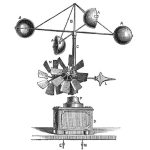
A more precise determination of these gravitational constants was not possible until 1797 when the British natural scientist Henry Cavendish developed a “gravitational balance”. The gravitational attraction between small bodies could now be measured directly for the first time. The masses of the bodies were known and so the experiment allowed to calculate the proportionality constant in the law of gravitation from the measured gravitational attraction. The more exact value for the gravitational constant and the much more easily measurable gravitational acceleration now make it possible to determine the mass of the Earth with far greater accuracy than by volume. Earth was the first planet that scientists could weigh using Newton’s law of gravity.
Measuring the Weight of the Solar System
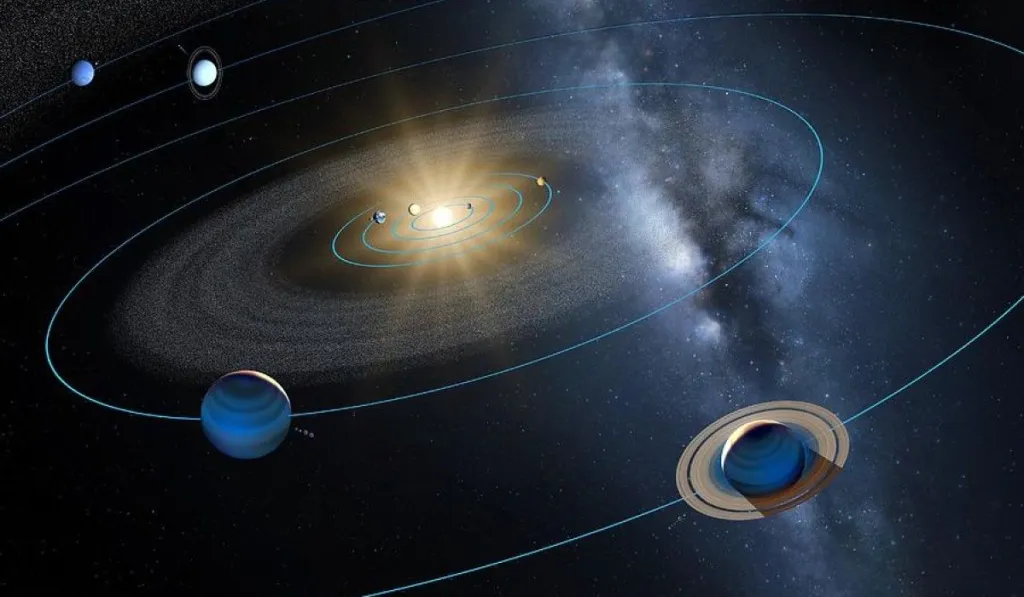
The solar mass is the standard unit of mass in the astronomical community. The Sun’s mass is equal to 1.9890 x 1030 kg, or around 333,000 Earths. More than 99 percent of the solar system’s mass is found in the sun.
Almost three decades before Cavendish’s experiment, researchers had already succeeded in scaling our solar system. Before that, the ratios between different distances in the solar system were known, but not absolute distances. Knowledge of both the absolute distances of celestial bodies and the gravitational constant finally enabled astronomers to weigh other planets as well. For if one disregards other forces – which play only a very minor role in celestial mechanics – gravity alone determines the orbit of a celestial body.
A common method for determining the masses of a planet is by determining the orbits of its moons or by passing space probes. Mass creates gravity, and the planet’s gravitational pull in turn determines the orbit of any object moving around the planet, in terms of size and orbital period.
This relationship can be illustrated using the example of a moon orbiting a planet. The gravitational pull of the planet that is keeping the moon in orbit can be calculated with the help of Newton’s law of gravity. The gravitational force acts here as a so-called centripetal force since it forces the moon into a circular orbit. This makes it possible to determine the mass of the planet solely from the orbital radius and orbital period of the moon. Astronomers have been able to weigh all the planets in the solar system by using this method except Mercury and Venus – which have no moons. This technique allows to find the mass of many celestial bodies, even including space probes.
Weighing the Extrasolar Planets
Astronomers must proceed somewhat differently if they want to weigh planets near other stars. Consider a planet and star that do orbit around their common center of gravity. This causes the star to periodically move toward and away from us. The motion is minimal, but it leaves traces in its light spectrum – caused by the so-called Doppler effect. The characteristic signatures of this light spectrum tell a lot about the star. And since the greater the planet’s mass (a bigger gravitational force), the more a star moves, scientists can use this method to determine the planet’s mass.
For this, however, not only the distance of the system must be known but also the type of star and thus its mass. However, both quantities are usually easy to determine in astronomy. Nevertheless, scientists usually get only a minimal value for the mass. Because as long as they do not know the orientation of the planet’s orbit in space, the actual distance between the star and its companion cannot be precisely quantified. This orientation could be better known only if the planet regularly passes in front of its star from Earth.
The Weight of Various Celestial Objects
| Name | Mass | Type |
|---|---|---|
| Sun | (1.989 × 1030 kg) | star |
| Jupiter | (1.899 × 1027 kg) | 5th planet |
| Earth | (5.9742 × 1024 kg) | 3rd planet |
| Mars | (6.4185 × 10²³ kg) | 4th planet |
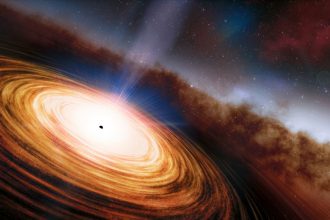
| TON 618 | 66 billion solar masses | black hole |
| Milky Way | 64 billion solar masses | galaxy |
| Ganymede | (1.482 × 10²³ kg) | satellite of Jupiter |
| Pluto | (1.305 × 10²² kg) | dwarf planet |
| Ceres | (9.5 × 10²⁰ kg) | dwarf planet |
Sources:
- How Do We Weigh Planets? | NASA Space Place – NASA Science for Kids. (2020, June 1). How Do We Weigh Planets? | NASA Space Place – NASA Science for Kids.
- How do scientists measure or calculate the weight of a planet? (n.d.). Scientific American.