Laser light has a very common use today. Visible light is a mixture of colors ranging across various wavelengths. Due to the random radiation of atoms, light waves emitted from atomic radiation are not in the same phase. Therefore, ordinary light contains both different wavelengths and waves in different phases. However, laser light is different from this; laser light has a single wavelength, and the waves of the same wavelength are coherent; that is, they are all in the same phase.
Discovery of laser light
It is necessary to energize a solid, liquid, or gas called a gain medium to produce the laser light. As the gain medium receives the energy, the atoms begin to radiate at a certain frequency. When the light from an atom hits the neighboring atom, it forces it to radiate at the same frequency. Thus, a chain effect happens, causing many atoms to radiate at the same time and at the same frequency. The resulting light is reflected back and forth between special mirrors and collected by the laser. When the amplitude of the light is large enough, it passes through the one-way mirror (semi-reflective mirror or beam splitter) and goes out of the device, thereby forming a laser beam.
The first laser emitted
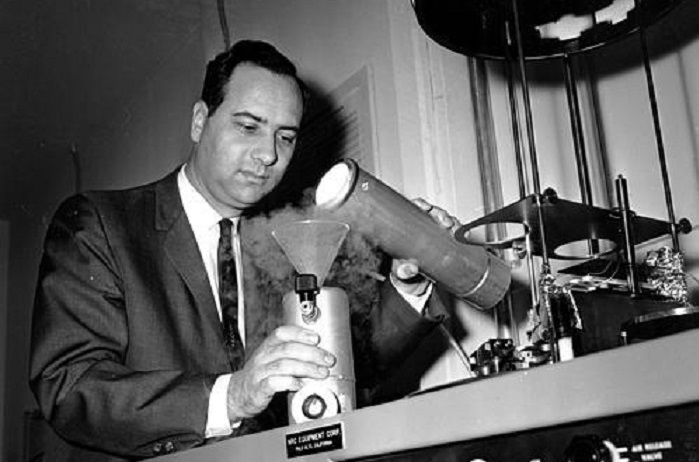
The word “laser” was created from the abbreviation of “Light Amplification by Stimulated Emission of Radiation.” The first laser ever built was made by Theodore Maiman in 1960. The picture above shows Maiman as he pours the coolant into his first experimental laser. This first laser consisted of an artificial ruby cylinder surrounded by a spiral glass. The size of Maiman’s laser was a few inches long, but it worked perfectly. With this discovery by Maiman, the intense light of coherent waves produced by the laser has found many use cases.
The Colossus of New York
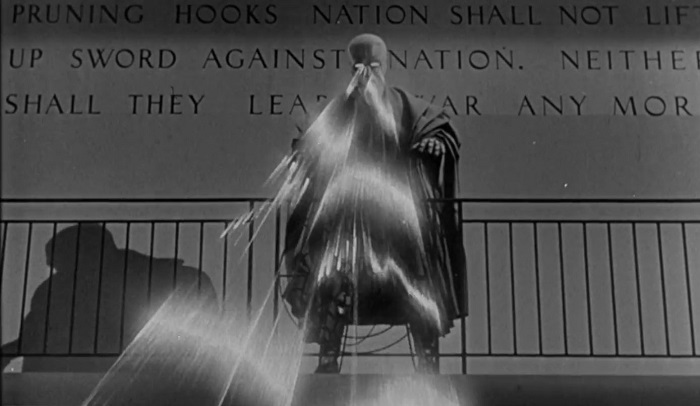
Once upon a time, the deadly beam of light was a popular thing in science fiction movies; For example, in the 1958 film The Colossus of New York, the creature that carries a dead scientist’s brain beams deadly rays from his eyes. However, with the discovery of the laser, it has become a reality to destroy or damage objects at long distances. Unlike regular light, laser light can focus accurately on the target without scattering around.
How does laser light work?
To create a laser beam, a large number of atoms or molecules must be excited. Thus, these atoms and molecules can emit light by bouncing back and forth in the gain medium where the light emits. The intensity of the light beam increases as it travels from one end of the tube to the other. As the light’s amplitude increases, it comes out of the mirror, which has a small hole in it or allows a small amount of light to pass through.
Types of laser machines
Ruby laser
The ruby laser was made in the middle of the 1960s, and it has a long rod made of artificial ruby. When the cover of the laser is closed, the rod gets closer to the lamp and becomes ready for use. The mirror-like surface inside the laser allows the ruby to be bombarded with as much light as possible. The resulting light also generates a high amount of heat, so some lasers have water cooling systems. Ruby lasers produce red light at a wavelength of 695 nanometers.
Helium-neon laser
In such lasers, a tube filled with a mixture of helium and neon gases is excited with the electric current, which produces light. The electric current excites helium atoms, and the energy that is generated by their collision with neon atoms is transferred to neon atoms. What makes up the laser light is the radiation of the neon atoms. One end of the tube has a fully reflective mirror and the other a semi-reflective mirror, and the laser beam comes out of this semi-reflective mirror.
Use cases of laser light
Life-saving
When the retina layer gets hurt, the eye can’t see well. By pointing a helium-neon laser beam at the pupil, the retina can be fixed. Surgeons use laser beams to “cut” or “sew” parts of the body together.
Laser measurement
Since laser beams can travel in a straight line for very long distances without breaking up, they are often used in construction projects like tunneling. Also, laser light is a very accurate way to measure distances. For this, a laser beam is split in half. When the two pieces are brought back together by reflecting off of two different surfaces, the interference pattern they make is used to figure out how far away they are. So, if you measure the phase shifts in the interference lines, you can figure out exactly how far apart the two objects are.
Using light to cut
Long-wavelength lasers are obtained at high temperatures by focusing the beam on a narrow surface area. This temperature is sufficient to cut many materials from fabric to steel sheets used in automobile manufacturing. Due to the high temperatures, lasers are also used in spot welding of metals. The biggest advantage of laser cutting is that it does not dull, unlike regular cutting tools.