

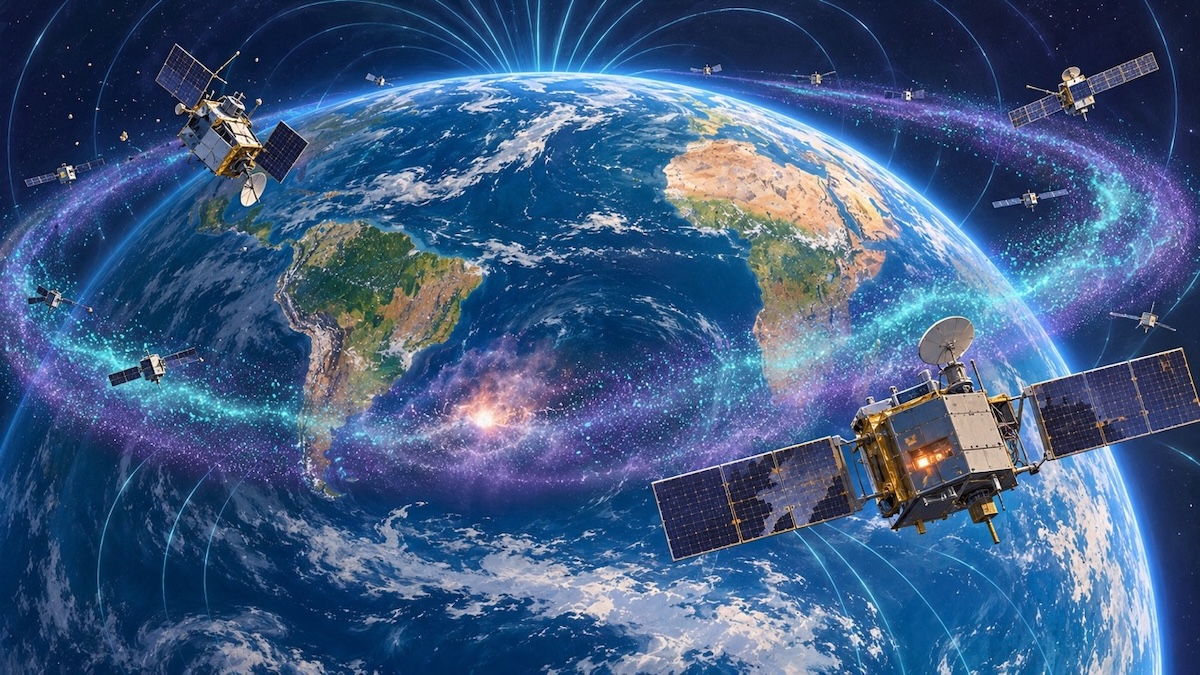
A nuclear detonation in low Earth orbit could disable nearly the entire satellite population within days, according to a new computer-modeling study. The main threat would extend beyond the initial explosion. Radioactive material could release electrons that become trapped in Earth’s magnetic field, creating an artificial radiation belt that repeatedly exposes passing spacecraft.
The research, titled Effects of a Nuclear Detonation in Low Earth Orbit, was posted as a preprint on arXiv on November 6, 2026. Researchers Zachary Petersen, Hong Qin, Sarah Thiele and Sébastien Philippe developed a model connecting the initial radiation from a nuclear detonation with satellite failures, orbital collisions and the gradual removal of damaged spacecraft from orbit.
In their central scenario, a one-megaton explosion at an altitude of 500 kilometers over the South Atlantic disables approximately 98% of the modeled satellite population within seven days. This result depends on the explosion’s location, yield and the radiation tolerance assumed for the satellites. It should not be interpreted as a universal prediction for every nuclear detonation in space.
The Radiation Threat Would Continue After the Explosion
There is a historical precedent for this process. On July 9, 1962, the United States conducted the Starfish Prime nuclear test, detonating a 1.4-megaton device approximately 400 kilometers above Johnston Atoll in the Pacific. Electrons released through the radioactive decay of fission products became trapped in Earth’s magnetic field, creating an artificial radiation belt that damaged satellites already in orbit and spacecraft launched afterward.

The orbital environment has changed considerably since then. More than 13,000 satellites occupied low Earth orbit by January 2026, with many concentrated between 500 and 600 kilometers in altitude. A radiation belt intersecting these orbital paths could therefore expose a large population of spacecraft.
Modeling the Effects on 13,306 Satellites
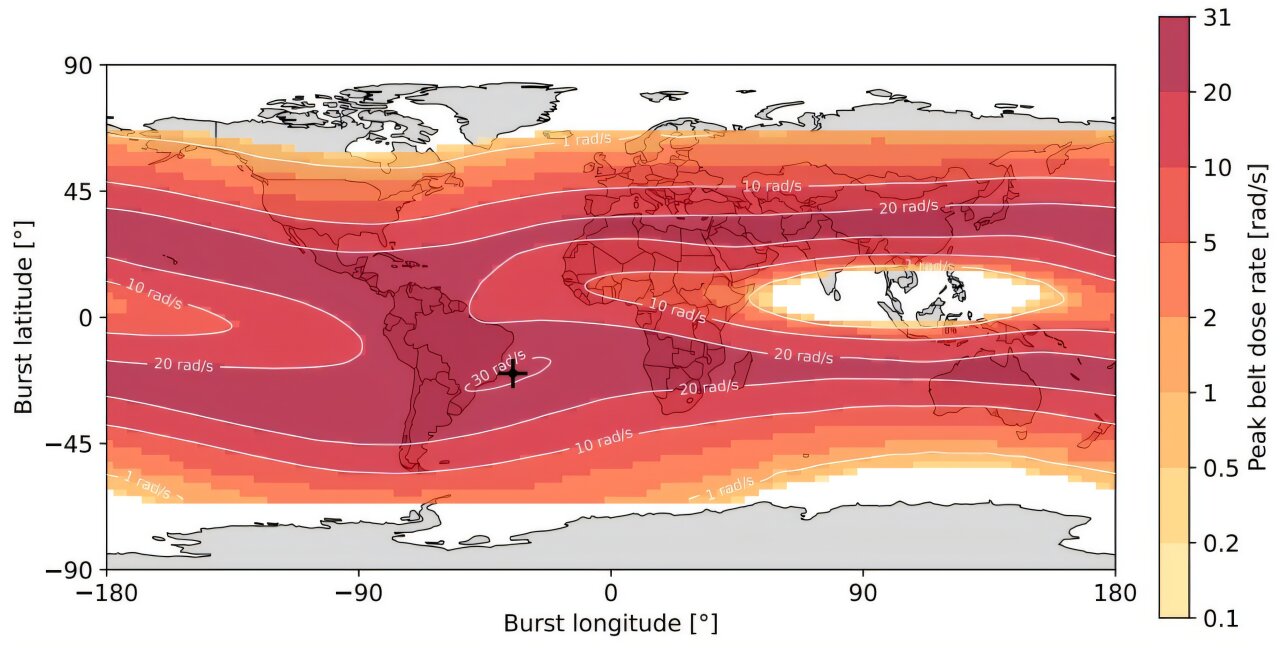
The research team used orbital data for 13,306 satellite payloads active in January 2026. Their main simulation examined a one-megaton detonation at an altitude of 500 kilometers, at 20 degrees south and 35 degrees west, near the South Atlantic Anomaly.
The location matters because Earth’s magnetic field is unusually weak in this region. The researchers found that the position of a detonation affects how radioactive electrons spread through the magnetic field and whether they remain trapped. At some locations, electrons can escape into the atmosphere. At others, they can form radiation belts that overlap heavily populated satellite orbits.
The central scenario assumed that nuclear fission accounted for 50% of the weapon’s explosive yield. The researchers also modeled radiation exposure behind two millimeters of aluminum, representing an assumed level of spacecraft shielding.

To estimate satellite failures, they used two radiation-tolerance thresholds: 40 and 120 krad(Si). These values were derived from assumed civilian and military satellite radiation tolerances, using a modeled fleet composition of 90% civilian and 10% military spacecraft. The researchers applied each threshold uniformly across the satellite population, an important simplification of the model.
How Quickly Could Satellites Fail?
In the central simulation, the initial X-ray burst disabled approximately 2.9% of the modeled satellites. The larger losses occurred afterward, as spacecraft accumulated radiation exposure from the artificial belt.
Using the lower radiation-tolerance threshold of 40 krad(Si), the model produced the following results:
- Immediately after the detonation: approximately 2.9% of satellites were disabled.
- After one day: approximately 25% had failed.
- After three days: the figure reached 78%.
- After seven days: approximately 98% were disabled.
- After 15 days: the modeled failure rate reached 99.4%.
The researchers also tested the higher tolerance threshold of 120 krad(Si). In this scenario, approximately 72% of the fleet was disabled within seven days and 97% within 15 days. Losses exceeded 99% by day 30.
These thresholds are representative assumptions rather than measurements of every satellite’s actual radiation resistance. The researchers also tested different estimates for the number of electrons released by radioactive debris. Those variations changed how quickly failures accumulated, although the model still projected widespread losses over time under the main 40 krad(Si) scenario.
Disabled Satellites Could Increase Collision Risk
Radiation damage would create another problem. Satellites that lose their ability to maneuver cannot reliably avoid other spacecraft, rocket bodies or debris.
The researchers modeled how this loss of maneuverability could change collision rates across the orbital population. Their central simulation estimated approximately three collisions within 15 days, six within 30 days and 20 within two years.
These figures are expected collision counts across the modeled population, not predictions of specific impacts between identified satellites. The calculation includes encounters involving spacecraft, rocket bodies and debris, with the modeled collision objects characterized by lengths of at least 10 centimeters.
The researchers estimated that approximately 2,400 new fragments at least 10 centimeters in size would remain in low Earth orbit after 15 days. By day 30, the number was projected to reach around 4,400.
The collision risk would not remain constant at every altitude. Atmospheric drag would gradually remove many disabled spacecraft from lower orbits, reducing the number of potential collision targets. Objects at higher altitudes would remain in orbit longer, allowing debris-related risks to persist.
The model estimated approximately 26 collisions over ten years, compared with 12 in a corresponding scenario without a nuclear detonation. Around 75% of the additional collision total in the detonation scenario was expected to occur during the first year.
Why Replacing the Satellites Would Not Be Enough
A damaged satellite can eventually reenter Earth’s atmosphere, but the disappearance of failed spacecraft would not immediately make the affected orbital region safe.
The artificial radiation belt could remain a hazard for newly launched satellites. The researchers note that electrons from the Starfish Prime test persisted for several years, illustrating how long radiation trapped in Earth’s magnetic field can affect spacecraft.
Their simulations suggest that replacing lost satellites would require careful consideration of the remaining radiation and debris environment. New spacecraft launched into affected orbital regions could encounter the same conditions that disabled the previous generation.
The study does not establish a precise date when satellite operations could safely resume. Its replacement-satellite analysis also relies on assumptions about spacecraft functionality and excludes debris smaller than 10 centimeters.
The Limits of the Simulation
The study connects several processes that are often examined separately: the initial radiation burst, electron production, magnetic trapping, satellite failures and subsequent orbital collisions. Its results nevertheless depend on assumptions about radioactive debris, electron trapping, spacecraft shielding and radiation tolerance.
One important uncertainty is how long radioactive debris remains above the atmosphere. This affects how many electrons are released and how much radiation becomes trapped in Earth’s magnetic field. The researchers model several electron-release scenarios to examine how this variable changes the outcome.
The radiation-tolerance thresholds also simplify a diverse satellite population into two representative values. Actual spacecraft differ in their components, shielding and ability to withstand accumulated radiation. Their responses could therefore vary from the uniform thresholds used in the simulation.
The collision model introduces further assumptions about object geometry, fragmentation and atmospheric drag. Its projections describe expected population-level outcomes rather than a precise sequence of future collisions.
Sources:
Zachary Petersen et al., Effects of a Nuclear Detonation in Low Earth Orbit, arXiv (2026). DOI: 10.48550/arxiv.2611.09827