Spanning less than five turbulent years between February 1848 and December 1852, the French Second Republic was one of the briefest yet most consequential experiments in the history of modern democracy. Born on the barricades of Paris in a burst of romantic idealism that abolished slavery, eliminated the political death penalty, and made France the first major nation on Earth to adopt universal male suffrage, the young republic was quickly torn apart by class warfare, rural conservatism, and constitutional deadlock—ultimately handing absolute power through the ballot box to the nephew of Napoleon Bonaparte.
The Banquet Campaign and the February Revolution of 1848
By early 1848, the constitutional monarchy of the seventy four year old “Citizen King” Louis Philippe—who had come to power eighteen years earlier in the July Revolution of 1830—faced a severe crisis of legitimacy. Under Louis Philippe and his conservative prime minister Francois Guizot, the right to vote was restricted strictly to the wealthiest two hundred and forty thousand property owners in a country of thirty five million people. When reformist deputies demanded that the voting franchise be expanded to the middle classes, Guizot famously brushed them off with the arrogant reply: “If you want to vote, get rich through work and savings!”
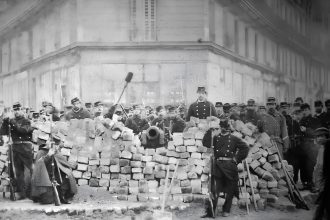
Combined with a severe agricultural crop failure in 1846 and an industrial financial crash in 1847 that threw hundreds of thousands of Parisian artisans out of work, opposition leaders bypassed the government’s ban on political rallies by organizing the “Campagne des Banquets”—seventy large public fundraising dinners across France where guests toasted electoral reform. When Guizot banned a massive final banquet scheduled in Paris for February twenty second, 1848, students and workers poured into the streets. The following evening, February twenty third, after nervous soldiers outside the Foreign Ministry accidentally opened fire on a crowd along the Boulevard des Capucines and killed fifty two demonstrators, citizens piled the corpses onto horse carts and paraded them by torchlight through working class neighborhoods. Within twenty four hours, over one thousand five hundred barricades rose across Paris; on February twenty fourth, Louis Philippe abdicated and fled to England in disguise, while the poet Alphonse de Lamartine stepped onto the balcony of the Hotel de Ville to proclaim the Provisional Government of the French Second Republic.
Utopian Spring: Universal Suffrage, Abolition, and National Workshops
The opening two months of the Second Republic felt like a utopian spring in which every social grievance seemed solvable through fraternity. Guided by moderate republicans like Lamartine alongside the socialist theorist Louis Blanc and an actual factory worker named Albert, the Provisional Government passed sweeping decrees that stunned the monarchies of Europe. On March second and fifth, they enacted universal male suffrage, expanding the French electorate overnight from two hundred and forty thousand rich men to more than nine million citizens regardless of wealth or literacy. On April twenty seventh, guided by the tireless abolitionist Victor Schoelcher, the Republic permanently abolished slavery across all French colonies in the Caribbean and Indian Ocean, freeing a quarter of a million enslaved people immediately.
To address the desperate hunger of unemployed workers in Paris, Louis Blanc pushed for the state to guarantee “the right to work” by creating National Workshops (Ateliers Nationaux). By May 1848, over one hundred thousand unemployed Parisians were enrolled on the state payroll at two francs a day digging earthworks and planting trees. However, when the first national parliamentary elections were held in April 1848 under universal suffrage, radical Paris got a rude awakening: the vast majority of France’s nine million newly enfranchised voters were conservative rural peasant landowners who resented paying higher land taxes (the hated forty five centime tax) to subsidize unemployed workers in Paris. Voters elected a firmly conservative and moderate National Constituent Assembly that viewed the socialist National Workshops as an expensive nursery of revolution.
The Bloody June Days and the Presidential Election of 1848
On June twenty first, 1848, the conservative Assembly abruptly ordered the immediate closure of the National Workshops, telling all unmarried workers under age twenty five to either enlist in the army or be shipped off to drain malaria infested swamps in the provinces. Betrayed by the very Republic they had bled to create four months earlier, the working class quarters of eastern Paris rose up in the “June Days” uprising (June twenty third to twenty sixth, 1848) under the desperate slogan “Bread or Lead!”
Entrusting dictatorial military command to General Louis Eugene Cavaignac, the government used artillery, mobile guards, and provincial reinforcements shipped in by railway to crush the workers’ barricades block by block in four days of savage urban combat. Over four thousand insurgents and one thousand five hundred soldiers perished, and eleven thousand workers were arrested and deported to Algeria. The bloodshed permanently shattered the republican alliance: working class socialists now hated the bourgeois Republic as a murderer of workers, while terrified middle class and rural voters craved a strongman to restore law and order. When the new constitution called for the direct popular election of a President of the Republic for a single, non renewable four year term in December 1848, voters rejected General Cavaignac and Lamartine in a historic landslide—giving seventy four percent of the vote (5.4 million ballots) to a forty year old political outsider carrying the most magical surname in France: Louis Napoleon Bonaparte, the nephew of Emperor Napoleon I.
The Prince-President and the Coup of December 2, 1851
Calling himself the “Prince President,” Louis Napoleon appealed skilfully to every faction: to peasants he promised low taxes and Napoleonic glory; to Catholics he dispatched French troops to Rome to restore Pope Pius IX and passed the Falloux Law restoring Church influence in schools; and when the conservative monarchist parliament foolishly passed a law in May 1850 stripping three million poor transient workers of their right to vote, Louis Napoleon shrewdly positioned himself as the populist champion of universal suffrage against the elitist parliament.
Barred by the constitution from running for a second presidential term in 1852 and blocked by royalist deputies from amending the constitution legally, Louis Napoleon struck on the symbolically charged date of December second, 1851—the exact anniversary of both his uncle’s coronation in 1804 and the victory at Austerlitz in 1805. In a meticulously executed overnight military coup d’etat codenamed Operation Rubicon, troops occupied the printing presses and parliament chamber, arrested opposition leaders before dawn, restored universal male suffrage by decree, and crushed republican resistance in Paris and the southern provinces. Confirmed by overwhelming national plebiscites, Louis Napoleon dissolved the Second Republic exactly one year later on December second, 1852, ascending the throne as Emperor Napoleon III of the Second French Empire.