When modern travelers think of ancient Egypt, they naturally picture ancient pharaohs like Tutankhamun and Ramesses II building temples along the Nile, yet the most famous ruler in Egyptian history, Queen Cleopatra VII, was not ethnically Egyptian at all. By birth, language, and royal bloodline, Cleopatra was a Macedonian Greek princess whose ancestors had arrived in the Nile Delta three centuries earlier in the army of Alexander the Great. Spanning nearly three hundred years from 332 BC to 30 BC, the Ptolemaic Period transformed Egypt into a vibrant Hellenistic superpower where Greek philosophy, language, and urban planning merged with three millennia of pharaonic religion.
Alexander the Great’s Liberation and the Oracle of Siwa
By the mid fourth century BC, ancient Egypt had endured generations of humiliating foreign occupation under the Persian Achaemenid Empire, whose kings had looted Egyptian temples and disrespected sacred animal cults. Consequently, when the twenty four year old Macedonian king Alexander the Great marched his army south into Egypt in the autumn of 332 BC after defeating the Persians at Issus, the Egyptian priesthood and populace did not resist him as an invader; they welcomed him with open arms as a liberator.
Demonstrating astute cultural respect, Alexander traveled immediately to the ancient capital of Memphis, where he offered sacrifices to the sacred Apis bull and was crowned with the traditional double crown of Upper and Lower Egypt. In early 331 BC, walking along the Mediterranean coast west of the Nile Delta, Alexander personally sketched the street grid in barley meal for a new port city that would bear his name: Alexandria. Before marching east to conquer Babylon and Persia, Alexander trekked hundreds of miles across the scorching Libyan Desert to the isolated Oasis of Siwa, where the chief priest of the oracle of Amun—whom the Greeks equated with Zeus—greeted the young king as the literal living son of the god, cementing his divine legitimacy in the eyes of every Egyptian subject.
Ptolemy I Soter and the Theft of Alexander’s Body
When Alexander the Great died suddenly of a fever in Babylon in June 323 BC at the age of thirty two without leaving a viable adult heir, his vast empire fractured among his most ambitious Macedonian generals, known to history as the Diadochi, or Successors. Among the shrewdest of these generals was Ptolemy, son of Lagus, one of Alexander’s childhood friends and trusted bodyguards. While rival generals fought suicidal wars trying to control the entirety of Alexander’s empire from Greece to India, Ptolemy immediately claimed the governorship of Egypt—a wealthy, grain rich fortress protected by deserts on both flanks and the sea to the north.

In 321 BC, Ptolemy pulled off the greatest geopolitical heist of antiquity. As the magnificent golden funeral cortege carrying Alexander the Great’s embalmed body in a temple wagon began rolling slowly from Babylon toward Macedon, Ptolemy marched an army into Syria, intercepted the procession, and hijacked the corpse. Bringing Alexander’s body first to Memphis and later entombing it inside a splendid mausoleum called the Soma at the heart of Alexandria, Ptolemy acquired the ultimate talisman of Hellenistic legitimacy. In 305 BC, Ptolemy formally assumed the title of Basileus (King) and Pharaoh, founding the Ptolemaic Dynasty as Ptolemy I Soter (the Savior), a royal line in which every subsequent male monarch was named Ptolemy and every queen was named Cleopatra, Arsinoe, or Berenice.
Alexandria: The Intellectual Capital of the Greek World
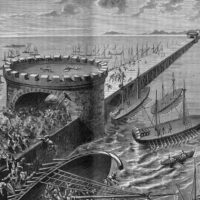
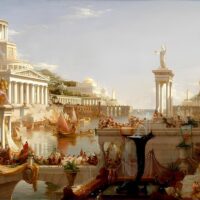
Under Ptolemy I and his son Ptolemy II Philadelphus, Egypt did not merely adopt Greek culture; it became the undisputed intellectual and scientific capital of the entire Greek speaking Mediterranean. Designed as a gleaming white marble metropolis separated administratively from the rest of Egypt, Alexandria was anchored by two wonders of the ancient world: the Pharos Lighthouse, rising nearly four hundred feet above the harbor entrance to guide maritime trade, and the Mouseion, the royal research institute housing the Great Library of Alexandria.
Funded generously by taxes collected from the fertile Nile harvest, the Ptolemies invited the brightest Greek minds from Athens, Syracuse, and Asia Minor to live tax free in Alexandria while receiving royal salaries. Within these halls, Euclid wrote the Elements of Geometry, Eratosthenes calculated the circumference of the Earth to within a few percent by measuring shadows between Alexandria and Aswan, Archimedes invented his water screw, Herophilus performed the first systematic dissections of the human nervous and cardiovascular systems, and Jewish scholars translated the Hebrew Torah into Koine Greek to create the Septuagint.
Greek Administration and the Creation of the God Serapis
To govern a country where a few hundred thousand Greek and Macedonian settlers ruled over roughly seven million native Egyptians, the Ptolemies instituted a dual system of administration. Koine Greek replaced Demotic Egyptian as the exclusive language of the royal court, taxation, banking, and high military command. Tens of thousands of veteran Macedonian and Greek soldiers, known as cleruchs, were granted lifelong plots of fertile farmland in the newly drained Fayyum Oasis in exchange for military service, planting Greek gymnasiums, theaters, and bathhouses deep in the Egyptian countryside.

At the same time, the Ptolemies realized they could never hold the country without the support of the wealthy native Egyptian priesthood. Outside of Greek Alexandria, the Ptolemies funded massive reconstructions of traditional Egyptian temples at Edfu, Kom Ombo, Philae, and Dendera, allowing temple sculptors to carve the Macedonian kings wearing traditional pharaonic kilts and crowns offering incense to Isis and Horus. To unite their Greek and Egyptian subjects under a shared state deity, Ptolemy I even introduced a brand new syncretic god named Serapis, combining the theological soul of the Egyptian underworld and bull deity Osiris Apis with the bearded, humanized artistic appearance of Greek gods like Zeus, Hades, and Asclepius.
Dynastic Marriage and Cleopatra’s Linguistic Breakthrough
To keep royal power strictly within the family and mirror the sacred mythological marriage of the Egyptian sibling gods Osiris and Isis—while shocking traditional Greek morality—the Ptolemies adopted the practice of brother sister royal marriage, beginning when Ptolemy II married his full sister Arsinoe II. For nearly three centuries, the rulers of this Macedonian dynasty lived inside the seaside palaces of Alexandria speaking exclusively Greek, viewing the Nile hinterland primarily as an estate to be taxed.
Remarkably, as the Greek biographer Plutarch recorded, not a single Ptolemaic king or queen bothered to learn the native Egyptian language until the very last ruler of the dynasty: Cleopatra VII, who ascended the throne in 51 BC. Fluent in Egyptian alongside Greek, Ethiopian, Troglodyte, Hebrew, Arabic, Syriac, Median, and Parthian, Cleopatra embraced her dual identity as both an educated Hellenistic monarch and the living reincarnation of the goddess Isis, presiding over the final brilliant twilight of Greek Egypt before its annexation by Rome in 30 BC.