While the world celebrates July fourteenth, 1789—the storming of the Bastille—as France’s national holiday, historians of the French Revolution recognize that the Bastille merely limited the King’s power to create a constitutional monarchy. The true second revolution—the bloody, decisive day that physically overthrew the thousand-year-old French monarchy, drove King Louis XVI and Queen Marie Antoinette from their throne, and gave birth to the First French Republic alongside the dark seeds of the Reign of Terror—occurred three years later on the scorching summer morning of August tenth, 1792, when twenty thousand armed Parisian citizens and provincial militias stormed the royal Tuileries Palace.
War Panic and the Infamous Brunswick Manifesto
By the summer of 1792, the experiment of the constitutional monarchy established after 1789 had completely broken down in mutual distrust. A year earlier, in June 1791, King Louis XVI and Marie Antoinette had attempted to flee Paris in disguise toward the Austrian border at Varennes, convincing ordinary Parisians that the King was secretly colluding with foreign monarchies to invade France and crush the Revolution. When revolutionary France went to war against Austria and Prussia in the spring of 1792 and French armies suffered humiliating early defeats along the northern border, Louis XVI used his constitutional veto power to block emergency laws raising twenty thousand patriotic provincial guardsmen (the federes) and deporting rebellious priests.
The final fuse that ignited the insurrection was lit by France’s enemies on July twenty-fifth, 1792, when Charles William Ferdinand, the Duke of Brunswick—commander of the invading Prussian and Austrian army—issued a proclamation known as the Brunswick Manifesto. Drafted with the encouragement of Marie Antoinette’s secret contacts abroad and intended to intimidate Paris into protecting the royal family, the manifesto threatened that if the Tuileries Palace were attacked or the slightest insult offered to King Louis XVI and his family, the allied armies would subject the city of Paris to “an exemplary and forever memorable vengeance” by burning the capital to the ground and executing its rebels. Instead of frightening Parisians into submission, the threat produced volcanic fury across the working-class neighborhoods (the forty-eight sections) of Paris, who viewed the manifesto as final proof that Louis XVI was a traitor directing an enemy army toward their homes.
Midnight Bells, the Insurrectionary Commune, and the March on the Tuileries
At midnight between August ninth and August tenth, 1792, the great tocsin bells in church steeples across Paris began clanging the alarm. Led by radical leaders including Georges Danton, Camille Desmoulins, and Santerre, delegates from the forty-eight Parisian neighborhood sections marched into the Hotel de Ville (City Hall), ousted the legal municipal government, and proclaimed the revolutionary “Insurrectionary Commune.” To ensure the city’s National Guard would not defend the palace, the Commune summoned the commander of the National Guard, the royalist Marquis de Mandat, to City Hall, stripped him of his command, and shot him dead on the steps—removing the brain of the palace’s defense.
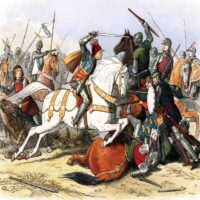
As dawn broke on August tenth, columns of twenty thousand armed insurgents converged on the Tuileries Palace from both sides of the Seine. Marching at their head were the fierce working-class militants known as the sans-culottes—armed with pikes, muskets, and neighborhood cannons—alongside thousands of provincial federes from Brest and Marseille, who marched into battle singing a brand-new revolutionary war anthem by Claude Joseph Rouget de Lisle that Paris quickly named “La Marseillaise.” Inside the Tuileries courtyard, the defense had largely collapsed: the Parisian National Guard artillerymen defected on the spot and turned their cannon muzzles toward the palace, leaving only nine hundred professional, red-coated mercenary soldiers of the King’s loyal Swiss Guard and roughly two hundred lightly armed royalist noblemen (“Chevaliers of the Dagger”) to hold the building.
The King’s Flight and the Slaughter of the Swiss Guard
Around eight o’clock in the morning, before a single shot had been fired, the procurator Pierre Louis Roederer convinced a hesitant King Louis XVI that staying inside the Tuileries meant certain death for his wife and children. Escorted through the palace gardens by a detachment of Swiss Guards while fallen autumn-dry chestnut leaves crunched beneath their shoes, Louis XVI, Marie Antoinette, their young son and daughter, and the King’s sister walked across the street into the hall of the Legislative Assembly (the Salle du Manege) to ask the deputies for parliamentary protection—effectively surrendering royal initiative forever.
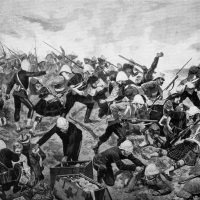
Back at the palace, left without clear orders after the King walked away, the nine hundred Swiss Guards stood in disciplined silence along the grand marble staircase as thousands of insurgents crowded into the courtyard calling for them to surrender their weapons. Suddenly, a shot rang out, and a ferocious battle erupted. Firing disciplined, rolling musket volleys from the palace windows and charging down the stairs with fixed bayonets, the outnumbered Swiss Guards actually drove the insurgents completely out of the courtyard and captured their cannons. Hearing the thunder of gunfire from the nearby Assembly hall, the horrified Louis XVI scribbled a fatal written order on a slip of paper commanding his loyal Swiss soldiers to cease fire immediately and retire to their barracks. Obeying their King in the middle of a pitched firefight, the retreating Swiss columns were overwhelmed by cannon blasts and surging crowds of pikes. Over six hundred Swiss Guards and roughly four hundred Parisian insurgents and federes perished in the courtyard, corridors, and gardens of the Tuileries as the crowd stormed and ransacked the palace—a sacrifice later commemorated in Lucerne, Switzerland, by the famous dying stone sculpture, the Lion Monument.
The Fall of the Monarchy and the Birth of the Republic
Huddled inside a tiny, stifling ten-foot-by-ten-foot stenographer’s box behind the speaker’s rostrum in the Legislative Assembly for sixteen hours while sweaty, blood-stained insurgents marched into the hall dumping looted palace silver on the floor and demanding the King’s head, Louis XVI watched his dynasty end. Intimidated by the victorious Insurrectionary Commune outside, the fewer than three hundred remaining deputies voted unanimously to “suspend” the King from all royal functions, dismiss his ministers, appointing Georges Danton as Minister of Justice, and call for the immediate election—by universal male suffrage for the first time in French history—of a new National Convention to write a republican constitution.
Three days later, on August thirteenth, 1792, Louis XVI and his family were driven in a carriage not back to a palace, but to the medieval fortress prison of the Square Temple Tower. Six weeks later, on September twenty-first, 1792—the day after the French revolutionary army halted the Prussians at the Battle of Valmy—the newly elected National Convention met for its opening session and officially abolished the French monarchy, proclaiming Year One of the First French Republic and setting King Louis XVI on the direct path to the guillotine five months later.