How does a double rainbow form? The concepts of coexistence, completeness, and also the protection of the natural world are represented by the rainbow’s spectrum of colors. Even though it has been known for a long time how this characteristic sequence of colors comes about, the arch of light has not lost any of its symbolic force for us, nor has it lost its ability to fascinate us. When a double rainbow forms in the sky, it is a remarkably beautiful sight to see. But how does this multiplication even take place?
Formation of a single rainbow

Everybody seems to have a soft spot for rainbows, one of the many enchanting natural phenomena. They mostly appear after a rain, thanks to the sunlight that is reflected off the raindrops. The raindrop absorbs most of the visible spectrum of light, reflecting just a fraction of it. The spherical nature of the raindrop concentrates these reflections at a direction away from the Sun that is 138 degrees. This powerful beam of light will then show a rainbow thereafter.
We have to be looking at raindrops at an angle of 138 degrees from the direction of the sun, or 42 degrees from the antisolar point, in order to see the arc of a natural rainbow.
Light undergoes refraction, or bending, as it travels through air and then into water. All the colors of the sunlight seem a little different after passing through water drops.
Dispersion is the process that causes the colors of a rainbow to shift apart from one another. When passing through the droplets, the different colors of sunlight are bent in slightly different ways. Due to the light’s spectral breakdown, we are able to make out the standard color spectrum. Since blue light has a shorter wavelength and is refracted more strongly in the water droplets, the blue band is the first color in the order of the rainbow, while the red band is the most outside one, followed by the yellow, green and blue stripes.
The reason for the 42 degrees
Raindrops’ ability to bend and reflect light from the sun results in the formation of a simple rainbow. There is no “gold treasure” concealed at the end of the rainbow but the direction in which a rainbow can be seen can still be calculated with a high degree of accuracy. All rainbows will always appear at an angular distance of 42 degrees around the point that is directly opposite the sun.
Why does the angle of formation of the rainbow consistently measure out to 42 degrees all the time? When light rays enter a drop of water, the boundary layer that separates the water from the air causes them to be reflected at an angle relative to the direction from which they entered the drop.
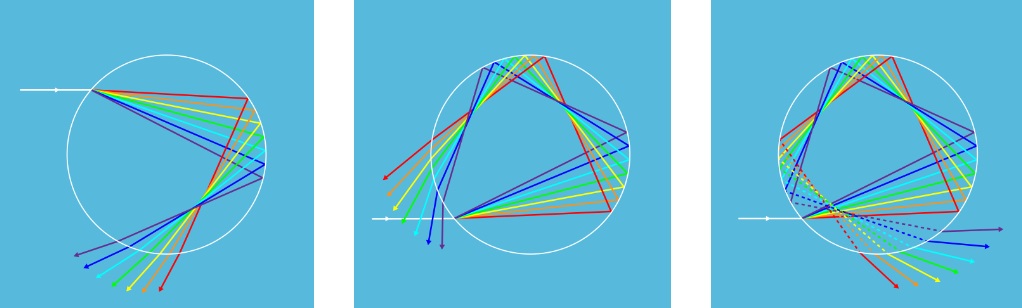
However, because of the laws of physics for the shape of the objects, a reflection that is more than 42 degrees is not conceivable. All of the light rays that ought to be reflected farther than 42 degrees are instead concentrated at this boundary value.

It is not feasible to see a rainbow at noon because the point opposing the sun that is required to create a rainbow is located below the horizon when the sun is high in the sky. When the sun is high in the sky, the rainbow is more horizontal, but when the sun is low in the sky, it is arced in a way that is proportional to its position.
Formation of a double rainbow
In many cases, in addition to the primary arc, we can also see a paler secondary arc farther out in the distance. This secondary rainbow arc is virtually a mirror image of the primary arc due to the fact that its color sequence is the exact opposite of the primary arc. The light from the secondary rainbow arc, much as the light from the “regular” rainbow, is refracted into raindrops.
But, when the light beam enters the droplet at a certain angle of incidence, a portion of it is reflected not once, but twice at the boundary layer within the droplet. In this scenario, the maximum permissible value for the angle of the second arc is 51 degrees, instead of 42. In other words, the second rainbow arc always forms at 51 degrees.
The number of light rays that have been twice reflected is smaller than the number of light rays that have been single-reflected, which is why the secondary rainbow arc always looks far weaker.
Bibliography
- Rainbows, St-Andrews.ac.uk
- “Rainbows, Halos and Glories”, Robert Greenler, Cambridge University Press, 1980.
- American Mathematical Society. The Mathematics of Rainbows.
- Gary Waldman, 1983. Introduction to Light: The Physics of Light, Vision, and Color.