Who is James Watt? One afternoon in May 1765, Scottish engineer James Watt made an invention that would change the world. It was a clever craft that would make steam machines more useful and powerful. Thanks to Watt’s invention, steam became the driving force of the Industrial Revolution.
Who is James Watt?
In 1712, British engineer Thomas Newcomen (1663-1729) created the first steam engine. This gadget was used to draw water from the mines. At the time of Watt’s birth, there were about 100 Newcomen machines in use in England, and it was also used in other nations.
Newcomen’s innovation was based on the notion of pushing a piston in a huge, vertical cylinder using air pressure. This was only possible if the vacuum was formed inside the cylinder, at the bottom of the piston. By condensing the steam in the cylinder back into the water, Newcomen achieved the requisite vacuum. This amounted to just a tiny portion of the total volume of steam. The cylinder was filled with steam through a series of valves, then sprayed with cold water to condense the steam. With each landing of the piston, the cylinder cooled. However, the steam waiting for the next landing reheated it once again. This contradiction significantly impacted the machine’s efficiency. This is the case that James Watt was interested in on that fateful day in 1765.
James Watt was born in Greenock, Scotland, on the banks of the Clyde River, west of Glasgow. His father was a shipbuilder. Thanks to his father’s toolbox, Watt had been a skilled craftsman since his childhood. After working in London, and Glasgow for a year, he learned to make mathematical tools such as theodolite and compass. His dream was to open his own business. After repairing a broken instrument of a professor at the University of Glasgow, James Watt earned a room at the university to use as a workshop. The future scientist began to earn money by making and selling mathematical and musical instruments.

James Watt and his inventions
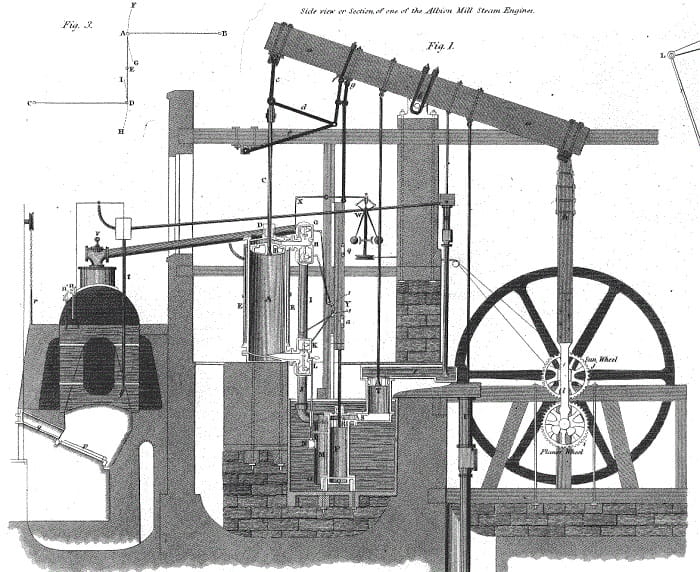
In 1763, James Watt began experimenting with a model of the Newcomen machine. He realized that the Newcomen’s invention was using a lot of fuel, steam, and heat. The new design that Watt developed in 1765 was based on the “independent cooler.” According to his idea, the steam was condensed in a reservoir separate from, but adjacent to, the cylinder. The chamber was kept at a low temperature so that the cylinder could remain at the boiling point. Watt received a patent for his invention in 1769. Entrepreneurial engineer Matthew Boulton (1728-1809) collaborated with Watt in 1775. This union, which ended with James Watt’s withdrawal from business in 1800, led to a complete revolution in the use of steam engines in the industry.
Until 1872, steam engines were used only to drain water accumulated in mines. In the same year, Boulton asked James Watt to develop a new method for steam engines that allowed rotary motion instead of linear motion. Watt delivered, and as a result, the new rotary steam machines suddenly achieved great success. Soon, Watt’s machines began operating in textile mills, foundries, mills, breweries, and papermaking plants.
Watt as a unit of power
Watt produced several significant advances that improved the usage of steam power. His designs were all backed by ingenious automated valve systems. In 1782, a “double-acting” machine was constructed, in which steam was supplied into the cylinder alternately from above and below the piston. James Watt also invented a steam pressure measurement apparatus and a technique for calculating a steam engine’s efficiency. In 1788, he devised the “regulator,” a mechanism that automatically controlled the speed of the machine.
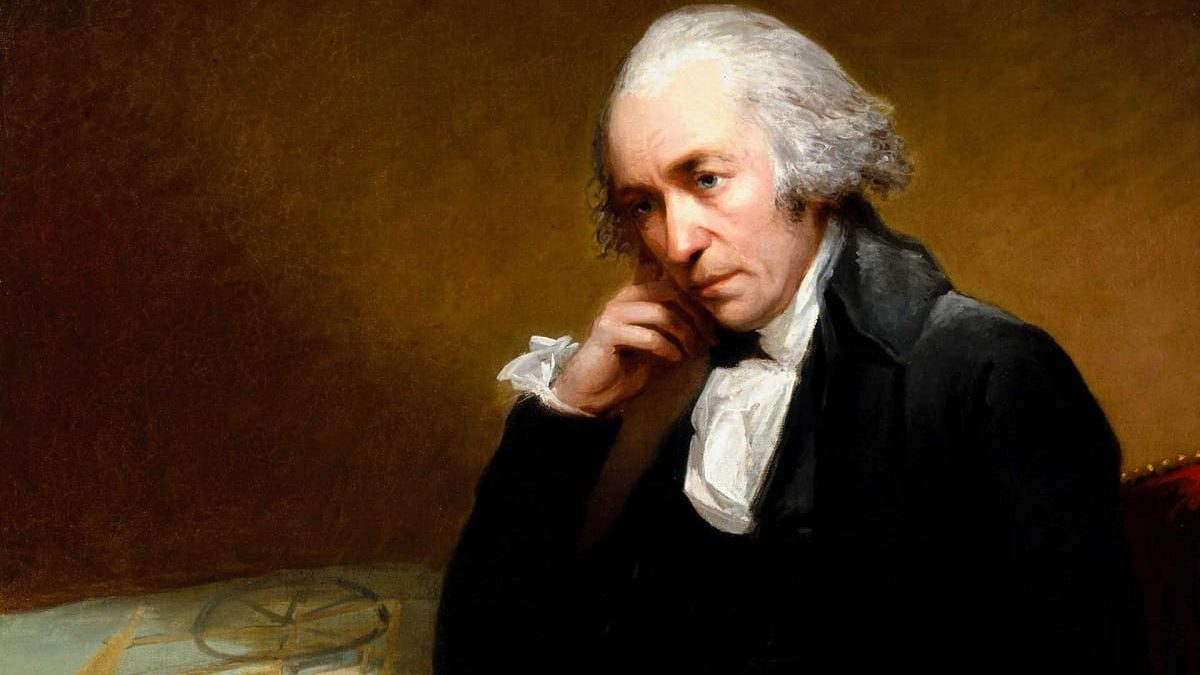
James Watt also worked on canal projects as a civil engineer. His one invention was a widely used device for making copies of letters. But the steam was the main focus of his life. Due to his incredible contributions in the field of engineering and technology, the “watt” is the unit of power all over the world for the measurement of energy.
Lunar Society
James Watt was a member of a very significant organization known as the Lunar Society. This group consisted of scientists, engineers, industrialists, philosophers, doctors, painters, and poets.
The members of the association were typical examples of intellectuals who believed in the spirit of the Age of Enlightenment, where technology, science, and rationale began to shape society. Regular meetings were held at Matthew Boulton’s house, who was also a member of the association. Outside the meetings, the members were constantly in correspondence.
The Lunar Society was a very important organization on the way to turning the peasant, farmer society of England into an industrial society. It was described as the revolutionary committee of the Industrial Revolution. The name of the association came from the weekly gathering on Mondays just before the full moon. The moonlight made it easier for members to return home in the dark.