Astronomers may have uncovered evidence of the earliest stars in the cosmos in the second oldest quasar yet found. Their traces manifest themselves in a strange excess of iron in the quasar spectrum, which cannot be explained by standard definitions. A first-generation Population III star with a mass of roughly 300 solar masses may have been the source of this chemical signature when it exploded as an unusual “pair-instability supernova.”
About a few hundred million years after the Big Bang, the first stars in our universe began to form. In addition to ushering at the end of the so-called “dark ages,” the heavier elements in the periodic table were produced by Population III stars. After a few million years, the massive stars weighing hundreds to thousands of solar masses burst into a supernova as they die, spreading their heavy elements across the galaxy and enriching nearby stellar birthplaces.
Short-lived, highly massive big stars were the first kind of stars to form in the universe. Astronomers may have uncovered evidence of elemental traces from the explosion of one of these Population III stars.
Using the light of the ancient quasar as a torch
With the help of the earliest known quasar, ULAS J1342+0928, scientists may have finally picked up the spectral signature of this primordial star debris. This quasar contains the second-most distant and oldest known supermassive black hole. The redshift of z=7.45 for this active supermassive black hole indicates that the quasar formed when the universe was 690 million years old. Researchers led by Yuzuru Yoshii of the University of Tokyo used the Gemini North Telescope in Hawaii and its near-infrared spectrograph to examine the quasar’s radiation and learn more about it and its neighborhoods.
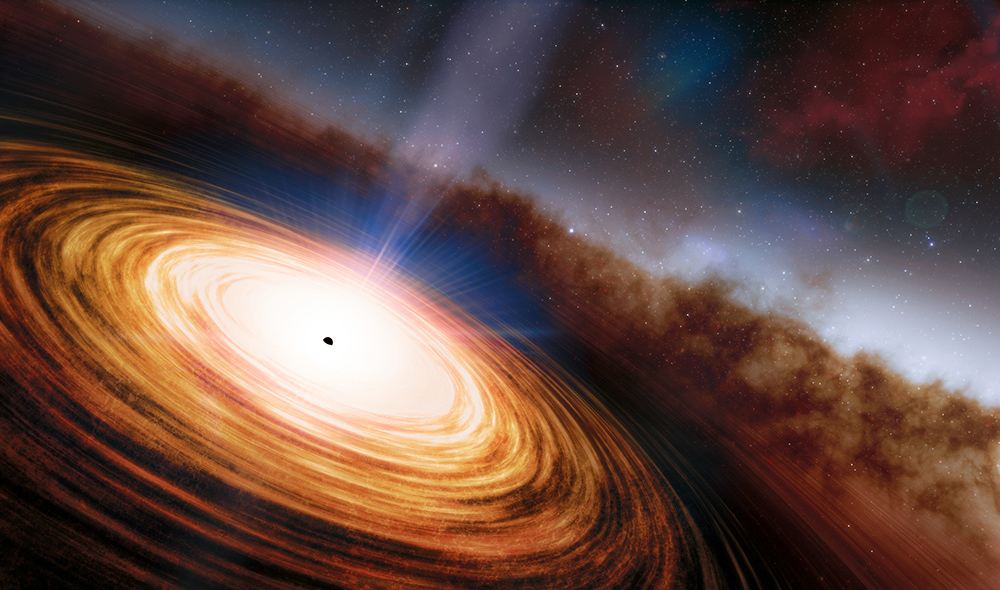
They reason that because a black hole’s gravity pulls in gas from its surroundings, the quasar’s light spectrum should mirror its chemical make up, and therefore the elemental signature of the primordial stellar remains. This is the first time a comprehensive near-infrared spectrum of the most distant quasar has been produced, according to the researchers.
Abnormally high iron content
This ancient quasar’s light included spectral traces of iron that were very strong for an object from the early cosmos. Iron is heavy, thus it was relatively uncommon in the early universe. Yoshii and coworkers found that the quasar’s spectrum is 20 times more iron-enriched compared to its solar circumstances. This is quite rare for a period of only 700 million years after the Big Bang.
But from where did all this iron come? This massive element must have been created in the cores of first-generation stars by nuclear fusion and then ejected during their supernova explosions since this is the only plausible explanation. The team’s modeling shows that frequent stellar explosions, such as core-collapse supernovas of huge stars or type 1a supernovas in binary systems, cannot discharge such vast quantities of iron. Thus, it’s concluded that such an extraordinary enrichment cannot be described by the standard model of chemical evolution, which takes into account just the effects of the typical supernova.
Supernova remnant caused by a pair-instability
The remarkable iron enrichment thus probably originated from a distinct kind of star explosion. According to Yoshii and coworkers, the most promising possibility for this is a pair-instability supernova. No remnants of the star, such as a black hole or neutron star, remain after this particular supernova. It has never been seen but is thought to happen only in stars with a mass greater than 150 Suns.
The researchers next used astrophysical models to examine the element fingerprints that would be left behind in various star varieties after a supernova caused by a pair-instability. A pair-instability supernova of a first-generation star is the best explanation for the high iron content detected in the quasar. The researchers infer that the magnesium-iron ratio in the quasar ULAS J1342 was created by the pair-instability supernova of a Population III star of 280 solar masses.
Birth and death of stars in the early universe
If this is verified, astronomers will have uncovered the chemical signature of the earliest stars in the cosmos. Their hypothesis requires one of these massive stars to have originated at the core of a protogalactic cloud of gas. Exploded after roughly two million years, it released the heavy components it had created into the surrounding thick gas.
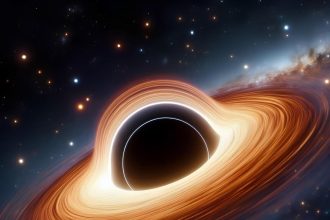
Meanwhile, this protogalaxy’s core black hole became active and started to attract and swallow some of these gases. Radiant, hot plasma began to create a ring around the event horizon, and it continued to expand. The black hole evolved into a quasar over time, emitting so much energy that it can be seen from billions of light-years distant. The signature of the Population III star has stayed in this radiation since it originates in part from the remnants of the very earliest stars circling the black hole, and this radiation has now been seen.
However, the integrity of this theory requires more examination. They suggest measuring the silicon-to-iron ratio in the quasar’s spectrum as another means of doing so. This is because it may provide light on whether or not the supernova was caused by a pair-instability or a more typical core collapse.