- Large wolf with unique features, robust build, wide feet.
- Theories suggest survival of amphicyonids or unique local wolf species.
- Reported sightings in Nahanni Valley, Alaska, and Michigan.
The Canadian Northwest Territories and the Nahanni Valley are purported hotspots for sightings of the wolf-like cryptid known as the Waheela. There have been reports of sightings in both Alaska and Michigan. Even though the extinct Canis dirus (Dire wolf) does not fit the description of the Waheela, cryptozoologist and writer Ivan T. Sanderson thought in the 1970s that the Waheela may represent a remnant population of amphicyonids, ancient bear-dogs from the Pleistocene. Since no physical evidence of the Waheela survives, the presence of this mysterious wolf-like animal cannot be demonstrated by science.
The Waheela is a murderous ghost-like animal described in Native American mythology.
What Does Waheela Look Like?
The reality of the Waheela, a big wolf said to inhabit the tundra of northern Canada and Alaska, has not been established. The Waheela is said to resemble a huge wolf in appearance. Its feet are unusually large, and it is reported to be larger and more robustly constructed than a wolf.
It’s been stated that its forelegs are noticeably longer than the back ones. This type of leg disproportion is common in mythical figures such as Dahu goats, or Nasnas, Ciguapa, and Fachan humanoids.
Its feet are notably wider apart than those of a typical wolf, producing footprints that are fashioned like a wolf’s but far larger in size. It has a robust tail and relatively small ears in contrast to its enormous, wide head. The animal allegedly stood as tall as 4 feet at the shoulder.
The snowy tundra regions of Michigan’s far north, Alaska, and Canada’s Northwest Territories are said to be home to this creature.
Scotland-born cryptozoologist T. Sanderson claimed that a hunter friend of his fired two shots at such a monster in the 1940s or 1950s while tracking in Canada’s Nahanni Valley. The thickness of its fur, however, rendered his bullets ineffective, and the animal just retreated. Waheelas have also been blamed for the finding of decapitated prospectors throughout the years in the same area.
Theories on Waheela’s Origin
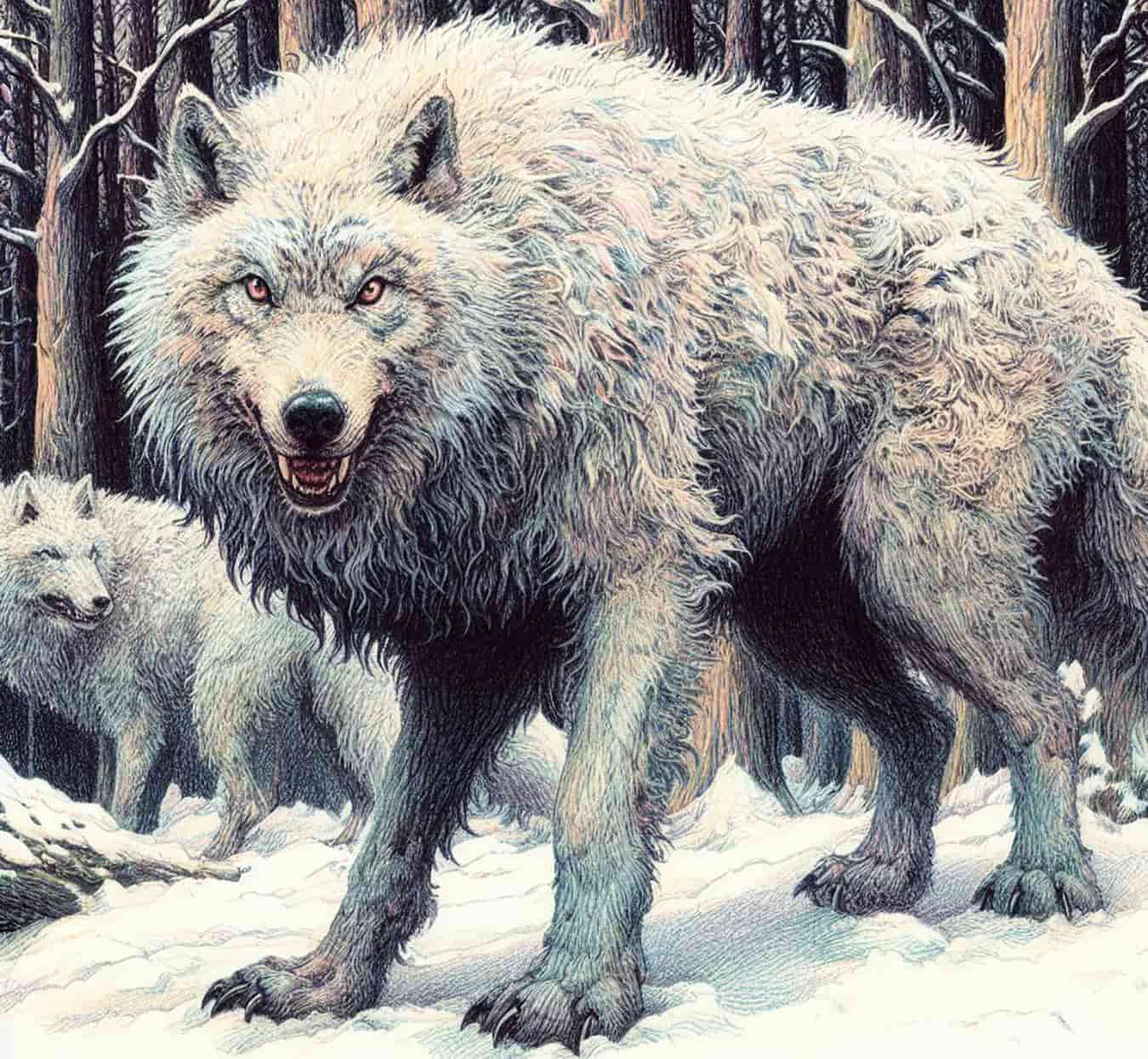
Sanderson made a bold guess, suggesting it might be a living amphicyonid (“bear-dogs“). These powerful predators, different from dogs and bears, vanished around 5 million years ago in the Late Miocene. He thought a group of them survived in the harsh Arctic of northern North America, rarely seen by people and hunters.
Another theory suggests Waheela might be an extinct local wolf type from Alaska, similar to modern wolves but with unique features described in Waheela accounts.
Waheela also might have suffered from a condition called “gigantism.”
The name “Waheela” comes from an old report that was uncovered by the American cryptozoologist Loren Coleman, who learned that three trappers in colonial-era Michigan claimed to have seen a ghostly, white wolf of enormous size near a lake. As both are characterized as enormous white wolves, the name is sometimes mistaken for the Great White Wolf of Canada’s Nahanni Valley.

Specimens of the suborder of ancient bear-dogs and the extinct relative of modern Pleistocene wolves, Canis dirus, have been linked to this legendary narrative. An extinct kind of hyena or a new type of canine are among other candidates.
Other Cryptids Similar to Waheela
According to urban legend, the Waheela has all-white fur and can survive in subzero conditions. Although it resembles the Shunka Warakin, another large cryptid caniform, the Waheela lives considerably further north.
Greenland sightings of this animal have also been linked to the Amarok, a mythical enormous wolf from Inuit folklore. This gigantic wolf is certainly an analogue of this beast.
However, a lot of people also think it resembles the Ringdocus, a nearly monstrous canid with blackish hair that a taxidermist shot in Montana in 1886 and later stuffed.
However, there are also many who believe it is similar to the Ringdocus, an almost-monstrous canid with blackish hair that was shot in Montana in 1886 and later stuffed by a taxidermist.
References to Waheela
- “Ista” is a therianthropic waheela and a close friend and ally of Verity Price, the heroine of the American writer Seanan McGuire’s novel series called InCryptid.
- Waheela is a character in Barrack Muluka’s 1997 novel When Ogres Lived.
- The Secret Saturdays is an animated animation that features the Waheela. The same show also features the giant Amarok wolf.