In Greek mythology, Iasion (in Ancient Greek Ἰασίων / Iasíôn, meaning “the sower” or “the bindweed”) or Iasos (in Ancient Greek Ἴασος / Íasos) is a character associated with the agricultural cults of Demeter. When he died, Iasion was placed in the stars, forming with Triptolemus the constellation Gemini, although the most widespread version says that it was formed by the brothers Castor and Pollux.
| Iasion | |
|---|---|
| Greek: Ιασίων | |
| Gender | Male |
| Father | Zeus |
| Mother | Electra |
| Children | Plutus, Corybantes, Philomelus, and Atalanta |
Myth
Iasion is the son of Zeus and the Pleiad Electra, and the brother of Dardanus (ancestor of the royal lineage of Troy) linked to the cult of the mysteries of Samothrace, where he is honored under the name “Eetion.” He is sometimes associated (along with Triptolemus, another hero involved in agricultural myths) with the constellation Gemini.
Iasion is best known for being the lover of the goddess Demeter. In the version recounted by Homer and Hesiod, they unite in Crete in a field plowed three times. From this union is born Ploutos, a deity personifying wealth. In Homer’s account, however, Iasion is struck down by Zeus, who seeks to punish the hubris that led him to unite with a goddess. While Hesiod does not mention this, the striking down is also reported by Pseudo-Apollodorus with a slightly different motif, as in his version Iasion attempts to violate Demeter.
Hyginus relates a Cretan legend where Jason and Demeter have a son named Philomelos, with Ploutos being said in this version to be the son of Demeter and Thuscus.

Furthermore, a more complete late tradition reported by Diodorus Siculus diverges quite notably from the archaic tradition. In Diodorus Siculus, Iasion and Dardanus have a sister named Harmonia. Zeus, wishing to honor his son, teaches him the sacred mysteries, which Iasion extends and is the first to admit strangers to. He then marries Cybele, with whom he has a son, Corybas. The union with Demeter is only reported by Diodorus as allegorical:
“The true meaning is that the wheat [of Demeter], given to Iasion at the wedding of Harmonia, is the source of the riches represented by [Ploutos].”
Samothracian Mysteries
In Hesiod’s writings, his name is written as Eetion, but elsewhere he is referred to as Iasion. Myths about him connect him with Samothrace or Crete. Beloved by Demeter, she shared her bed with him in a field plowed three times on Crete, and for this, Zeus struck him with lightning. The triple plowing of the field is mentioned in the Eleusinian Hymn. Demeter, grieving for the death of Iasion, refused to give a harvest. Then the gods allowed Iasion to leave Hades annually and return to Demeter on Earth, symbolizing the changing of the seasons.
He established the Samothracian mysteries. According to other sources, Zeus entrusted him with the mystery rites. Demeter loved him and gave him a harvest of wheat. Then Iasion married Cybele and became the father of Corybantes. Alternatively, he fell in love with Demeter and wanted to dishonor her but was killed by lightning on an island. According to Hyginus, he was destroyed by his team. Or he was killed by his brother Dardanus.
According to one myth, Iasion and his brother were born in Crete and then migrated to the island of Samothrace. There Zeus initiated them into the mysteries of Demeter. Zeus commanded them to spread the Samothracian mysteries throughout the land, so the brothers traveled extensively.
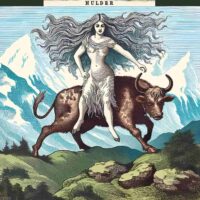
Another version of the myth: Iasion was the brother of Harmonia, the wife of Cadmus. At their wedding, he met Demeter. According to Virgil, Iasius is an ancestor of the Trojans, born in Italy, like Dardanus.
According to Petelidou from Crete, Iasion and Demeter had two children, Philomel and Plutus. Plutus (the god of wealth and abundance) personifies the fertility of the earth. From Demeter, Iasion received as a gift wheat grains and taught people agriculture. Iasion is the protagonist of the play “Iasion” by Antiphanes. In modern science, he is considered an ancient Cretan deity of agriculture.
Interpretation
The story of Iasion is an allegory of fertility. Iasion and Demeter represent the male and female principles, as well as the human and divine/natural aspects. As for their son Ploutos, he illustrates the epithet of ploutodeiria (“she who gives wealth”) often attributed to Demeter. As for Zeus’s divine punishment, it is to be understood in the same sense as that inflicted on Prometheus. Iasion, symbolizing the sower, the farmer, steals and violates divine power. He “alters” the natural order of things and cycles. Through his mastery of natural productions, he frees himself from divine/natural vicissitudes. Like Prometheus, Iasion must be punished for this theft. This must be linked to the fairly widespread idea in various cultures, sometimes very distant from each other, that agriculture is a violence, a wound inflicted on Mother Earth. It must be “forced” by plowing to obtain the harvest and “wealth.”
References
- Diodorus Siculus. Historical Library V 48, 4; 49, 2
- Pseudo-Apollodorus. Mythological Library III 12, 1; Dionysius of Halicarnassus. Roman Antiquities I 61, 4; Strabo. Geography VII, fragment 49
- Virgil, Aeneid, III 15 and 167
- Strabo, Geography, VII 49
- Diodorus Siculus, Historical Library, V 48
- Virgil, Aeneid III, 168
- Hyginus. Astronomy II 4, 7
- Hesiod, Theogony 969-974